The Birth of Formula One: Silverstone, May 13, 1950
On May 13, 1950, at Silverstone, England, the first-ever Formula One World Championship race turned Grand Prix racing into a global sport.
On the afternoon of Saturday, May 13, 1950, twenty-one racing drivers lined up on a converted wartime airfield in Northamptonshire, England, and waited for a flag to drop. They had raced Grand Prix cars for years. But this race had something no race had ever had before: a world championship at stake.
Grand Prix racing stretched back to the early 1900s, but it had always been a patchwork of one-off events with no season-long title. After World War II, the FIA — the sport's governing body — created the World Championship of Drivers: six races across Europe (Britain, Monaco, Switzerland, Belgium, France, and Italy), plus the Indianapolis 500, which none of the European teams contested. Silverstone, a former bomber base, would host the opener, officially named the Royal Automobile Club Grand Prix d'Europe Incorporating the British Grand Prix.
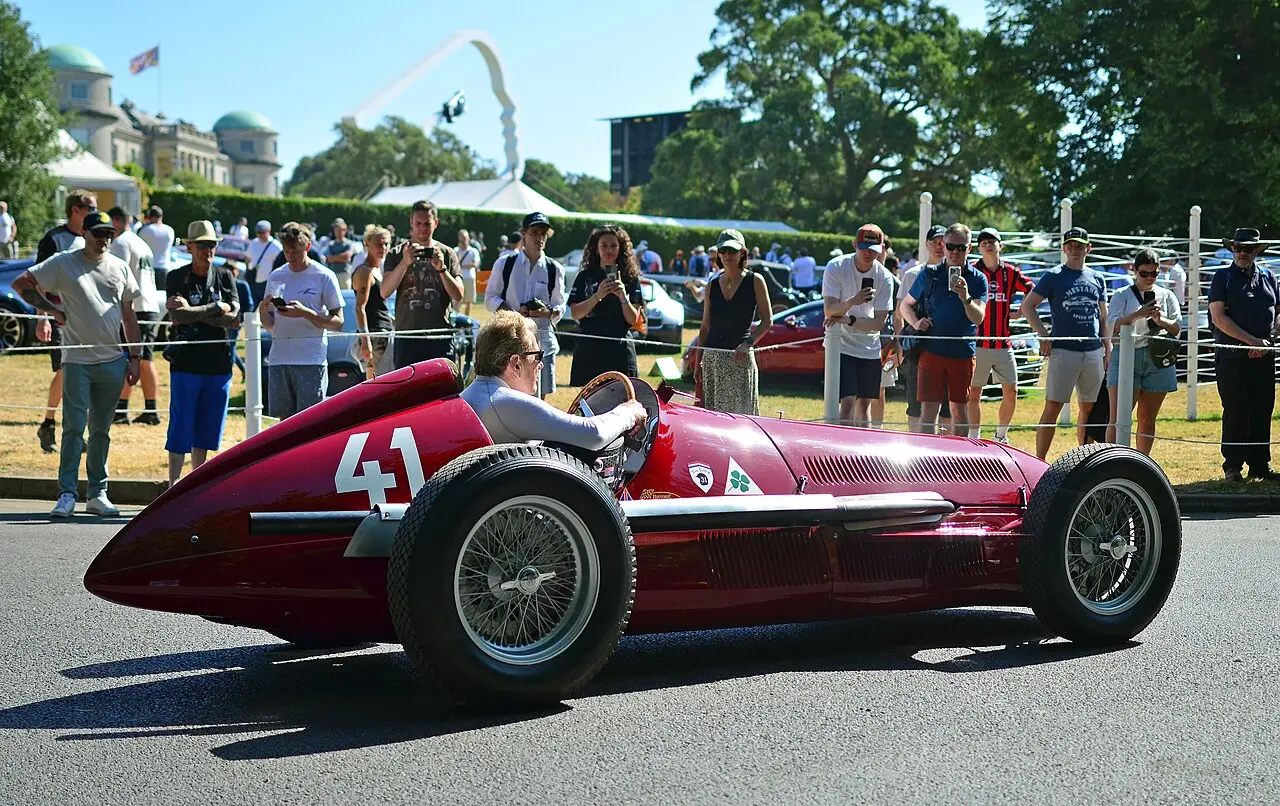
The day was sunny and mild, and somewhere between 100,000 and 200,000 spectators crowded the old airfield. Seventy laps. Three hundred twenty-five kilometers. From the start, it was a procession — the kind dominance fans still argue about. The red Alfa Romeo 158 'Alfetta' was in a different league, and Italian driver Giuseppe 'Nino' Farina put on a clinic: pole position, fastest lap on lap two, and victory in 2 hours, 13 minutes, and 23.6 seconds, averaging over 146 kilometers per hour. His teammates Luigi Fagioli and Reg Parnell finished second and third for an Alfa Romeo sweep. Juan Manuel Fangio, who would become the era's defining driver, retired with a broken oil pipe. Parnell's Alfetta picked up a dent along the way — from a hare that ran onto the track.
The grid itself belonged to another age. The average driver was 39 years old. Fagioli was 51, Louis Chiron was 50, and Philippe Étancelin was 53 — men who had raced before the war. The 'baby' of the field was a 29-year-old Englishman, Geoffrey Crossley. These were gentleman racers, not athletes, driving machines with no seatbelts and straw bales for barriers.
Farina went on to win the inaugural championship. He and Fangio each won three of the season's seven races, but Farina's fourth place in Belgium gave him the title, 30 points to 27, sealed with victory at Monza in September. At 43, he became Formula One's first world champion. His life ended tragically: in 1966, he was killed in a road accident while driving to the French Grand Prix, where he was to work as a driving double for Yves Montand in the film 'Grand Prix.'
That May afternoon at Silverstone turned scattered Grand Prix races into Formula One — a single, season-long championship with a world title on the line. From twenty-one aging gentlemen on a converted airfield grew a sport that now commands hundreds of millions of fans, billions of dollars, and cars that would lap that 1950 Alfetta several times over. But every modern season — every lights-out, every championship battle — traces back to the flag drop on May 13, 1950.
Photo: Neil, CC BY 4.0 (via Wikimedia Commons).