The China Clipper Opens the Pacific
On November 22, 1935, Pan Am's flying boat China Clipper left Alameda, California, with the first transpacific airmail — an eight-day island-hopping journey to Manila.
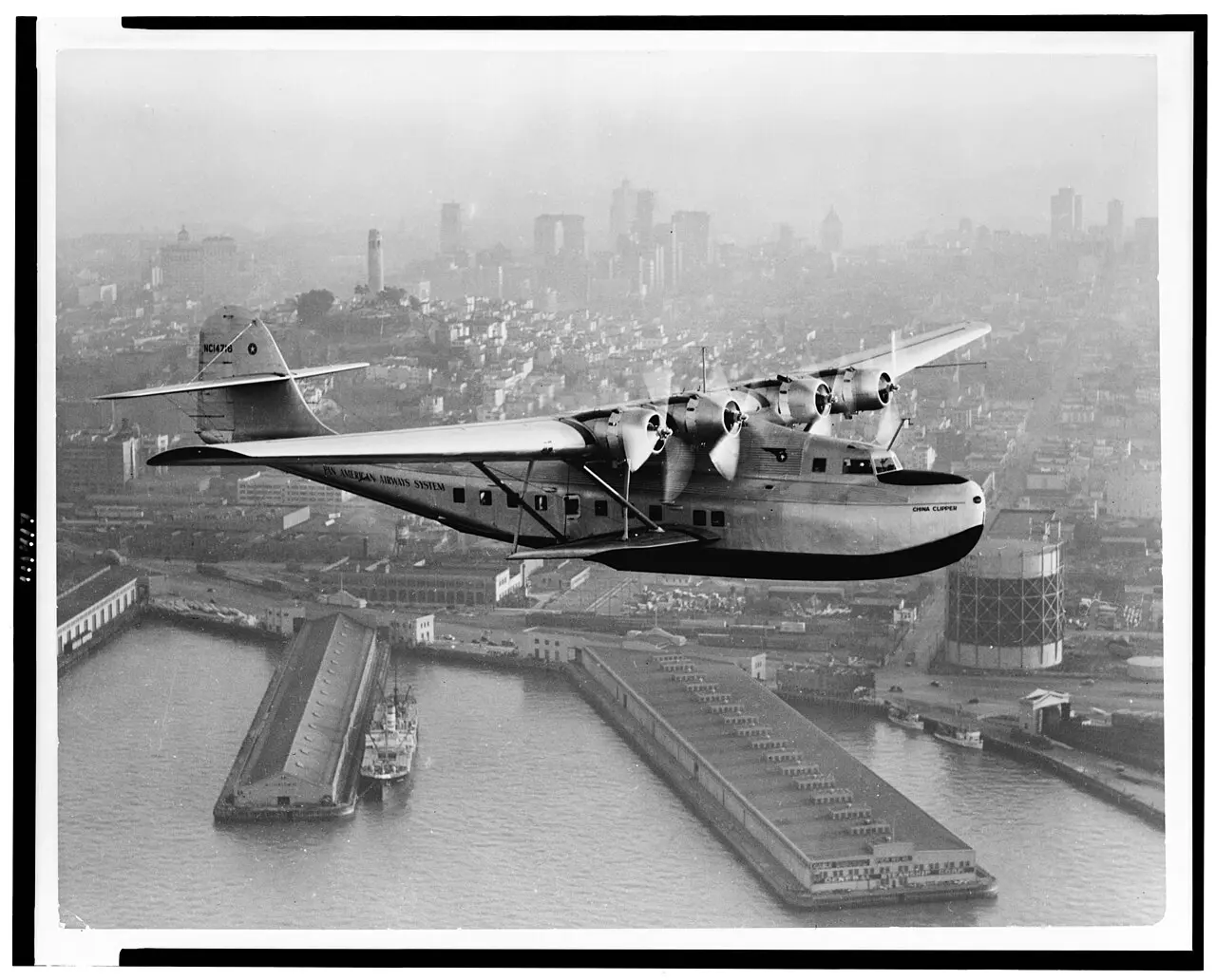
At 3:46 on the afternoon of Friday, November 22, 1935, a crowd of some twenty thousand people stood on the shore at Alameda, California, watching a silver flying boat lift off the water and turn west — toward an ocean no airplane had ever crossed on a schedule. Around San Francisco Bay, perhaps a hundred thousand more watched, and radio networks carried the moment live. The China Clipper was about to make history.
The plane was a Martin M-130, the first of three built for Pan American Airways at a cost of $417,000 by the Glenn L. Martin Company in Baltimore and delivered to Pan Am only weeks earlier, on October 9. Four engines, an all-metal hull, wings built for distance — she was among the largest airplanes in the world, and Pan Am's founder Juan Trippe had ordered her for one purpose: to carry the mail across the Pacific.
Aboard for the inaugural run were seven crewmen and more than 110,000 pieces of mail — 58 mailbags, and not a single passenger. In command was Captain Edwin C. Musick, Pan Am's most celebrated pilot, with First Officer R.O.D. Sullivan and a navigator named Fred Noonan, who two years later would fly into legend alongside Amelia Earhart.
Within a minute of takeoff, the flight nearly ended in disaster. The plan had been to fly over the San Francisco–Oakland Bay Bridge, still under construction; Musick realized the great flying boat would not clear it, and threaded her underneath instead. The crowd gasped — and the Clipper droned on toward Honolulu, landing the next morning at 10:39.
From there the journey was island-hopping on a grand scale: Honolulu to Midway to Wake to Guam, then on to Manila, which the Clipper reached on November 29. In about a week the crew had flown some 8,000 miles across the world's largest ocean, delivered the first transpacific airmail, and proved that a regular air route across the Pacific was possible. The Post Office issued a special airmail stamp for the new service, and within a year Pan Am's clippers were carrying passengers along the same island chain.
The China Clipper herself — nicknamed "Sweet Sixteen" for the last two digits of her registration, NC14716 — flew the Pacific until her career ended in a crash in 1945. But that November afternoon in 1935, when she lifted off the water at Alameda before a hundred thousand witnesses, she shrank the planet. Her departure point is now California Historical Landmark No. 968.
Photo: Clyde H. Sunderland, public domain (via Wikimedia Commons).