
The Beige Box That Changed Everything
On August 12, 1981, IBM unveiled the Personal Computer — a machine that turned computing into an industry standard.
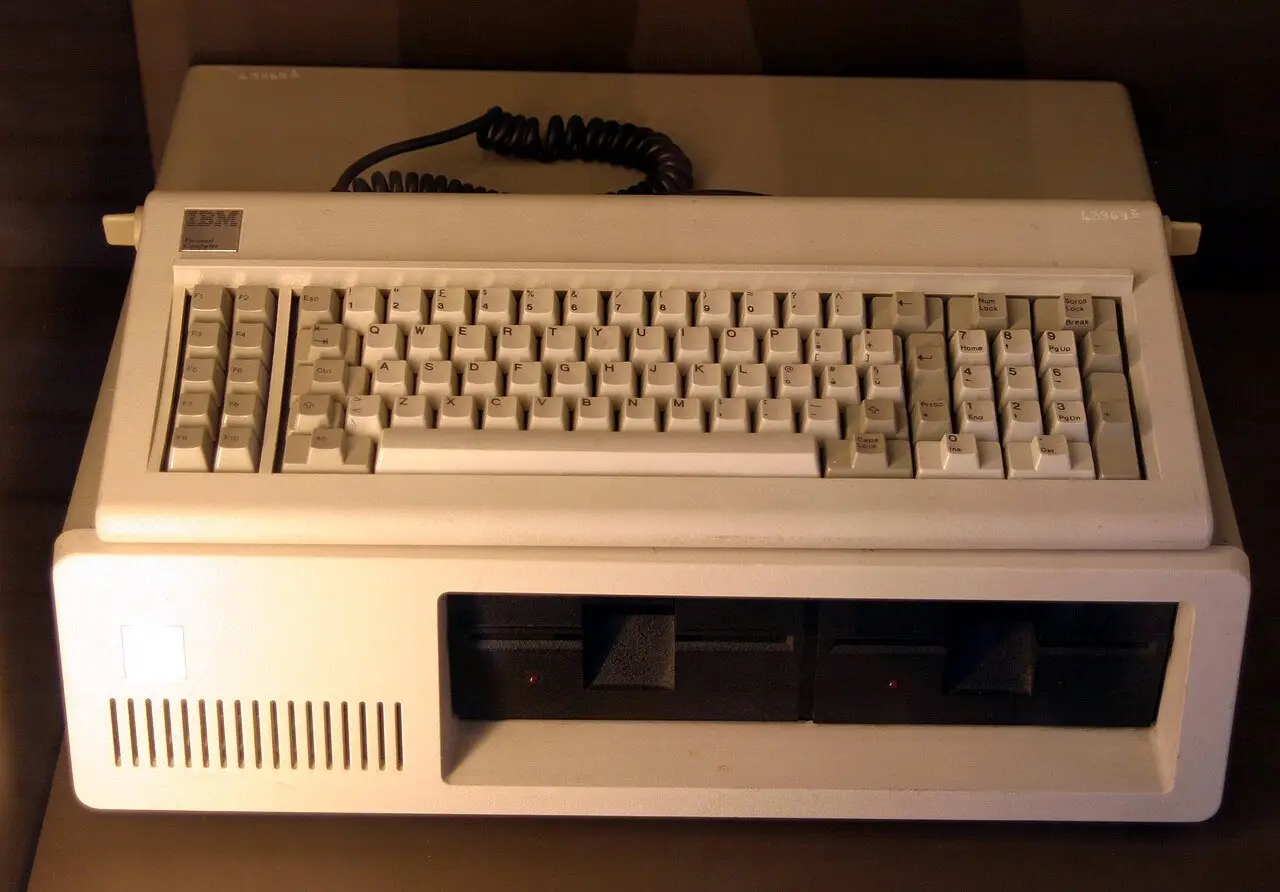
On the morning of August 12, 1981, a group of journalists gathered in a ballroom at the Waldorf Astoria in New York while a man named Don Estridge stepped to a podium and introduced a beige box. It had 16 kilobytes of memory, no hard drive, and a price tag of $1,565. Within eighteen months, IBM couldn't build them fast enough.
The machine was the IBM Personal Computer, the Model 5150 — assembled in extraordinary secrecy at IBM's plant in Boca Raton, Florida, by a skunkworks team working under the codename "Project Chess." The project had begun in 1980, when IBM executive William Lowe pitched CEO Frank Cary on building an affordable personal computer. Cary's answer was blunt: a prototype in a month, a product on shelves in a year, a price under $1,500.
To hit that impossible timeline, the team broke nearly every IBM rule. Instead of designing proprietary parts, they used off-the-shelf components: an Intel 8088 chip running at 4.77 megahertz, standard floppy drives, an ordinary power supply. And then came the decision that defined the decade: IBM published the machine's complete technical specifications and invited the world to build for it. Software houses, peripheral makers, expansion-card manufacturers — anyone could write for the IBM PC.
The company also broke tradition by selling through retail stores — ComputerLand and Sears — rather than its own sales force, and licensed Charlie Chaplin's "Little Tramp" character for its advertising. Dealers were overwhelmed with orders, some customers offering pre-payment with no guaranteed delivery date. In four months IBM sold 65,000 machines; 200,000 in the first year.
Then there was the operating system. IBM first talked with Digital Research, maker of the dominant CP/M system, but the negotiations fell apart. A 25-year-old Bill Gates stepped into the gap — though Microsoft had no operating system to sell. Gates knew Seattle Computer Products had a rough-hewn system called 86-DOS, written by programmer Tim Paterson. Microsoft licensed it in December 1980, bought the full rights in July 1981 for $50,000, and delivered it to IBM as PC-DOS — keeping the right to sell the same software to any other hardware maker as MS-DOS. At launch IBM offered a choice, PC-DOS for $40 or CP/M-86 for $240, and the overwhelming majority picked the $40 option. DOS became the industry standard.
The open architecture had one locked door: the BIOS, the small copyrighted program that let the operating system talk to the hardware. In February 1982, three former Texas Instruments executives founded Compaq in Houston and reproduced exactly what IBM's BIOS did without copying a line of its code — one team documented the BIOS's behavior, while a second team, walled off from the original, wrote fresh code to match. Compaq's Portable, announced in November 1982 and shipped the following March at $2,995, sold 53,000 units in its first year. And every one of those machines could run Microsoft's MS-DOS — the clause Gates had quietly kept was paying off.
IBM hadn't invented the personal computer — the Apple II, the TRS-80, and the Commodore PET were already on the market. What it did was standardize it. Clones followed, and the phrase "IBM-compatible" became the industry's common language. The standard IBM created that August morning in Manhattan shaped the hardware and software of the entire modern computer era — every PC on every desk today is, in a sense, a descendant of that beige box.
Don Estridge rose to IBM vice president but never saw what the standard became. On August 2, 1985, he and his wife Mary Ann were killed aboard Delta Air Lines Flight 191, which crashed at Dallas–Fort Worth; he was 48. At the time, his Boca Raton unit employed nearly 10,000 people and had sold more than a million PCs. IBM would eventually lose the market it created to the clones — but the standard set that August morning still runs the world's desktops.
Photo: Rama, CC BY-SA 2.0 (via Wikimedia Commons).