The Flat Tire That Found a Dinosaur: Sue Discovered, August 12, 1990
On August 12, 1990, a flat tire in the South Dakota badlands led fossil hunter Sue Hendrickson to the most complete T. rex ever found.
The most complete Tyrannosaurus rex ever found was discovered because of a flat tire. On August 12, 1990, fossil hunter Sue Hendrickson was working with a crew from the Black Hills Institute of Geological Research in the badlands near Faith, South Dakota, on land within the Cheyenne River Indian Reservation. The crew was packing up to leave when a flat tire delayed their departure. With time to kill, Hendrickson walked off alone toward a bluff the team hadn't searched.
About three miles out, at the base of a 49-foot cliff, she spotted dark-brown fragments of fossilized bone scattered in the mudstone. She looked up — and saw three huge vertebrae jutting from the rock above. She knew instantly what they were: the bones were big, and T. rex was likely the only large meat-eating dinosaur that had lived in that area at the end of the Cretaceous. She hurried back to camp and told the institute's president, Peter Larson. Two days later, excavation began.
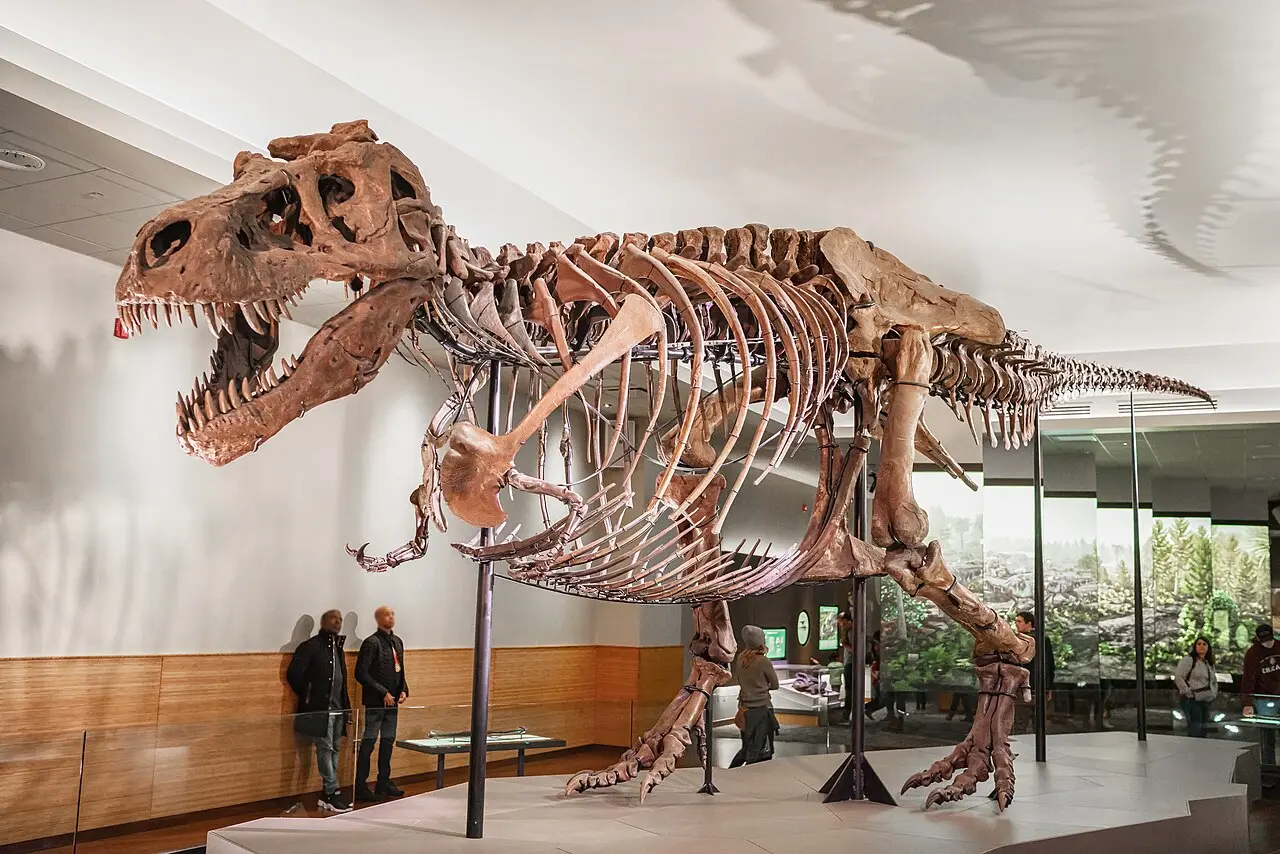
The skeleton turned out to be extraordinary: more than 90 percent complete, with roughly 250 of the approximately 380 bones known in a T. rex represented — the largest, most complete, and best-preserved T. rex ever found. Catalogued as FMNH PR 2081 and nicknamed "Sue" for her discoverer, the dinosaur had lived about 67 million years ago, stretched more than 40 feet long, stood 13 feet high at the hips, and died at about 33 years old. The bones were so well preserved that scientists could see where muscles and tendons had attached.
Then came the fight. The institute had paid the landowner, Maurice Williams, $5,000 for excavation rights — but Williams, a member of the Cheyenne River Sioux Tribe, had transferred his land to the tribe decades earlier, and the sale was ruled invalid. Federal agents seized the bones. What followed was years of lawsuits over who owned a 67-million-year-old dinosaur.
The courts finally settled it, and in October 1997 Sue went under the hammer at Sotheby's in New York. Chicago's Field Museum of Natural History won the auction with a bid of $8.36 million — then the highest price ever paid for a fossil — backed by donations from McDonald's, Disney, and others. In May 2000, Sue went on display in Chicago, where the great predator now greets visitors in a hall of its own.
Sue's bones have taught scientists about T. rex growth, injuries, and disease. But the deeper lesson is the one Hendrickson embodied on that August afternoon: discovery favors the curious. A flat tire, an unsearched cliff, and a fossil hunter willing to take a walk added the finest T. rex in the world to science.
Photo: Jorge Jaramillo, CC BY-SA 4.0 (via Wikimedia Commons).