The Arrow Incident: How One Small Ship Started a Four-Year War
On October 8, 1856, Chinese officials boarded a British-registered ship in Canton — the spark that ignited the Second Opium War.
It was one small ship, a disputed flag, and twelve arrested sailors. It started a war that would last four years, humble an empire, and legalize the drug trade across China.
On the morning of October 8, 1856, Chinese officials boarded the Arrow, a lorcha — a fast hybrid sailing vessel — anchored at Canton. The ship was owned by a Chinese merchant but registered in Hong Kong as a British vessel, and the officials arrested its twelve Chinese crewmen on suspicion of piracy. It was later alleged that the officials had also hauled down the British ensign flying over the ship — a deliberate insult to the Union Jack.
The Arrow's registration, as it turned out, had lapsed — technically it was not a British ship at all. But the acting British consul in Canton, Harry Parkes, was in no mood for technicalities. He demanded the immediate release of the crew and a formal apology from the Chinese authorities. The imperial commissioner, Ye Mingchen, released most of the sailors but refused to apologize. So on October 23, British gunboats shelled the barrier forts guarding Canton.
In London, Lord Palmerston's government decided that British honor — and British commercial interests in China — required a full expedition. France joined in, citing its own grievance: the execution of a French missionary, Auguste Chapdelaine, in Guangxi province earlier that year. Admiral Michael Seymour's fleet was dispatched, and by December 1857 the Anglo-French forces had stormed Canton, captured Ye Mingchen, and shipped him into exile in Calcutta.
The war that followed — the Second Opium War, or the "Arrow War" — rolled north. The allies seized the Taku Forts, threatened Tianjin, and in 1860 marched on Beijing itself, burning the emperor's Summer Palace in an act of destruction still remembered bitterly in China. The settlements that ended it, the Treaty of Tientsin in 1858 and the Convention of Peking in 1860, were catastrophic for the Qing dynasty: eleven more ports forced open to foreign trade, foreign merchants and missionaries granted the right to travel and buy land deep inside China, and the opium trade — the original poison at the heart of the conflict — made legal.
The Arrow incident endures as a case study in how thin a pretext for war can be: a ship whose papers had expired, a flag allegedly pulled down, a consul unwilling to back down — and within four years, an empire humbled and a drug legalized by treaty. The gunboats fired first over honor; they finished by rewriting the map of Asia.
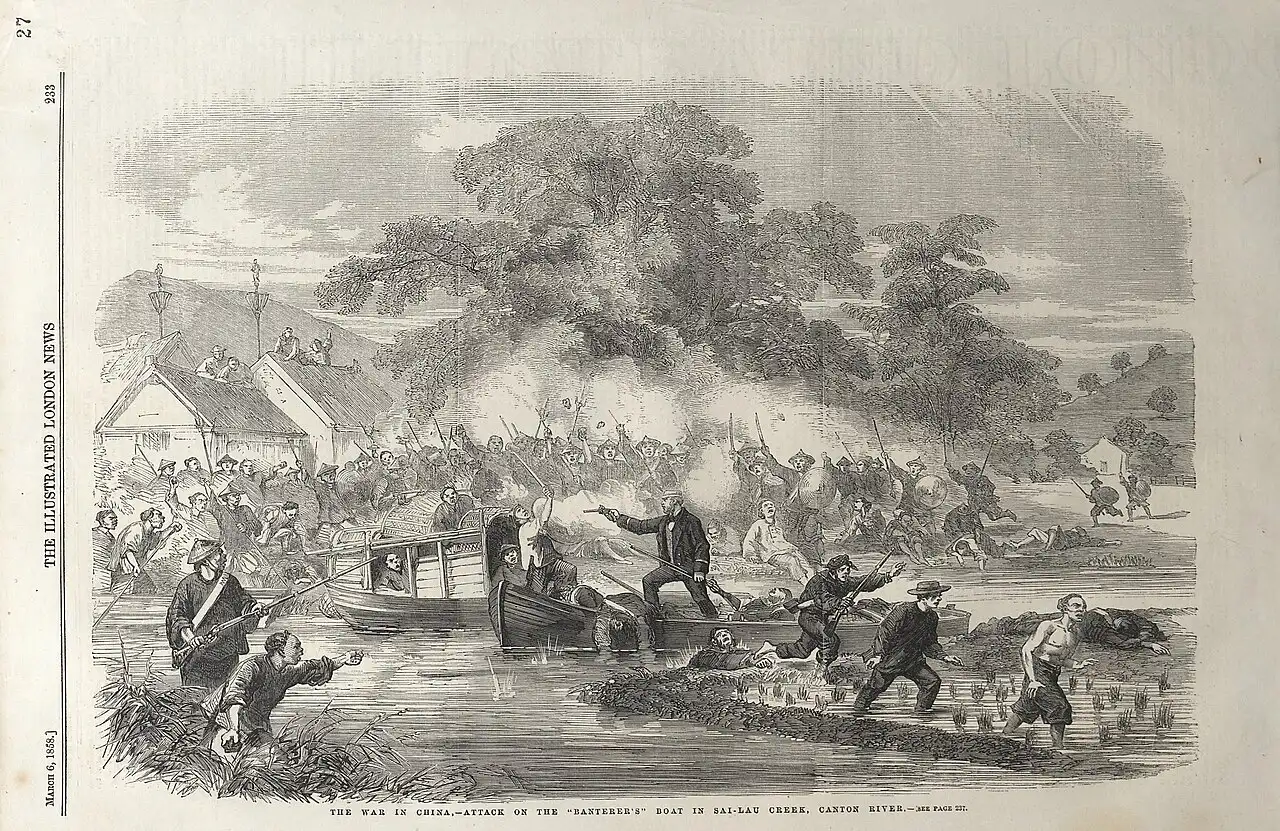
Image: "The war in China — attack on the 'Banterer's' boat in Sai-Lau Creek, Canton River," an engraving published in The Illustrated London News on March 6, 1858, depicting fighting on the Canton River during the Second Opium War; public domain (via Wikimedia Commons).