One Issue and Done: America's First Newspaper Lasted Four Days
On September 25, 1690, Benjamin Harris printed America's first multi-page newspaper in Boston — and colonial authorities shut it down four days later.
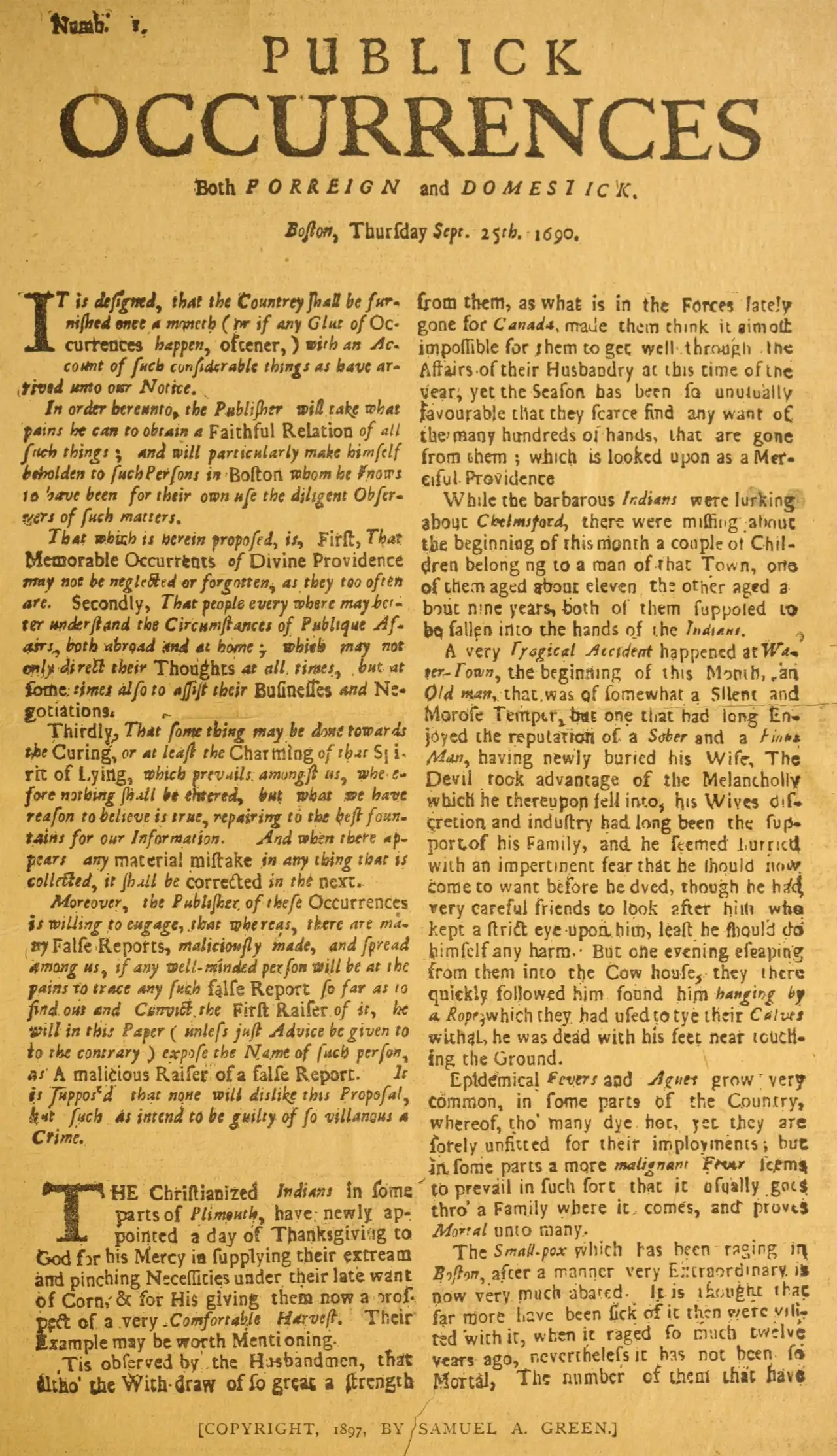
On a Thursday morning in September 1690, Bostonians could buy something America had never seen before: a real newspaper. The publisher promised a new issue every month. He never printed a second one.
The man behind it was Benjamin Harris, an Englishman with a talent for annoying the powerful. Back in London he had printed pamphlets attacking Catholics, which earned him fines, prison time, and finally drove him across the Atlantic. He landed in Boston in 1686, opened a bookshop and a coffeehouse — the London Coffee-House — that became the town's liveliest gathering place for talk of books and current events. The printer and historian Isaiah Thomas would later remember Harris as "a brisk asserter of English Liberties," a man who believed words should be free.
On September 25, 1690, Harris put that belief to the test. Printed by Richard Pierce, "Publick Occurrences Both Forreign and Domestick" ran four pages, each about the size of a modern sheet of notebook paper, with two columns per page and the last page left blank so readers could scribble a letter to a friend on the back. Harris promised the colony would be "furnished once a moneth (or if any Glut of Occurrences happen, oftener,) with an Account of such considerable things as have arrived unto our Notice." He pledged to print nothing but what he had reason to believe was true — and even offered to name and shame anyone caught spreading false reports.
The news itself was a mix of the grim and the ordinary: a smallpox outbreak in Boston was finally abating, Christianized Indians were celebrating a good harvest with a day of thanksgiving, a man had been murdered, and Native American prisoners of war had been executed. There were dispatches from King William's War against the French. And there was gossip: the paper repeated a scandalous rumor that the French king, Louis XIV, was sleeping with his son's wife — quite possibly invented by the fiercely Protestant Harris to embarrass a Catholic monarch.
That was the mistake. Four days later, on September 29, the governor and council of Massachusetts issued an order, signed by secretary Isaac Addington, declaring that the pamphlet had been printed "Without the least Privity and Countenance of Authority" and contained "Reflections of a very high nature" along with "sundry doubtful and uncertain Reports." It ordered the paper "Suppressed and called in" — every copy rounded up and destroyed — and forbade anyone from printing anything in the future "without License first obtained." Harris had published without the government's permission, and the government made sure nobody tried it again.
Nobody did, for fourteen years. Not until 1704, when John Campbell launched the Boston News-Letter — this time with a proper license, and careful to print nothing that might offend anyone in power.
Of Harris's single issue, only one copy is known to have survived. It turned up in London's Public Record Office, where the Reverend Joseph B. Felt of Salem stumbled on it in 1845 — a lone survivor of the first newspaper war America ever fought.
The irony is hard to miss. The first newspaper in American history opened with a solemn promise to fight misinformation — and was shut down, in part, for printing a rumor. The tension Harris walked into, between a free press and the powerful people it writes about, never went away. Every argument about fake news, press licenses, and who gets to decide what's true has a little of September 25, 1690, in it.
Photo: scan of the 1690 first issue, public domain (via Internet Archive).