Ninety-Five Theses and a Church Door: Luther's Challenge
On October 31, 1517, Martin Luther set out his 95 Theses disputing the sale of indulgences — the spark traditionally dated as the start of the Reformation.
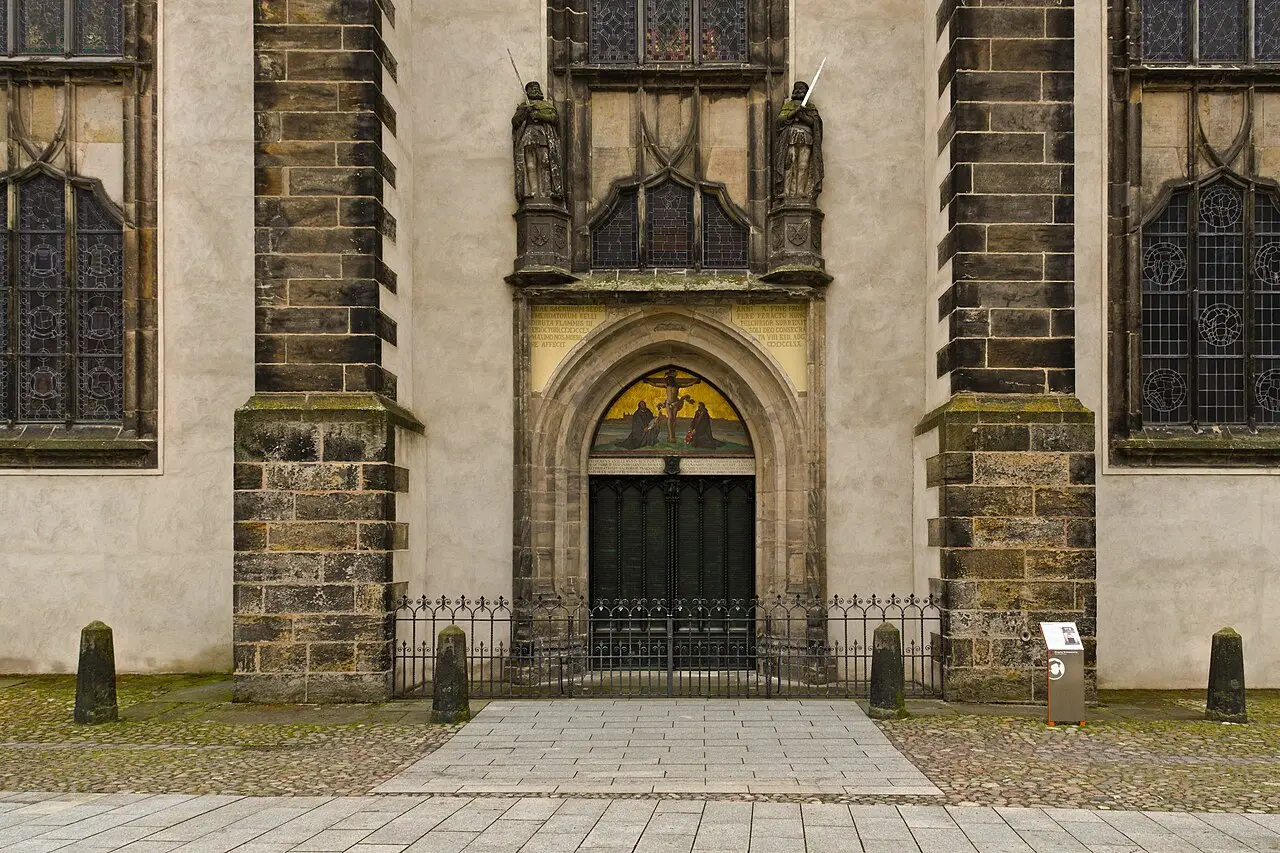
Tradition says it happened with a hammer. On October 31, 1517 — the eve of All Saints' Day — a 33-year-old Augustinian monk named Martin Luther walked up to the door of the Castle Church in Wittenberg, Germany, and nailed up a document that would split Western Christianity in two.
Whether he literally swung the hammer is one of history's favorite arguments. The nailing story comes from a single account written decades later by Luther's colleague Philip Melanchthon — who wasn't even in Wittenberg in 1517. What isn't disputed is the document itself: the 'Disputation on the Power and Efficacy of Indulgences,' better known as the 95 Theses.
The theses were, on their face, an invitation to academic debate — written in Latin, posted on a church door that served as the university's bulletin board. But their target was explosive: the Catholic Church's sale of indulgences, payments that supposedly reduced punishment for sin. Luther was outraged by preachers like Johann Tetzel, who hawked indulgences across Germany to raise money for rebuilding St. Peter's Basilica in Rome. 'Why does not the pope, whose wealth today is greater than the wealth of the richest Crassus,' Luther wrote, 'build the basilica of St. Peter with his own money rather than with the money of poor believers?'
At the theses' heart was a radical idea: that salvation came through faith and divine grace alone — not through purchased pardons, not through the Church's treasury of merits.
Luther may have expected a quiet scholarly dispute. Instead, the printing press — barely seventy years old — did what it does. The theses were printed, translated into German, and reprinted in city after city; they reached Rome by December. Within a year Luther was summoned to defend himself; within four he was excommunicated and condemned at the Diet of Worms. The Reformation he ignited would divide Europe, redraw its maps, and reshape everything from education to the relationship between church and state.
October 31 is still Reformation Day in much of Germany — a public holiday in several states, and nationwide for the 500th anniversary in 2017. Whether or not a hammer fell that Halloween eve in 1517, something did: the first crack in a thousand years of religious unity in the West.
Photo: The bronze Theses Door of Wittenberg's Castle Church, cast with the full text of Luther's 95 Theses — by Romzig, CC0 (via Wikimedia Commons).