Finished at Last: Mount Rushmore Is Declared Complete
On October 31, 1941, after fourteen years of blasting and carving, the Mount Rushmore memorial was declared complete — though its sculptor had not lived to see it.
On October 31, 1941, the drills fell silent on a granite mountain in South Dakota. After fourteen years of blasting and carving, Mount Rushmore was declared complete.
The four faces staring out from the Black Hills — George Washington, Thomas Jefferson, Theodore Roosevelt, and Abraham Lincoln, each sixty feet tall — had been the obsession of one man: Gutzon Borglum, a sculptor of volcanic temperament who had talked South Dakota into the project as a tourist attraction. Borglum chose his presidents to represent the birth, the growth, the development, and the preservation of the American republic.
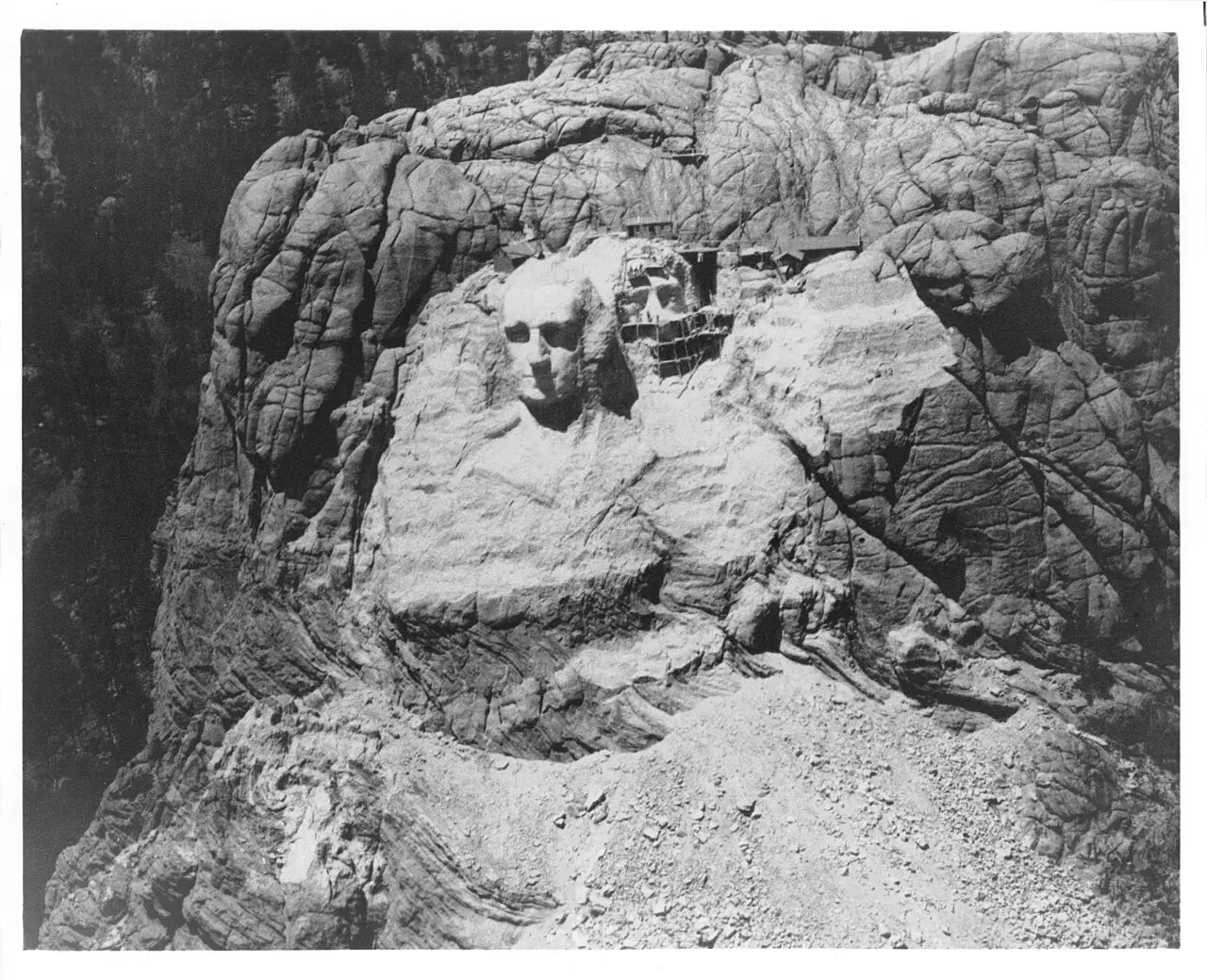
Building it was an act of controlled violence. Some 400 workers — miners, mostly — dangled from the cliff face in leather 'bosun chairs,' drilling, blasting with dynamite, and finishing with jackhammers and chisels. About 450,000 tons of rock came off the mountain. And remarkably, given the dynamite and the heights, not a single worker died.
The faces were unveiled one by one through the 1930s — Washington first, in 1934, Roosevelt last, in 1939 — each dedication a bigger celebration than the one before. Borglum himself didn't live to see the finish. He died in March 1941, at 73, and his son Lincoln oversaw the final months. What was declared complete that Halloween was less than Borglum had dreamed: he'd wanted the figures carved to the waist and a great Hall of Records tunneled behind the faces to hold America's founding documents — a 70-foot tunnel he actually began in 1938 before work was halted. Money ran out, war was coming, and Congress called a halt.
The project had started even more modestly. South Dakota historian Doane Robinson first proposed the carving in 1923 as a tourist attraction, imagining western heroes like Lewis and Clark, Red Cloud, and Buffalo Bill Cody on the mountainside. It was Borglum who insisted on presidents instead — and who picked which four.
The mountain has always meant more than one thing. To millions of visitors, it's a shrine to American ideals. To the Lakota, whose sacred Black Hills were guaranteed to them in the 1868 Treaty of Fort Laramie and then seized after gold was discovered, it's a monument carved into stolen land — a wound as much as a wonder. Both histories are true, and both are part of what the mountain means now.
Eighty-five years later, the faces are still there, weathering granite at a geologic pace. They were meant to last as long as the mountain itself. They just might.
Photo: Aerial view of Mount Rushmore under construction — National Park Service, public domain (via Wikimedia Commons).