Mr. Civil Rights Takes His Seat on the Supreme Court
On October 2, 1967, Thurgood Marshall was sworn in as the first Black justice of the U.S. Supreme Court — the great-grandson of an enslaved man, now the Court's 96th justice.
The oath was short. The journey to it had taken a lifetime. On October 2, 1967, in the Supreme Court chamber in Washington, Chief Justice Earl Warren administered the constitutional oath to Thurgood Marshall — the first African American ever to sit on the highest court in the United States, and its 96th justice.
Marshall's story began in Baltimore in 1908, the great-grandson of an enslaved person, growing up in a rigidly segregated America. When he applied to the University of Maryland Law School, he was rejected because of his race. So he went to the all-Black Howard University School of Law in Washington, studied under the great civil liberties lawyer Charles H. Houston, and graduated first in his class in 1933.
What came next made him, in President Johnson's words, one of "the great lawyers of this generation." Joining the NAACP's legal staff in 1936 and becoming its chief counsel in 1938, Marshall crisscrossed the Jim Crow South defending Black Americans in courtrooms where his own life was sometimes in danger — he once narrowly escaped a lynch mob of Tennessee police officers. He argued 32 cases before the Supreme Court and won 29 of them. The crown jewel was Brown v. Board of Education in 1954, in which the Court unanimously struck down segregated public schools, declaring that "separate but equal" had no place in American education. The decision lit the fuse of the modern civil rights movement.
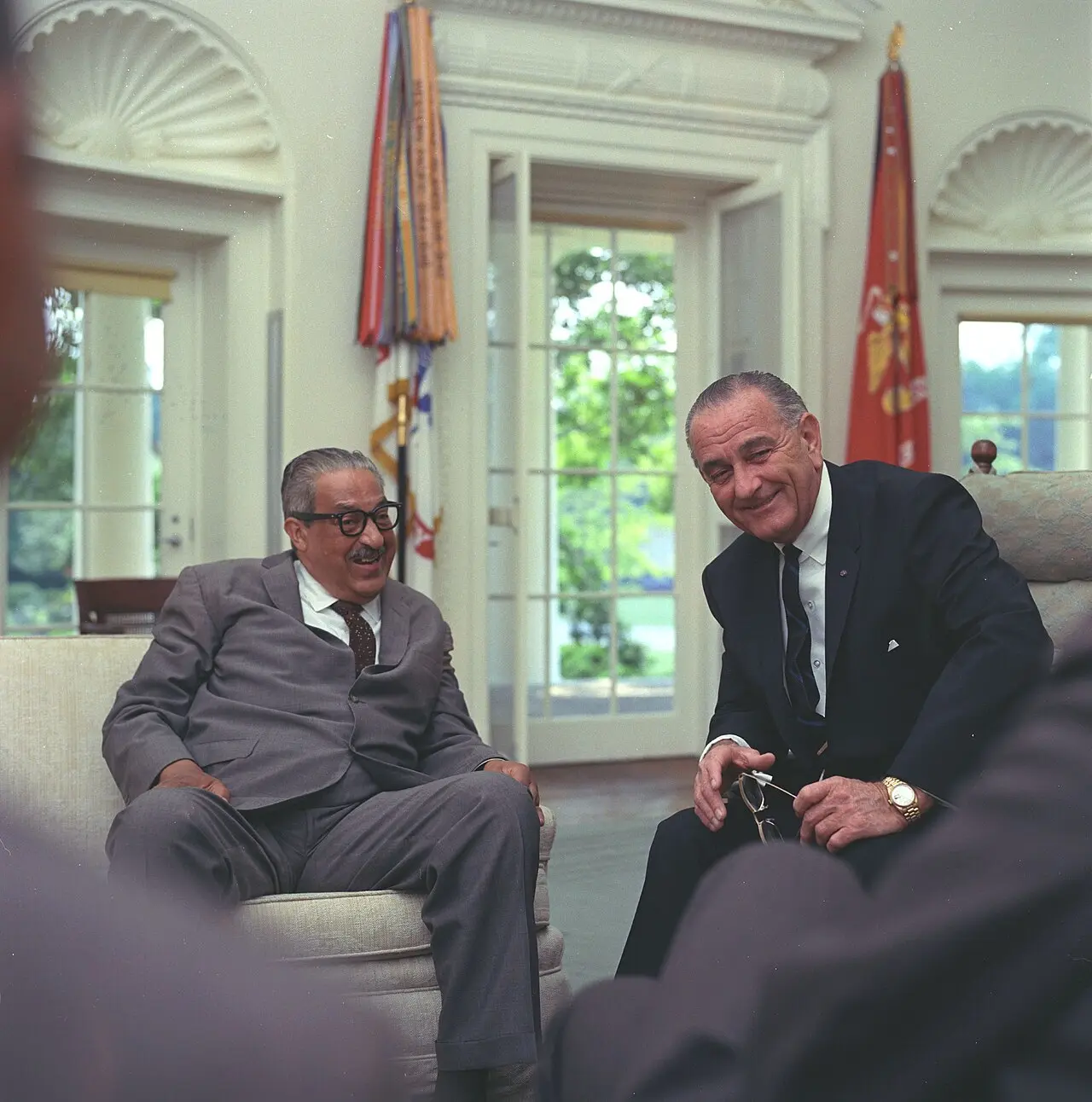
Presidents kept promoting him, and each promotion was another first. John F. Kennedy named him to the federal appeals court in 1961. Lyndon Johnson made him U.S. solicitor general in 1965 — the first Black American to hold the job. Then, on June 13, 1967, Johnson announced Marshall's nomination to the Supreme Court itself. The Senate confirmation was a bruising ordeal — segregationist senators subjected him to days of hostile questioning — but on August 30 the Senate voted 69 to 11 to confirm him.
Marshall served on the Court for nearly twenty-four years, retiring in 1991. A steadfast liberal voice, he wrote most consequentially in dissent in his later years, and he never stopped fighting what he called the country's unfinished business: racial injustice, the death penalty, the rights of the poor, of women, of criminal defendants. Colleagues and clerks called him, with affection, "Mr. Civil Rights."
It matters because the Court Marshall joined had, a century earlier, issued the Dred Scott decision declaring that Black people had "no rights which the white man was bound to respect." On October 2, 1967, a Black man took a seat on that same bench — not as a petitioner, but as a justice. The arc of Marshall's life, from a rejected law school applicant to the author of American justice, remains the clearest proof that the law, wielded with courage and patience, can remake a country.
Photo: Frank Wolfe, LBJ Presidential Library, June 13, 1967, public domain (via Wikimedia Commons).