The Birthday That Became a World Day of Peace
On October 2, 1869, Mohandas Gandhi was born in Porbandar, India — and the shy boy no one expected much of grew into the leader who freed a nation without firing a shot.
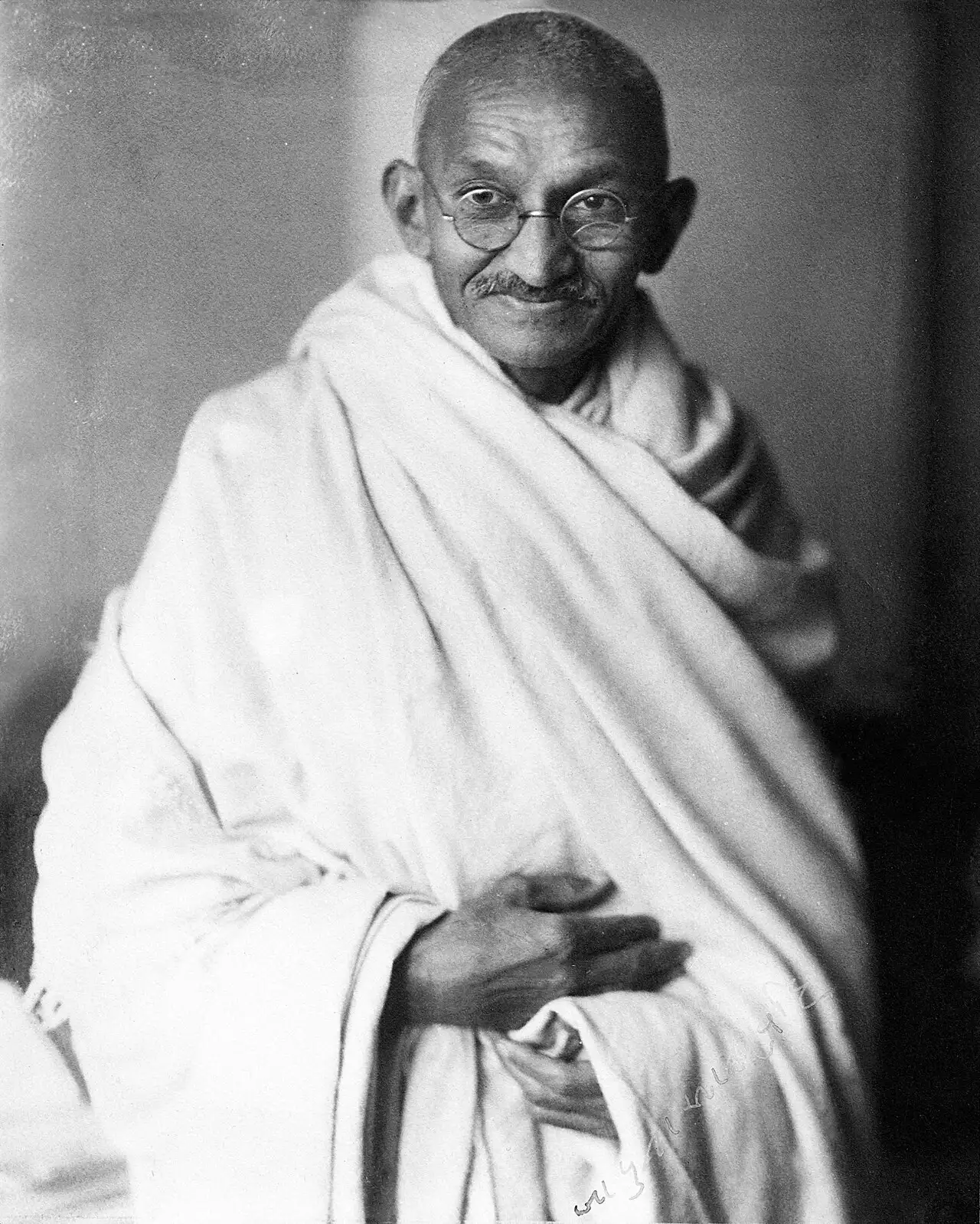
The boy born on October 2, 1869, in the coastal town of Porbandar gave no sign of what was coming. Mohandas Karamchand Gandhi was, by his own account, an average student — shy, unremarkable, the son of the town's chief minister and a deeply religious mother whose Hindu faith, touched by Jainism's reverence for nonviolence, would shape everything he became.
At nineteen he sailed to London to study law at the Inner Temple. He returned to India in 1891, set up a practice in Bombay, and floundered. The turning point came when an Indian firm sent him to South Africa — and South Africa showed him who he was. A European magistrate ordered him to remove his turban in court; he refused and walked out. On a train to Pretoria, he was thrown out of a first-class compartment for refusing to give up his seat to a European passenger. The humiliations of those years, endured over nearly two decades in South Africa, forged his answer: satyagraha — "truth and firmness" — the doctrine that unjust power could be resisted without raising a fist.
He brought satyagraha home in 1915 and took leadership of the Indian National Congress in 1921. What followed was the most sustained nonviolent campaign in history. In 1930 he led thousands of Indians on the Salt March, a 240-mile walk from Ahmedabad to the Arabian Sea to defy the British tax on salt; nearly 60,000 people, Gandhi included, were arrested. In 1942 came the Quit India movement, demanding an end to British rule outright. He was jailed again and again. He fasted. He never wavered.
And it worked. In 1947, Britain withdrew, and India became independent — the largest transfer of power in the modern world achieved without a war of liberation. Gandhi did not live long to see it. On January 30, 1948, amid the communal violence that accompanied partition, he was assassinated in New Delhi.
But the method outlived the man. His birthday, October 2, is India's national holiday of Gandhi Jayanti — and it is observed worldwide as the International Day of Non-Violence. His example traveled: Martin Luther King Jr. studied his campaigns, and Nelson Mandela drew on them in South Africa, the very country where Gandhi had first learned what discrimination felt like.
It matters because Gandhi proved something no one had quite believed before: that mass nonviolence is not passivity but power — a disciplined, strategic force capable of toppling an empire. Every peaceful march, sit-in, and boycott since 1948 walks, knowingly or not, in the footsteps of a shy boy from Porbandar who decided that truth, firmly held, was stronger than any army.
Photo: Elliott & Fry, London, 1931, public domain (via Wikimedia Commons).