Meet the Mercury Seven: America's First Astronauts
On April 9, 1959, NASA introduced the Mercury Seven — Carpenter, Cooper, Glenn, Grissom, Schirra, Shepard, and Slayton — America's first astronauts, at a press conference in Washington, D.C.
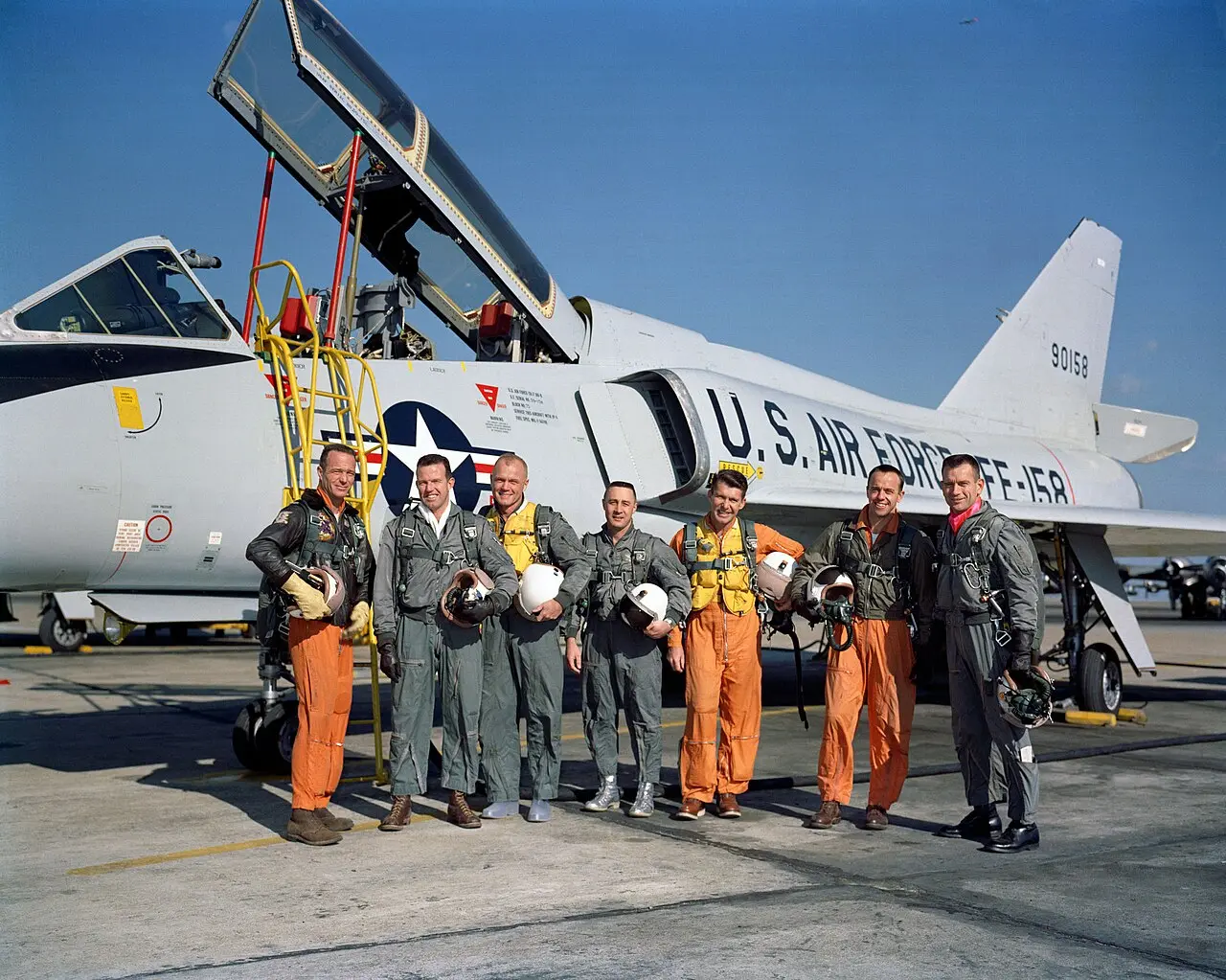
Seven test pilots walked into a Washington ballroom on April 9, 1959, and walked out as the most famous men in America.
The new space agency was barely six months old. NASA had announced Project Mercury the previous October with a single, audacious goal: put an American into orbit around the Earth and bring him home alive. The Soviet Union already had the lead — Sputnik had shocked the world in 1957 — and NASA needed pilots brave enough, and skilled enough, to ride a converted missile into the unknown.
After brutal screening — centrifuges, altitude chambers, and every stress test the military could devise — a selection committee at Langley chose seven candidates in late March 1959. Rejections went out by telephone on April 1; the seven winners got their calls on April 2.
Then, on April 9, NASA administrator T. Keith Glennan introduced them to the world in the ballroom of the Dolley Madison House on Lafayette Square, the agency's first headquarters. In alphabetical order: "Malcolm S. Carpenter, Leroy G. Cooper, John H. Glenn, Virgil I. Grissom, Walter M. Schirra, Alan B. Shepard, and Donald K. Slayton … the nation's Mercury astronauts!" Three were Navy men, three Air Force, one a Marine — all military test pilots. For the next 90 minutes they faced a barrage of reporters' questions, most of them having barely spoken to the press before. By the end, NASA noted, "they clearly sensed that their lives had changed forever."
The new word for them was "astronaut" — coined from "aeronaut," the old term for balloonists, and "Argonaut," the legendary Greek sailors. The seven became instant celebrities: Scott Carpenter, Gordon Cooper, John Glenn, Gus Grissom, Wally Schirra, Alan Shepard, and Deke Slayton. Each named his capsule and added the numeral "7" in honor of the team. Between 1961 and 1963 they flew six missions: Shepard became the first American in space on May 5, 1961; Glenn became the first American to orbit the Earth on February 20, 1962. Slayton, grounded for years by an erratic heartbeat, finally flew in 1975.
Novelist Tom Wolfe would later say they had "the right stuff" — the phrase that defined them forever.
Why it matters: the Mercury Seven proved that human beings could live and work in space, and that a democracy could do it with the whole world watching. Every astronaut since — every moonwalker, every space station crew — follows the trail those seven men blazed from a Washington ballroom.
Photo: NASA, public domain (via Wikimedia Commons).