
Lone Eagle Lands in Paris: Lindbergh's Solo Atlantic Crossing
On May 21, 1927, Charles Lindbergh landed the Spirit of St. Louis at Le Bourget, Paris, completing the first solo nonstop flight across the Atlantic.
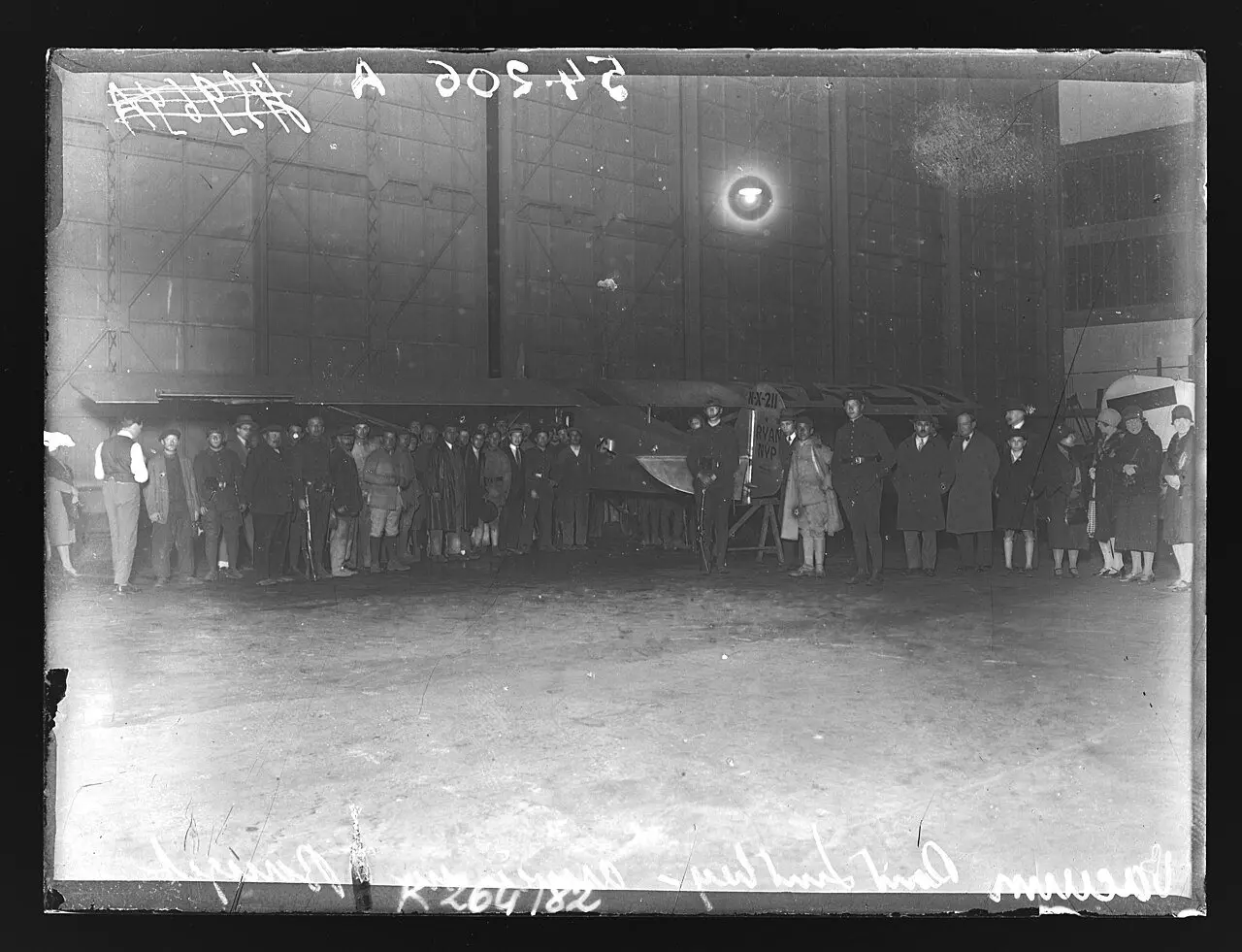
On the night of Saturday, May 21, 1927, a lone engine droned over the dark French countryside, and tens of thousands of people stood in a field outside Paris staring up at the sky. They had been waiting for hours. Rumors had swept the city: an American had left New York alone in a small airplane the day before, and now he was somewhere over France, running on fumes and willpower.
The pilot was Charles A. Lindbergh, a 25-year-old former barnstormer and airmail pilot. He had taken off from Roosevelt Field on Long Island on the morning of May 20 in a custom-built single-seat monoplane called the Spirit of St. Louis, registration N-X-211. His goal was a $25,000 reward — the Orteig Prize — offered to the first aviator to fly nonstop between New York and Paris. No one had ever crossed the Atlantic solo without stopping.
The plane itself was barely a machine for the job. Built by Ryan Airlines in San Diego, it was a single-engine high-wing monoplane carrying 1,704 litres of fuel and, by design, almost no margin for anything else. The main fuel tank sat directly in front of the cockpit, so Lindbergh could not see straight ahead — he navigated with a periscope, side windows, a compass, the stars, and dead reckoning. To prove he had made the crossing without landing, he carried a sealed barograph in the fuselage; its air-pressure trace would show he had never touched down.
For 33 hours and 30 minutes he flew through the night, through storm clouds and hours of blind fog, at times skimming as low as three metres over the wave tops and at others climbing to 3,000 metres to clear the weather. Exhausted and half-hallucinating — he later described seeing ghosts in the cockpit — he reached the French coast and felt his way toward the lights of Paris. "I circle. Yes, it's definitely an airport... It must be Le Bourget," he later wrote of the moment, sideslipping the untested plane down into a night landing he had never attempted before: "Not a bad landing."
At 10:22 p.m., the Spirit of St. Louis touched down at Le Bourget Aerodrome after roughly 3,600 miles (5,800 km). A crowd estimated at 100,000 to 150,000 people surged forward and mobbed the plane, dragging the stunned pilot from the cockpit. The boy from Minnesota had become, overnight, the most famous man on earth.
The honors poured in: France's Legion of Honour, America's Distinguished Flying Cross, a ticker-tape parade in New York City watched by an estimated four million people. For months Lindbergh toured the United States and Mexico with the plane on a goodwill mission, and in 1928 he donated it to the Smithsonian Institution, where it remains on display at the National Air and Space Museum in Washington, D.C.
Lindbergh's flight mattered because it settled the question everyone had been asking: the Atlantic could be flown, by one person, without stopping. It turned aviation from a daredevil's stunt into a believable future of everyday travel, and it gave a war-weary world a hero whose only weapon had been nerve. Nearly a century later, that silver monoplane hanging in a museum still tells the simplest version of the story: one man, one small plane, and the nerve to point it at the dark horizon and keep going.
Photo: Agence de presse Meurisse, public domain (via Wikimedia Commons).