Ike's Warning: The 'Military-Industrial Complex' Speech
On January 17, 1961, President Dwight D. Eisenhower used his farewell address to warn Americans against the 'military-industrial complex.'
It was the most unexpected farewell in American history. On the evening of January 17, 1961, a five-star general — the hero of D-Day, the man who had commanded the largest invasion ever attempted — looked into a television camera and warned his country about the growing power of its own military establishment.
Dwight D. Eisenhower spoke from the Oval Office at 8:30 p.m., carried live by the national television networks. In three days he would hand the presidency to John F. Kennedy, after two full terms and, as he put it, "half a century in the service of our country." Most farewell addresses are victory laps. Eisenhower's was a warning label.
Midway through the speech came the line that entered the language: "In the councils of government, we must guard against the acquisition of unwarranted influence, whether sought or unsought, by the military-industrial complex." He was describing something new in American life — the permanent alliance of "an immense military establishment and a large arms industry" built up during the Cold War. He also warned against deficit spending and against public policy becoming "the captive of a scientific-technological elite."
Eisenhower was no peacenik, and he said so himself. In the same speech he insisted that America could "no longer risk emergency improvisation of national defense" and that the times created an "imperative need" for a large military force and a permanent arms industry. As president, he had repeatedly resisted pressure to spend more on weapons, even as the armed services and the defense industry grew enormously through the 1950s. His warning was not against defense — it was against letting the machinery of defense take over the country it was meant to protect.
Historians have called this address, together with his 1953 "Chance for Peace" speech, the bookends of his administration: one laid out his hopes at the start, the other his fears at the end. Three days later, Kennedy took the oath of office — and Eisenhower's warning became part of the inheritance of every president since.
The phrase "military-industrial complex" outlived its author and became shorthand for one of democracy's hardest questions: how does a free nation stay strong without letting the business of strength run the government? More than six decades later, it is still quoted in every serious debate about war, weapons, and who profits from them.
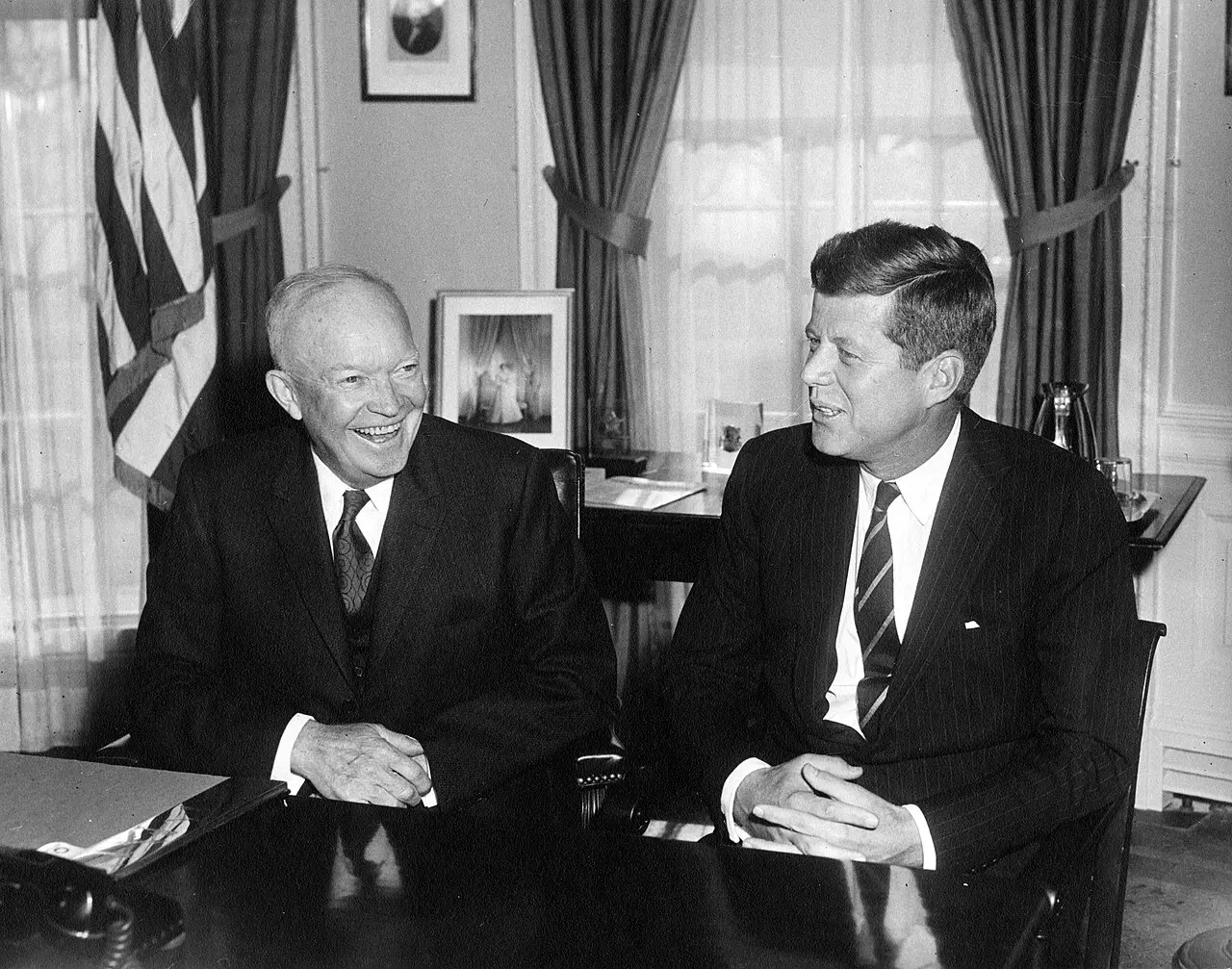
Photo: President Dwight D. Eisenhower meets with President-elect John F. Kennedy in the Oval Office during the 1960-61 presidential transition — photograph by Abbie Rowe (White House), public domain, via the John F. Kennedy Presidential Library and Wikimedia Commons.