Four H-Bombs Over Spain: The Palomares Broken Arrow
On January 17, 1966, a mid-air collision over Palomares, Spain, scattered four American hydrogen bombs across a farming village and the sea — and started an 80-day hunt.
At 10:30 on a clear January morning, two American warplanes touched in the sky above a Spanish farming village — and four hydrogen bombs tumbled out of the clouds over Palomares.
The date was January 17, 1966. A B-52G Stratofortress bomber, flying out of Seymour Johnson Air Force Base in North Carolina, was topping up its fuel tanks from a KC-135 tanker high over the Mediterranean coast of Spain. The bomber was part of Operation Chrome Dome, the Cold War program that kept nuclear-armed American bombers in the air around the clock, ready to strike the Soviet Union at a moment's notice. During the delicate refueling maneuver at 31,000 feet, the two aircraft collided. The tanker was destroyed instantly, killing all four men aboard. The bomber broke apart; three of its seven crew members were killed and four managed to eject.
What fell from the wreckage made it one of the most dangerous accidents of the nuclear age: four B28 thermonuclear bombs — hydrogen bombs, each vastly more powerful than the weapon dropped on Hiroshima. Three of them came down on land around Palomares, a village of tomato farmers in Almería province. One was found nearly intact. But the conventional explosives in two of the weapons detonated on impact — not a nuclear explosion, but enough to rip the bombs open and scatter plutonium across roughly two square kilometers of farmland and homes.
The fourth bomb was gone — carried out to sea under its parachute. What followed was one of the largest undersea searches in history. A local fisherman, Francisco Simó Orts, had watched the weapon splash down and marked the spot; the U.S. Navy, at first skeptical, eventually followed his lead. After an 80-day hunt involving dozens of ships and the deep-diving submersible Alvin, the bomb was found on the seabed nearly 2,850 feet down and hauled aboard the recovery ship USS Petrel intact, on April 7, 1966.
The cleanup was enormous and, to modern eyes, startlingly casual: some 1,750 tons of contaminated Spanish soil were dug up and shipped to South Carolina for burial. To calm public fear, the U.S. ambassador to Spain, Angier Biddle Duke, and Spain's tourism minister went swimming off the nearby beaches in front of the press — in the sea, not the fields where the plutonium had actually fallen. Spain banned American nuclear overflights within weeks, and the accident helped doom Operation Chrome Dome, which was shut down for good after a second B-52 crash in Greenland two years later.
Palomares is the Cold War's luckiest near-miss and its most instructive one. It showed how the machinery built to prevent war could manufacture catastrophe by accident — and how secrecy, cleanup and diplomacy collide when the unthinkable lands in a tomato field. Decades later, fenced-off plots in Palomares were still being monitored, a quiet reminder that some January mornings cast very long shadows.
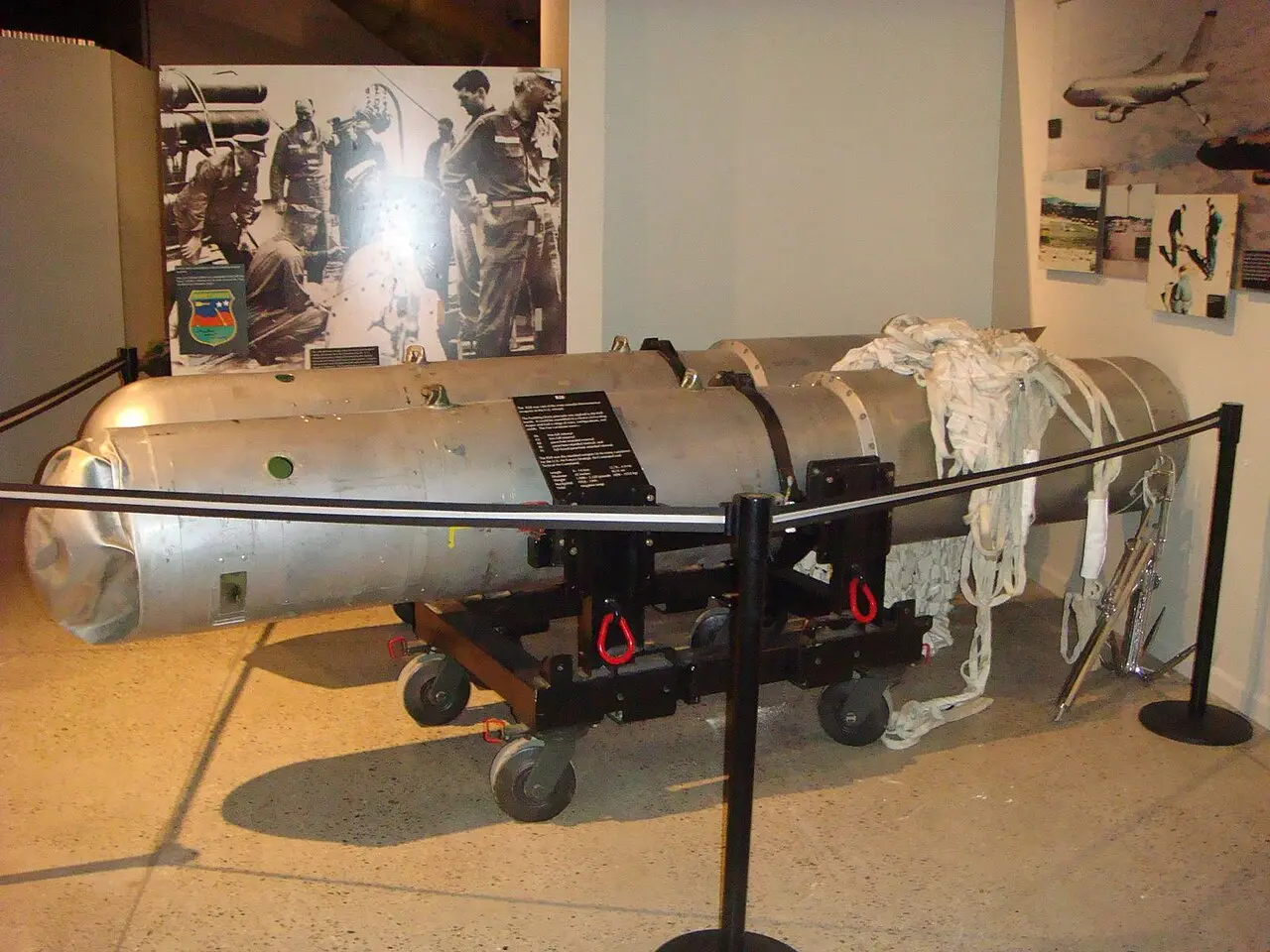
Photo: two of the actual MK-28 bomb casings from the 1966 Palomares incident, now on display at the National Museum of Nuclear Science & History — a modern photograph of the artifacts; photo by byteboy, CC BY 3.0 (via Wikimedia Commons).