
"Give Me Liberty, or Give Me Death!"
On March 23, 1775, Patrick Henry rose at St. John's Church in Richmond to demand Virginia arm its militia — and gave the Revolution its war cry.
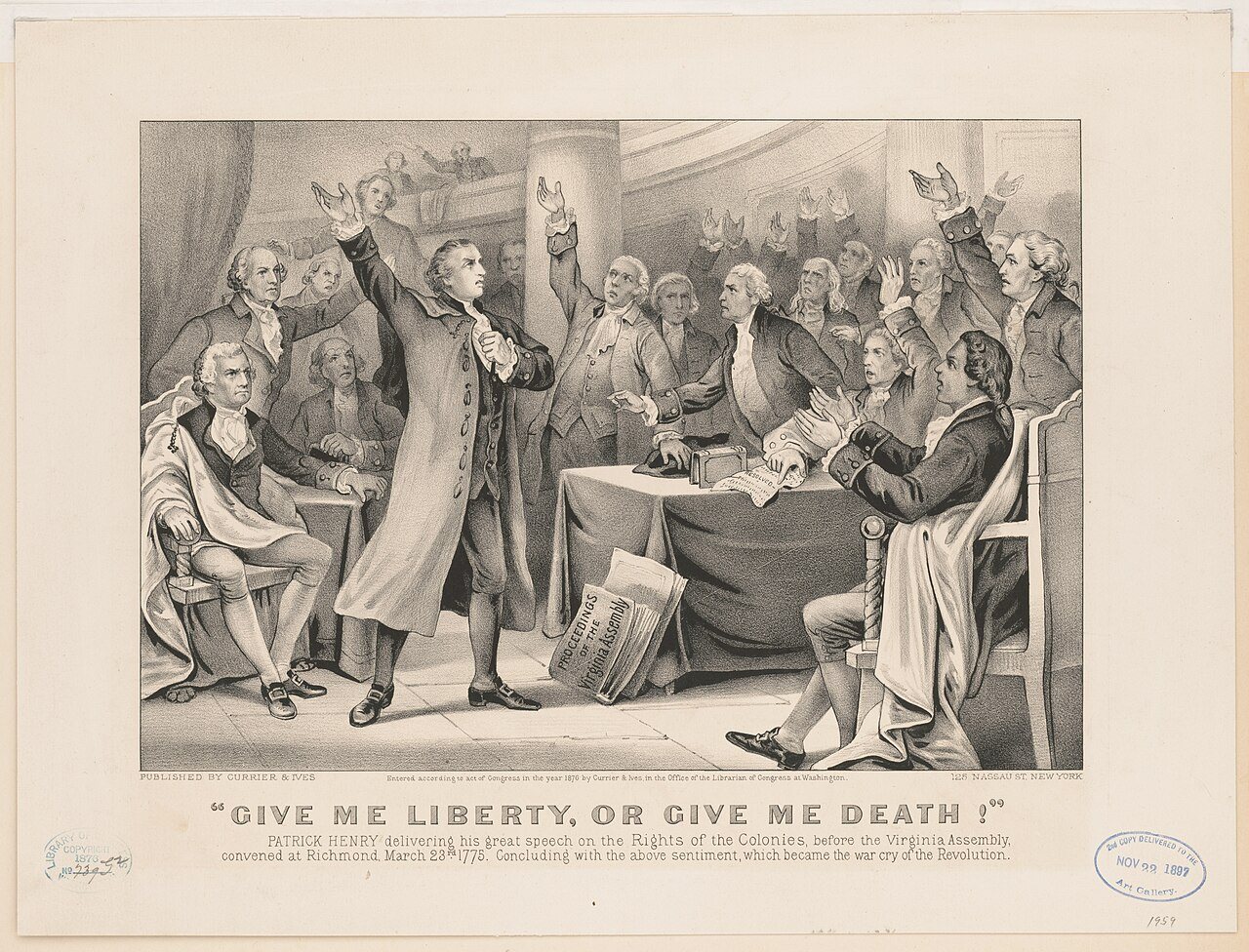
On March 23, 1775, the Second Virginia Convention met in St. John's Church in Richmond to answer an agonizing question: after years of failed petitions, the Boston Massacre, and Parliament's Intolerable Acts, should Virginia prepare for war with Britain? Among the delegates sat two future presidents, George Washington and Thomas Jefferson. Into that tense room rose Patrick Henry, a lawyer already famous for his fiery oratory.
The backdrop was grim. Five years earlier, British soldiers had killed five colonists in the Boston Massacre; the Boston Tea Party of 1773 had then provoked Parliament's Coercive Acts — the Intolerable Acts — which closed Boston's harbor, imposed military rule in Massachusetts, and stripped colonists of self-government. Many delegates still hoped for reconciliation. Henry did not.
Henry's argument was simple and terrifying: everything else had been tried and everything else had failed. The petitions had been slighted, he said; the fleets and armies Britain was gathering spoke louder than any promise of peace. What he wanted was for Virginia to raise and arm its militia immediately — to be ready for a war he believed was already inevitable. As he reached his close, his words rang through the church: "Is life so dear, or peace so sweet, as to be purchased at the price of chains and slavery? Forbid it, Almighty God! I know not what course others may take; but as for me, give me liberty or give me death!"
The convention voted to arm the militia, and the effect rippled outward. The Second Continental Congress convened in Philadelphia that May, appointed George Washington commander of the new Continental Army, and, in July 1776, signed the Declaration of Independence — for which Henry's Richmond speech had been a rehearsal in spirit. Less than a month after the church meeting, on April 19, British troops and colonial militia had already clashed at Lexington and Concord, and the Revolution was on.
The famous closing line, it should be noted, comes down to us through biographer William Wirt's 1817 reconstruction, written decades after Henry died — historians still debate his exact words. But no one disputes what happened in that church on March 23, 1775, or what followed: a colony choosing resistance over submission, in language that became the war cry of the American Revolution. Henry went on to serve as Virginia's first governor, and the 250th anniversary of the speech was commemorated at the national level in 2025.
Photo: Currier & Ives, 1876, Public domain (via Wikimedia Commons).