Galileo Found Neptune — and Let It Slip Away
On December 28, 1612, Galileo Galilei recorded the position of the planet Neptune for the first time — but mistook it for a fixed star and missed the discovery of his life.
He was looking right at it. On the night of December 28, 1612, Galileo Galilei aimed his telescope at Jupiter, sketched the positions of its moons — and carefully drew in a little "fixed star" nearby. That star was the planet Neptune. He had just become the first human being to record it, more than two centuries before its official discovery. And he had no idea.
By 1612, Galileo was the most famous astronomer in Europe. His telescope had already revealed Jupiter's four largest moons and the phases of Venus, blows against the old Earth-centered universe. Night after night he tracked the moons of Jupiter, sketching their shifting positions. On December 28, Neptune happened to be in conjunction with Jupiter — the two planets close together in the sky — so the distant world wandered into his field of view. He noted it again on January 27, 1613.
Why did he miss it? Cruelly, Neptune had just turned retrograde that very day — at the turning point of its apparent backward loop across the sky, it was nearly motionless against the background stars. Combine that standstill with Neptune's own stately pace and a telescope magnifying only about 30 times, and no movement was detectable. A star it was, and a star it remained in his notes.
The real discovery had to wait until September 23, 1846, when Johann Galle — assisted by Heinrich d'Arrest — pointed his telescope where Urbain Le Verrier's mathematics said a new planet must be, and found it within a degree of the predicted spot. (John Couch Adams had made the same prediction independently.) The clue had come from Uranus, whose orbit wobbled in ways that betrayed an unseen neighbor's gravity.
In 2009, University of Melbourne physicist David Jamieson presented evidence that Galileo may actually have noticed his "star" shifting position between observations — he may have been closer to the truth than his notebooks let on. But noticing a wobble is not the same as recognizing a world.
The near-miss stings even more for what happened between his two observations. On the night of January 3–4, 1613, Jupiter passed directly in front of Neptune — an extraordinarily rare planetary occultation. Had Galileo aimed his telescope just before dawn that morning, he would have watched the "star" emerge from behind Jupiter's dark edge. He didn't look that night, and the moment passed.
Galileo's near-miss is a reminder that discovery is not just seeing — it is understanding what you see. His meticulous sketches survived, and centuries later astronomers could overlay them on the true positions of the planets and confirm exactly what he had drawn. The data was perfect. The interpretation slipped away.
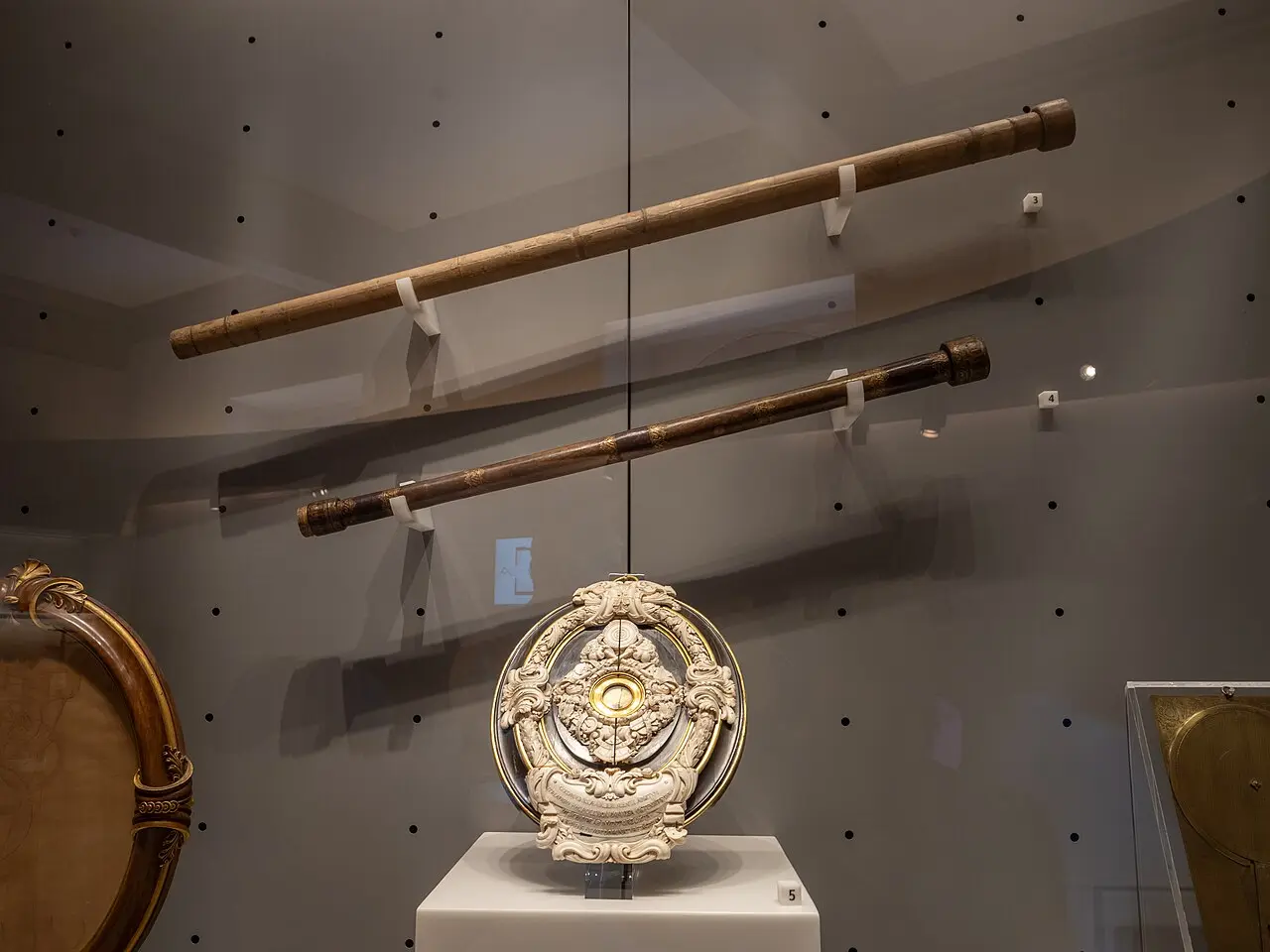
Photo: Galileo's telescopes at the Museo Galileo, Florence, by C messier, CC BY 4.0 (via Wikimedia Commons).