A Dying King's Gift: Westminster Abbey Is Born
On December 28, 1065, Edward the Confessor's great new abbey at Westminster was consecrated — eight days before the king's death, planting the seed of a thousand years of English history.
The most important guest never showed up. On December 28, 1065 — Holy Innocents' Day — the great new abbey church at Westminster was consecrated in a solemn ceremony, and the man who had paid for every stone of it lay dying a short distance away, too ill to attend.
Edward the Confessor had been King of England since 1042. During his long exile in Normandy, the story goes, he vowed that if he ever regained his throne he would make a pilgrimage to St. Peter's in Rome. Once crowned, he found he could not leave his kingdom — so the Pope released him from the vow on one condition: he must found or restore a monastery dedicated to St. Peter. Edward chose a marshy island in the Thames called Thorney, where a small Benedictine house had stood since about 960, and rebuilt it on a grand scale.
His new church was the first in England built in the Norman Romanesque style, and the first English church laid out on a cruciform floor plan, with a great central tower. It was, quite deliberately, a royal burial church — Edward was building his own tomb as much as a house of God.
He finished just in time. The consecration took place on December 28, 1065, with the king absent and failing. Eight days later, on January 5, 1066, Edward was dead. The next day — the Feast of the Epiphany — he was buried before the high altar of the church he had built. His funeral procession is depicted in the Bayeux Tapestry.
His death detonated one of the most famous succession crises in history. Harold Godwinson was crowned — probably in the new abbey — only to fall at Hastings on October 14. On Christmas Day 1066, William the Conqueror was crowned in Edward's church, beginning an unbroken line: every English and later British monarch since has been crowned at Westminster Abbey.
Edward's Norman building did not survive — Henry III demolished most of it from 1245 to raise the soaring Gothic church that stands today — but the site never lost its meaning. Edward was canonized in 1161, his shrine became a magnet for pilgrims, and the abbey grew into the burial place of kings, queens, poets, and scientists.
Edward's own afterlife at the abbey was eventful. In 1103, his tomb was opened and his body reportedly found incorrupt — taken as proof of sanctity — and in 1161 Pope Alexander III canonized him, the only English king ever made a saint. His shrine behind the high altar became the glittering heart of Henry III's rebuilt church, and the abbey's prestige only grew: it is the traditional coronation church, the resting place of seventeen monarchs, and home to Poets' Corner, where Chaucer, Dickens, and hundreds of others are buried or memorialized.
Nearly a thousand years on, the abbey founded on a dying king's vow remains the stage on which Britain tells its story: coronations, royal weddings, state funerals. All of it traces back to a consecration day its founder was too ill to attend.
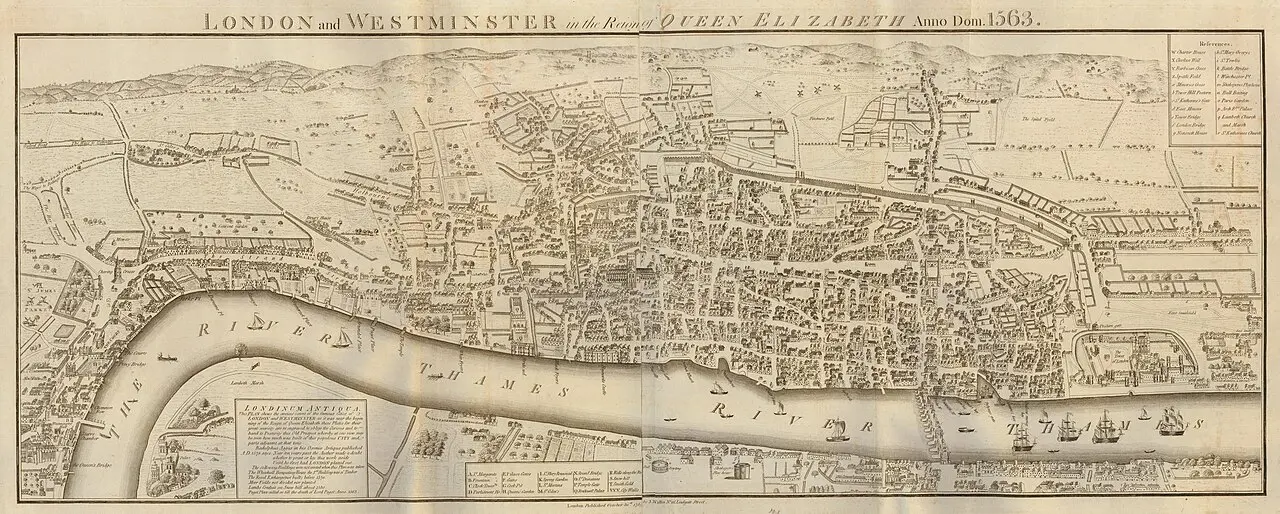
Photo: Panorama of London and Westminster in 1563, after Ralph Agas, public domain (via Wikimedia Commons).