Eighteen Hours Over the Ice: Byrd's Flight to the South Pole
On November 28, 1929, Richard E. Byrd and three crewmates took off from Little America in the Ford trimotor Floyd Bennett on the first airplane flight over the South Pole.
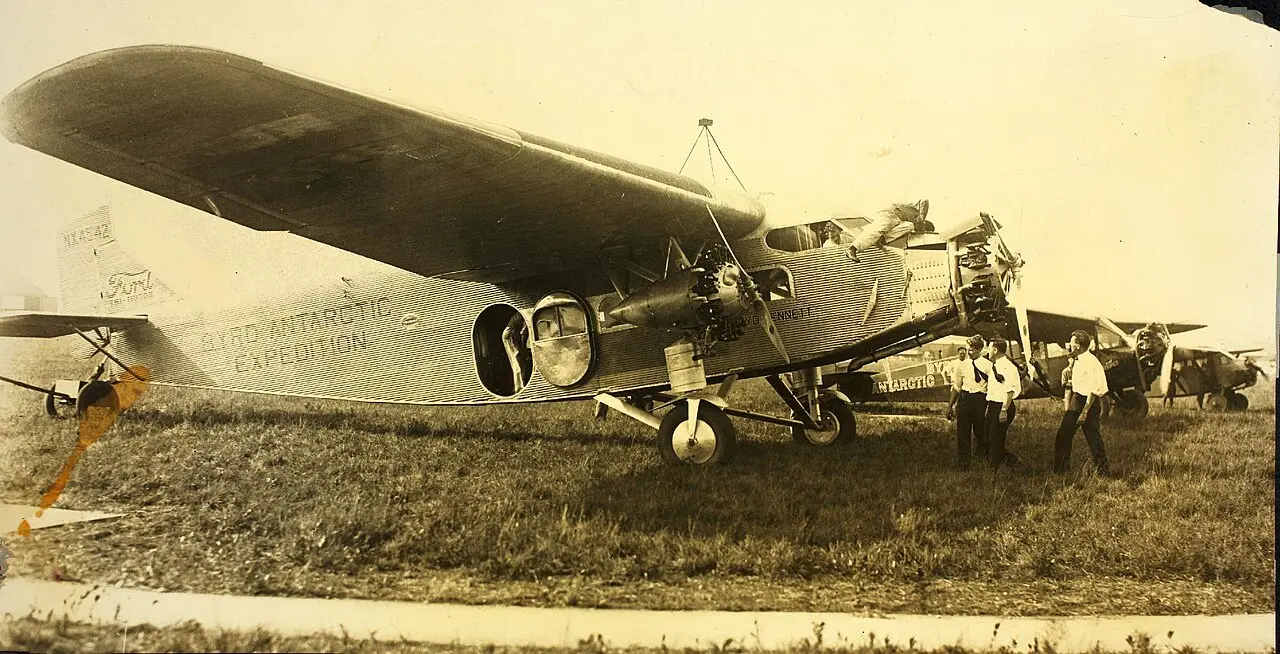
At 3:29 on the afternoon of November 28, 1929, a heavily loaded Ford trimotor airplane rumbled down a rough ice runway at Little America — the expedition base on Antarctica's Ross Ice Shelf — and lifted into the polar sky. The plane was the Floyd Bennett, named for the pilot who had flown with Commander Richard E. Byrd toward the North Pole three years earlier. Its mission: the first flight over the South Pole.
Getting airborne at all had been an ordeal. Byrd's expedition — 83 men, four ships, and three airplanes — had overwintered at Little America, and the aircraft had to be dug out of the snow and readied before the flight. When the Floyd Bennett finally lifted off, it carried four men and more than seven tons of fuel, food, and emergency gear. Byrd served as navigator. The pilot was Bernt Balchen, a Norwegian aviation pioneer; Harold June was co-pilot and radio operator; Ashley McKinley was the aerial photographer, tasked with documenting the route. Magnetic compasses were useless that close to the pole, so they steered by sun compasses and Byrd's skill as a navigator.
The hardest hours came over the polar plateau. Early in the flight, at 8:15 p.m., they dropped supplies for a geological party camped near the Queen Maud Mountains and pressed on. The overloaded plane then struggled to climb high enough to clear the mountain passes, which rose past 10,000 feet. At one point Balchen could not get the plane to climb at all. Byrd ordered food and fuel thrown overboard — a 150-pound package of provisions went out, then another — until the plane finally clawed its way over the pass by only a few hundred yards. "Those were the worst minutes of our flight," Byrd said later.
At around 1 a.m. on November 29, they reached the South Pole — the first humans ever to arrive by air. They flew a few miles past it, then right and left to cancel out any navigation error, and Byrd dropped a small American flag onto the ice. Then they turned for home, landing back at Little America at 10:11 a.m., about eighteen and a half hours after takeoff.
Amundsen and Scott had reached the pole by sled in 1911 and 1912; Byrd's crew were the first to fly there. The flight — undisputed, unlike Byrd's contested 1926 North Pole claim — made Byrd a global hero and helped open the mechanical age of Antarctic exploration.
Photo: SDASM Archives, public domain (via Wikimedia Commons).