Early Bird Takes Flight: The First Commercial Satellite
On April 6, 1965, Intelsat I — nicknamed Early Bird — launched from Cape Canaveral, becoming the first commercial communications satellite.
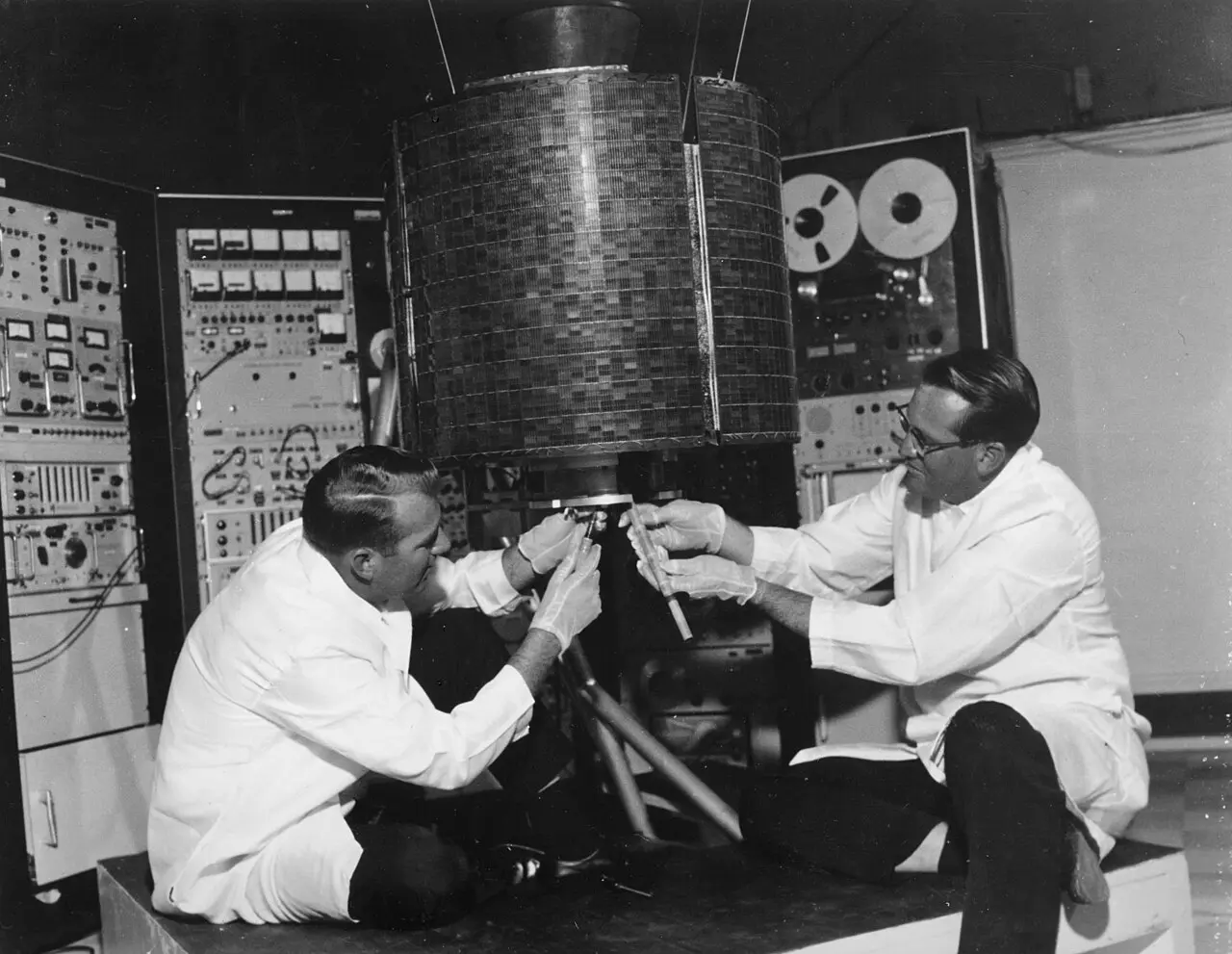
It was the size of a beach ball, weighed 76 pounds — and it shrank the planet.
On April 6, 1965, a Thrust Augmented Delta rocket lifted off from Launch Complex 17A at Cape Canaveral, Florida, carrying Intelsat I — quickly nicknamed "Early Bird," after the proverb "the early bird catches the worm." Built by the Hughes Aircraft Company for the Communications Satellite Corporation (COMSAT), it was the first commercial communications satellite ever placed in geosynchronous orbit. Hughes had already proven the concept for NASA with its Syncom satellites; Early Bird was the commercial version. As was standard practice in the early space age, two identical satellites were built, in case the launch failed.
The satellite was tiny: a drum about 76 by 61 centimeters, weighing 34.5 kilograms, wrapped in 6,000 solar cells. But parked over the Atlantic at 28° West longitude, it did what no machine had done before — it gave Europe and North America direct, nearly instantaneous contact, carrying television, telephone, and telefax signals. It could handle 240 two-way telephone circuits, or a single TV channel. COMSAT activated it on June 28, 1965.
Early Bird was also a bargain. The undersea telephone cables of the day carried fewer circuits and cost roughly ten times as much — and demand for the satellite's circuits was immediate on both sides of the Atlantic, fueling the rapid growth of the Intelsat system.
The little satellite kept making history. It carried the first live television coverage of a spacecraft splashdown — Gemini 6, in December 1965. It was part of 1967's record-breaking "Our World" broadcast. And when the Atlantic Intelsat satellite failed just before Apollo 11, Early Bird was pulled out of retirement in June 1969 to help carry the Moon landing to the world.
Designed to last eighteen months, Early Bird served for four years and four months before its deactivation in January 1969. It still orbits silently today — save for a brief reactivation in 1990 to mark its twenty-fifth launch anniversary — and its ground spare, the identical twin built in case the launch failed, now belongs to the Smithsonian's National Air and Space Museum.
Why it matters: Early Bird founded the commercial satellite industry. Every live global broadcast, every intercontinental call routed through space, descends from that 76-pound drum lofted on an April morning in 1965. The age of instant global communication began with a beach-ball-sized drum circling the Earth.
Photo: NASA, public domain (via Wikimedia Commons).