Black Friday 1869: The Gold Panic That Got Its Name
On September 24, 1869, a scheme by Jay Gould and Jim Fisk to corner the gold market collapsed, crashing Wall Street — and giving history the term 'Black Friday.'
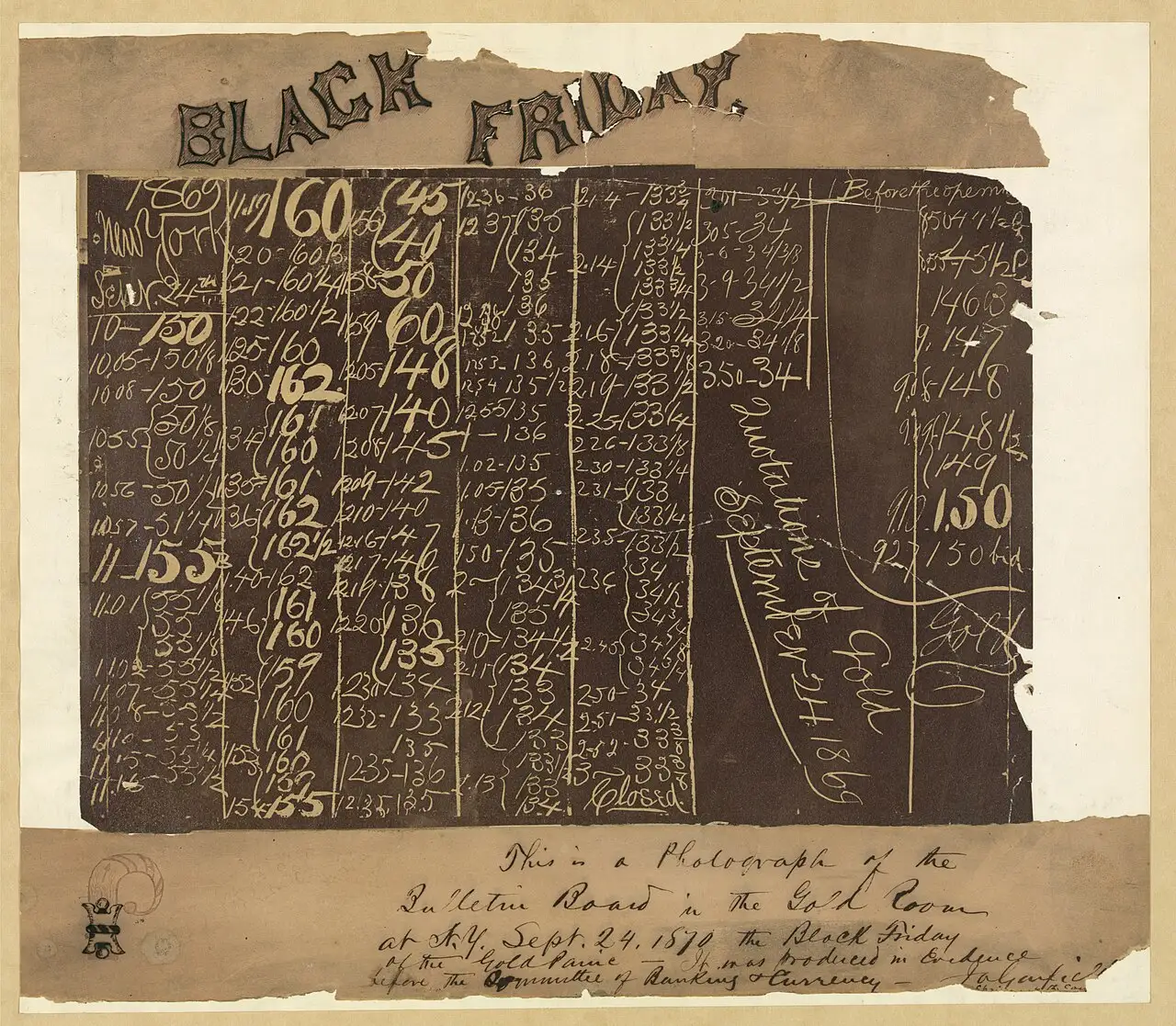
The photograph looks like a relic from another world: a chalkboard headed "BLACK FRIDAY," covered in columns of handwritten gold prices, with a note scrawled beneath saying it was entered as evidence before Congress. It was taken in New York's Gold Room on September 24, 1869 — the day two Wall Street schemers nearly broke the American economy, and gave financial history its darkest weekday.
The schemers were Jay Gould and Jim Fisk, a pair of Gilded Age speculators famous for bending markets to their will. Their target was gold. After the Civil War, the Treasury regularly sold gold to pay down the national debt and steady the dollar — sales that kept gold prices in check. Gould and Fisk hatched a plan to corner the market: buy up enormous quantities of gold, then persuade the government not to sell any of its own, sending the price soaring while they held the supply.
To pull it off, they needed a friend in the White House. They found one in Abel Corbin, a small-time speculator who had married Virginia "Jennie" Grant — the younger sister of President Ulysses S. Grant. Through Corbin, Gould and Fisk cozied up to the president, fishing for hints about Treasury policy and arguing against government gold sales. At a meeting on September 2, Grant confided to Corbin that he planned to order no Treasury gold sales for the coming month — and the ring pounced, buying gold through an army of brokers until Gould and Fisk alone held some $60 million worth, roughly three times the public supply in New York.
The price climbed through September — from about $132 for a $100 gold piece in August to $141, then $144.50 at the close on September 23. On Friday the 24th, trading opened and gold leapt to $160. Crowds of spectators and reporters packed the streets around the Gold Room while ruined short-sellers watched in horror; Fisk kept buying and boasted the price would hit $200. But in Washington, Grant had seen through the scheme. Shortly before noon he ordered Treasury Secretary George Boutwell to open the vaults: the government would sell $4 million in gold. The corner broke. Gold crashed to about $130, stocks tumbled more than 20 percent over the following week, and leveraged speculators were wiped out.
The day entered history as Black Friday — the original one, and the reason market crashes have been called "black" days ever since, from Black Tuesday in 1929 to Black Monday in 1987. A congressional investigation followed, with the Gold Room's own blackboard photographed as evidence. Gould, who had quietly sold out before the collapse, largely escaped ruin; the Grant administration's reputation did not.
Black Friday endures as the classic American market mania: a reminder that when a few men try to own the whole game, it is everyone else who pays. And it all happened on a single Friday in September — recorded in chalk, on a board, in a photograph that still tells the story.
Photo: Library of Congress, public domain (via Wikimedia Commons).