An Eternal Flame Is Lit: JFK's State Funeral, 1963
On November 25, 1963, three days after his assassination, President John F. Kennedy was buried at Arlington as the world watched and his widow lit an eternal flame.
On Friday, November 22, 1963, President John F. Kennedy was assassinated in Dallas, Texas. Three days later, on Monday the 25th, the nation said goodbye. In between, his flag-draped casket had rested in the East Room of the White House and then lain in state in the Capitol Rotunda, where hundreds of thousands of mourners filed past through the day and the night.
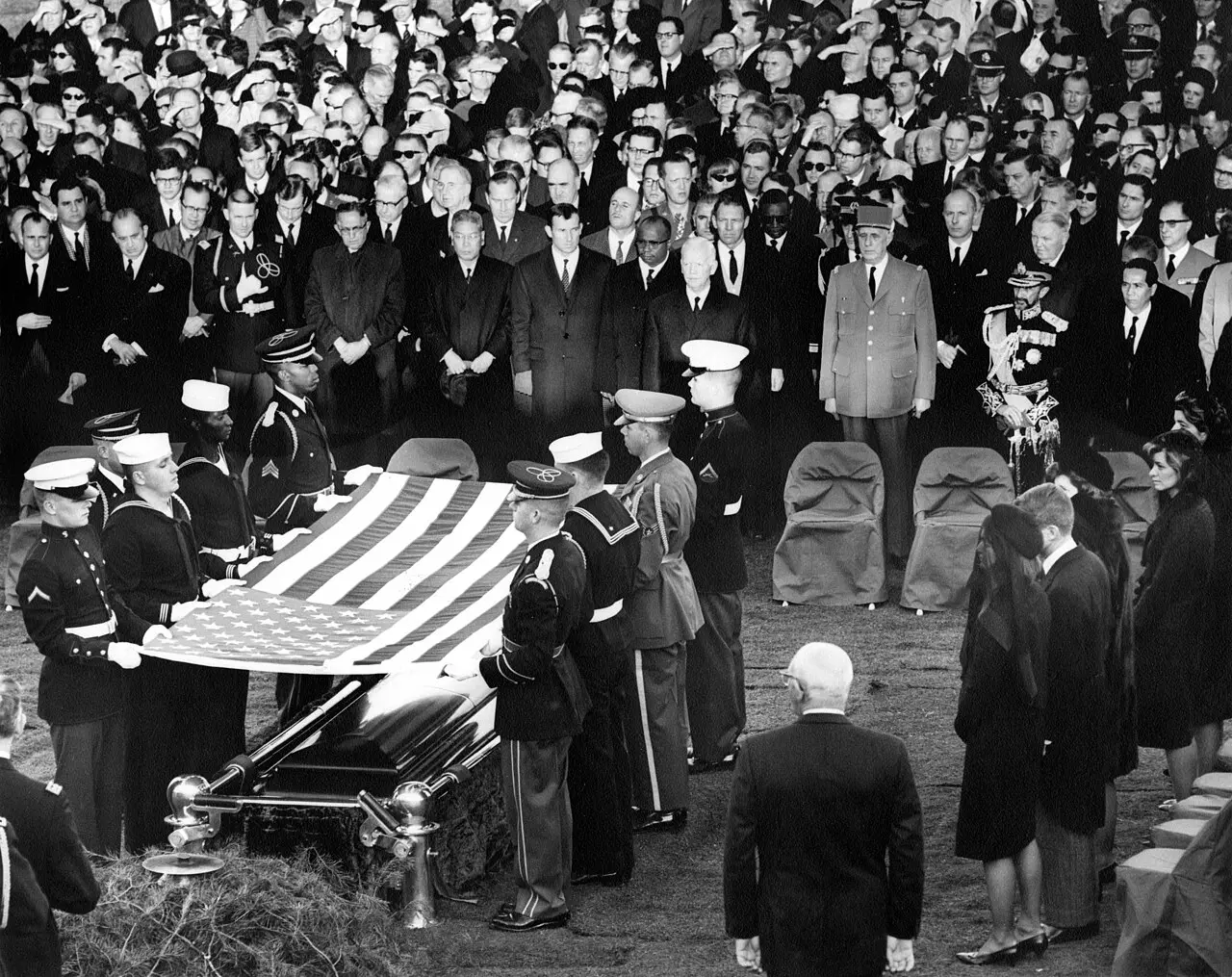
The state funeral was among the largest gatherings of world leaders ever seen in Washington. After a Requiem Mass at St. Matthew's Cathedral, the casket rode a horse-drawn caisson to Arlington National Cemetery in Virginia, followed on foot by Jacqueline Kennedy, the Kennedy family, and dignitaries from 92 countries — including France's Charles de Gaulle, Ethiopia's Emperor Haile Selassie, and Britain's Prince Philip. Tens of millions watched on television in the United States and around the world.
The burial plot sat on a grassy hillside below Arlington House, chosen at Jacqueline Kennedy's wish after she and Defense Secretary Robert McNamara visited the site two days earlier. The grave was aligned so it would face the Lincoln Memorial and the Washington Monument across the river.
Then came the moment that would outlast them all. On Sunday, the day before the funeral, Jacqueline Kennedy had asked for an eternal flame at the grave — inspired, she said, by the flame burning at the Tomb of the Unknown Soldier beneath the Arc de Triomphe in Paris, which she and the president had seen on a visit to France in 1961. Her brother-in-law had counseled against it, worried it might seem ostentatious, but she was adamant. With barely a day to prepare, Colonel Clayton B. Lyle and an Army Corps of Engineers team worked overnight: a gas-fed torch was procured and tested, a gas line run to a propane tank some 200 yards away, and a mound of evergreens arranged to hide the mechanism. At the end of the burial service, the widow lit a taper from a candle held by a nearby soldier and brought the flame to life; the president's brothers, Robert and Ted, symbolically lit it after her. It still burns today.
Overhead, a military flyover passed in tribute — including Air Force One itself, tipping its wings in a final salute. Kennedy became only the second president buried at Arlington, after William Howard Taft. Three days that had begun with gunshots in Dallas ended with a flame on a Virginia hillside, and a country learning how to grieve in public.
Photo: Abbie Rowe, public domain (via Wikimedia Commons).