
An 18-Year-Old Wakes Up Queen: Victoria's First Day on the Throne
On June 20, 1837, eighteen-year-old Princess Victoria was woken at Kensington Palace with the news that she was Queen of England.
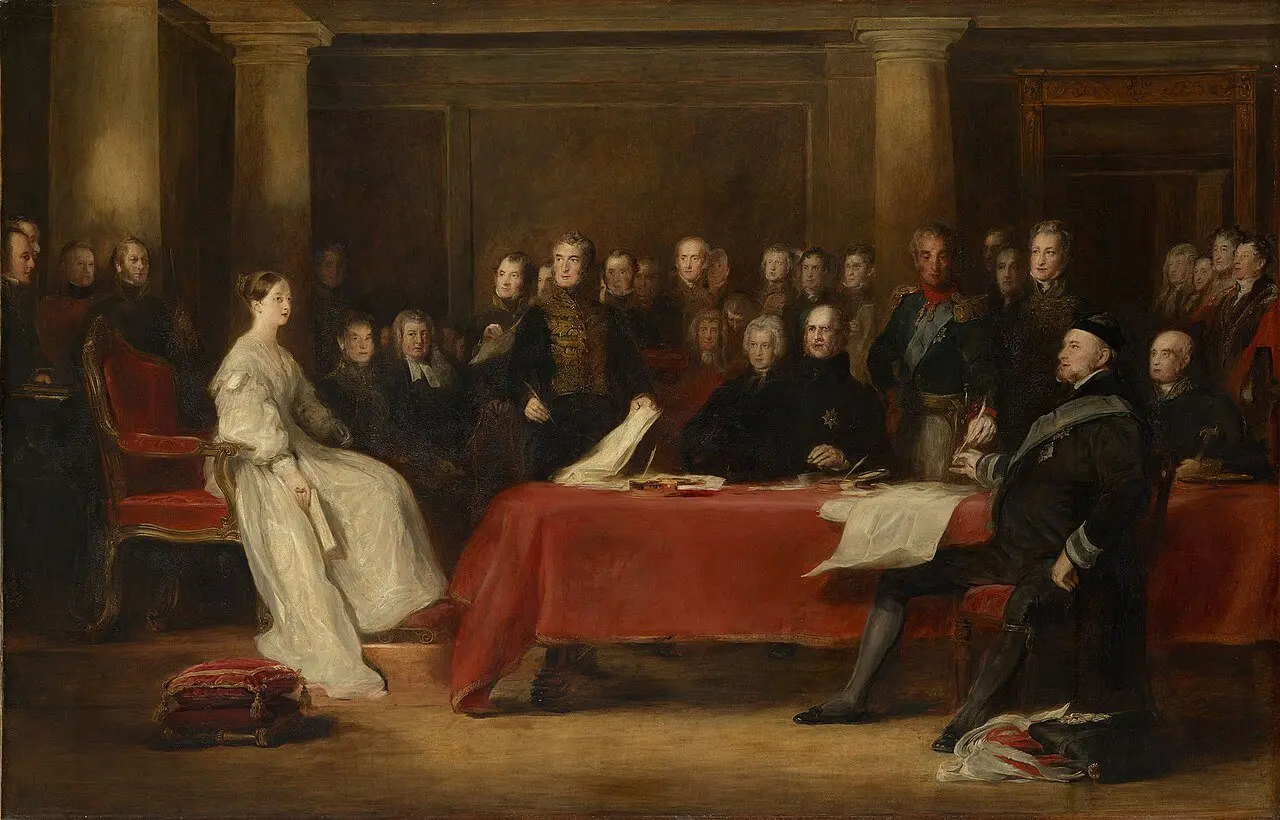
At six o'clock on the morning of Tuesday, June 20, 1837, an eighteen-year-old girl was shaken awake at Kensington Palace in London. Her uncle, King William IV, had died in the night at Windsor Castle. The girl in the dressing gown — Alexandrina Victoria, not yet a month past her eighteenth birthday — was now Queen of the British Empire.
Victoria had been raised for this moment, but not in luxury. Her father, the Duke of Kent, had died when she was a baby, and her widowed mother had raised her under a strict regime known as the Kensington System: tightly scheduled lessons, almost no unsupervised contact with children her own age, and — until this very morning — a shared bedroom with her mother. She had turned pale and burst into tears the day before when she heard her uncle's condition was grave.
The news arrived with ceremony even in the small hours. The Archbishop of Canterbury and the Lord Chamberlain, Lord Conyngham, reached Kensington at about five in the morning and asked to see her. She received them alone, in her sitting room, still in her dressing gown. Conyngham knelt, kissed her hand, and delivered the official announcement. The Archbishop described the old king's peaceful final hours. Victoria wrote it all down in her diary that day — she would keep a diary for the rest of her life.
She went straight to work. At eleven o'clock that same morning she held her first Privy Council in the Red Saloon at Kensington Palace, greeting the most powerful men in the kingdom with what witnesses described as remarkable composure for an eighteen-year-old. (She later grumbled that the painter Sir David Wilkie had dressed her in white in his famous painting of the scene — she had worn black, in mourning.) And she began, immediately and quietly, to assert her independence: in her diary she noted pointedly that she was seeing her ministers "alone," without her mother present. The sheltered girl of the Kensington System was charting her own course from day one.
Her reign would last 63 years, 7 months, and 2 days — the longest of any British monarch until Elizabeth II surpassed it in 2015. She was crowned at Westminster Abbey on June 28, 1838, married her beloved Albert in 1840, and became the figurehead of an era that took her name: the Victorian Age, an age of railways, telegraphs, photography, and an empire that spanned the globe.
One quiet consequence of that morning: Hanover, the German principality tied to the British crown since the Hanoverian kings, separated from Britain that day. Hanover's laws did not allow a woman to reign, so its crown passed to Victoria's uncle, the Duke of Cumberland. England kept its young queen; Hanover went its own way.
Why it matters: empires are usually inherited by men with gray beards. On June 20, 1837, the world's mightiest empire passed to a teenager who had never had a room of her own — and she spent the next six decades proving that morning was not a mistake.
Photo: Sir David Wilkie's painting of Queen Victoria's first Privy Council, held at Kensington Palace on June 20, 1837; public domain via Wikimedia Commons.