Across the Atlantic: The NC-4's First Transatlantic Flight
On May 27, 1919, the Navy flying boat NC-4 landed in Lisbon harbor, becoming the first aircraft in history to fly across an ocean.
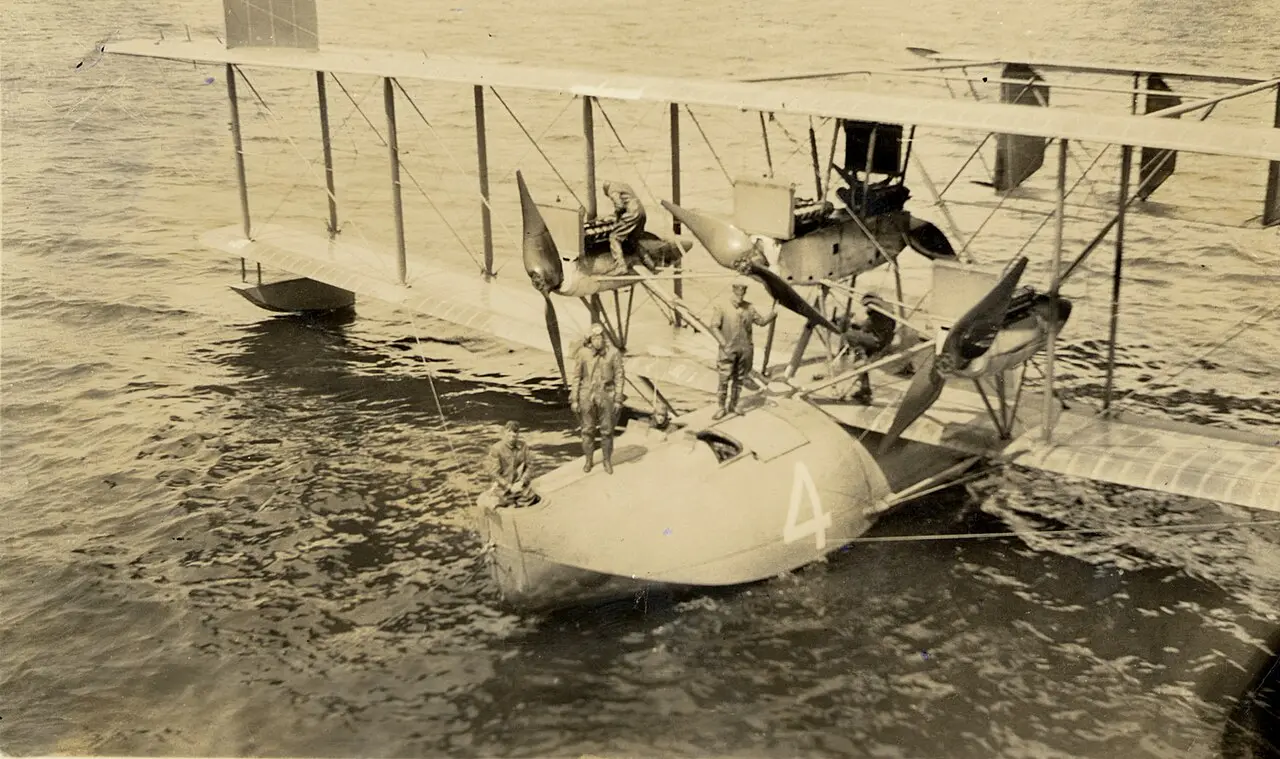
On the evening of May 27, 1919, a crowd surged to the edge of Lisbon harbor as a strange craft — part boat, part airplane — settled onto the waters of the Tagus River. The NC-4, a United States Navy flying boat, had just become the first aircraft in history to fly across an ocean.
The flight had begun as a wartime idea. In 1917, with German U-boats sinking Allied shipping, a Navy admiral asked whether big flying boats could hunt submarines from the air — and fly themselves across the Atlantic to get there. The Curtiss Aeroplane Company built the answer: the NC flying boats, with four Liberty engines and a wingspan of 126 feet.
The war ended before the planes were ready, so the Navy turned the mission into a demonstration. Three flying boats — the NC-1, NC-3, and NC-4 — left the Naval Air Station at Rockaway, New York, on May 8, 1919, hopscotching to Newfoundland and then to the Azores, guided by a chain of 53 American warships stationed along the route like stepping stones. The Atlantic was merciless: the NC-1 was crippled landing in rough seas, and the NC-3 broke down and had to be towed. Only the NC-4, commanded by Lieutenant Commander Albert C. Read, kept going.
At dawn on May 27, Read and his five-man crew — pilots Walter Hinton and Elmer Stone, engineers Eugene Rhoads and James Breese, and radio operator Herbert Rodd — lifted off from Ponta Delgada in the Azores. Nine hours and forty-three minutes later, the flying boat's keel sliced into the Tagus. Lisbon erupted. Bells rang, boats crowded the harbor, and the crew were celebrated as heroes; the Navy even flew the NC-4 on to Plymouth, England, to complete a triumphal tour. The gamble was vindicated: the ocean could be crossed by air.
Just weeks later, Britain's Alcock and Brown would make the first nonstop crossing, from Newfoundland to Ireland, grabbing the headlines. But the NC-4 got there first — the first wings over any ocean, proving that the age of transatlantic flight had arrived.
Why it matters: every flight you take across an ocean today descends from the NC-4's wobbly hop across the Atlantic. It proved the machines could do it, the navigation could be done, and the crews could survive it — turning the ocean from a barrier into a highway.
Photo: Smithsonian Institution, public domain (via Wikimedia Commons).