A Nine-Year-Old Inherits the Tudor Throne
Henry VIII died in the early hours of January 28, 1547, leaving England — and its turbulent religious future — in the hands of his nine-year-old son Edward.
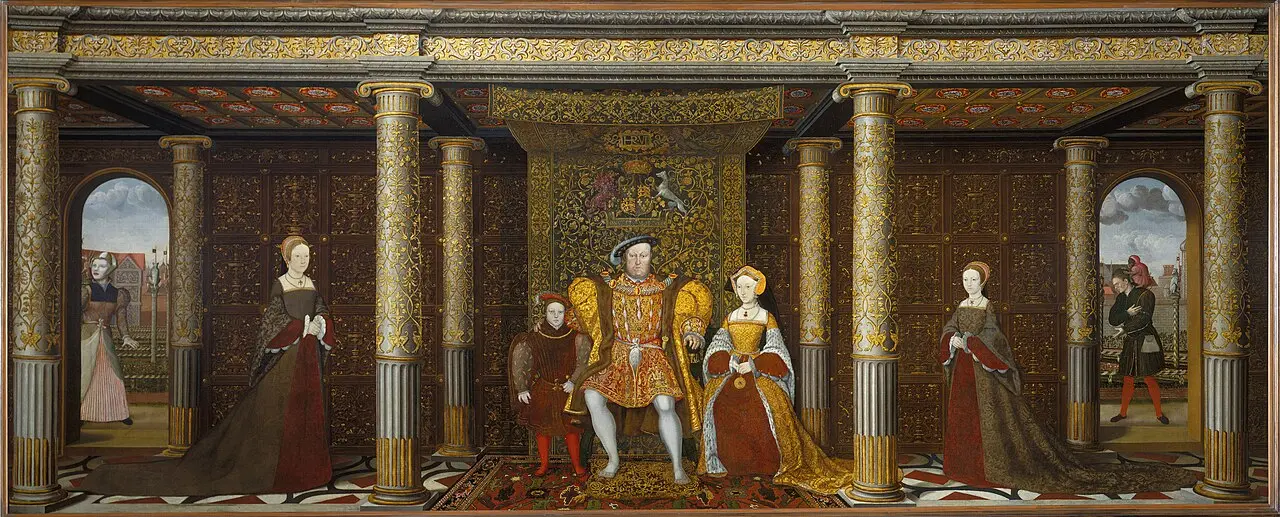
In the small hours of January 28, 1547, the most formidable king in English history died quietly in his bed at Whitehall Palace. Henry VIII was 55 years old, enormously overweight, and in constant pain from an ulcerated leg that had tormented him for years. He had ruled England for nearly four decades, bending church, Parliament, and nobility to his will. And he left behind a kingdom shaped entirely around one man's desires — and a nine-year-old boy to carry it.
Henry's reign had been defined above all by his search for a male heir. His break with the Church of Rome, his six marriages, the dissolution of the monasteries — all of it flowed from his determination to father a legitimate son who would secure the Tudor dynasty. The irony of his life is that the son finally arrived late and fragile: Edward, born in 1537 to Henry's third wife, Jane Seymour, who died days after the birth. Henry got the heir he had torn a kingdom apart to produce, and the boy was nine years old, small for his age, and already showing the weak health that would shadow his short life.
The court kept the king's death quiet for a day or two — the machinery of succession had to be managed. Then, on January 31, the boy was proclaimed King Edward VI, and on February 20 he was crowned at Westminster Abbey, a child wearing robes far too heavy for his shoulders. A nine-year-old cannot rule, so England was governed by a regency council, and the council's factions immediately began pulling the young king — and the country's religion — in competing directions.
Edward's six-year reign pushed England decisively toward Protestantism: English prayer books, married clergy, the stripping of Catholic ritual. Then, in 1553, the frail teenager died at fifteen, and the succession Henry had obsessed over collapsed into crisis — the brief, doomed reign of Lady Jane Grey, then the Catholic restoration under Mary, then Elizabeth. The male Tudor line Henry sacrificed so much to secure lasted exactly one boyhood.
January 28, 1547, is the hinge of the Tudor century: the day the strongman exited and the age of child kings, religious whiplash, and finally Elizabeth began. It is also a reminder that power built entirely around one person is brittle — no matter how absolute that person seems, the future belongs to whoever is left holding the crown. In this case, a nine-year-old.
Painting: an unknown artist, c. 1545 (public domain, via Wikimedia Commons). Made in Henry VIII's own lifetime, it shows the king enthroned with the young Prince Edward at his side — the boy who would succeed him within two years.