
A Handshake in Space
On July 15, 1975, the United States and the Soviet Union launched rockets hours apart — and their spacecraft docked in orbit for the first time in history.
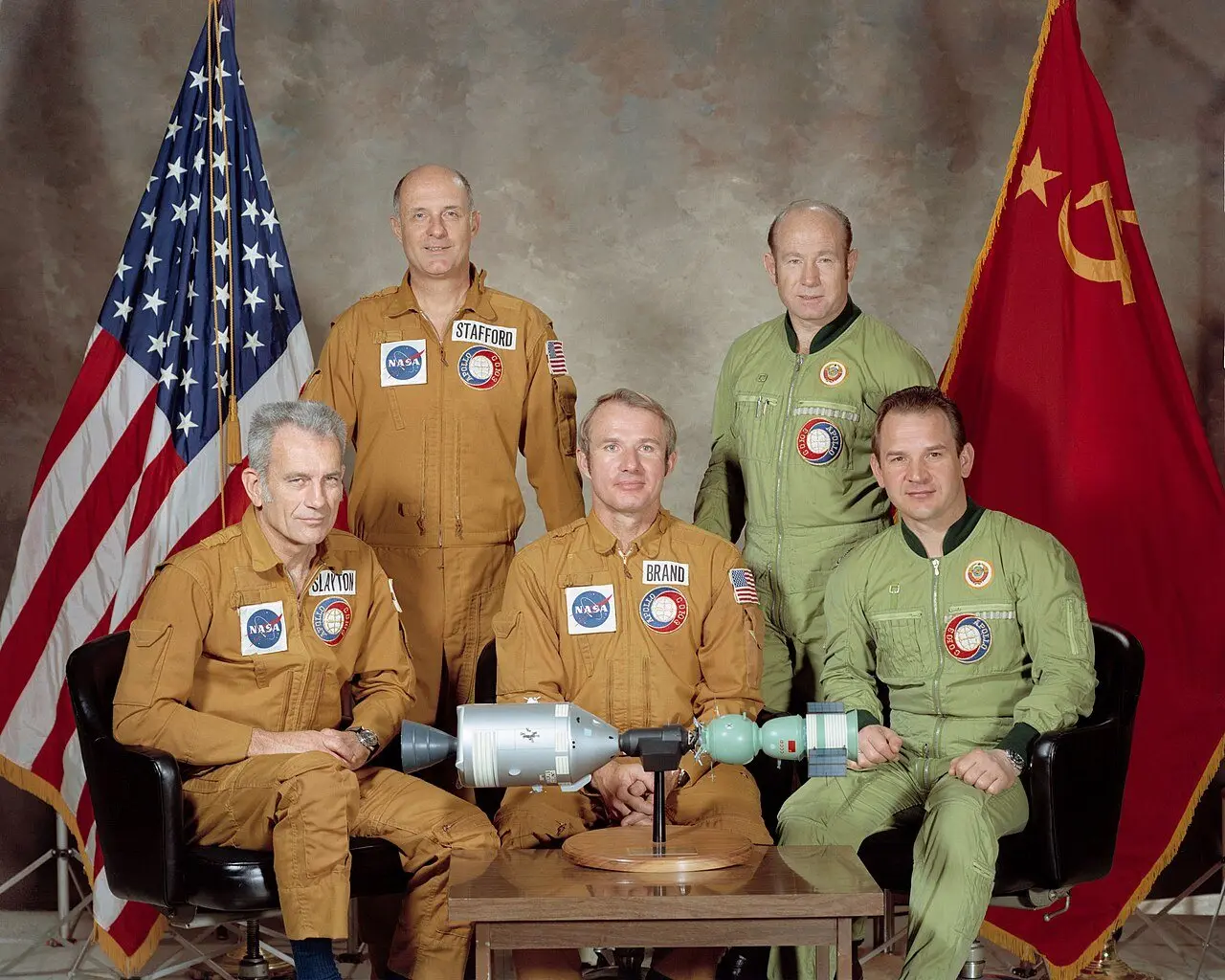
At 8:20 on the morning of July 15, 1975, a Soyuz rocket lifted off from the Baikonur Cosmodrome in Kazakhstan, carrying cosmonauts Alexei Leonov and Valery Kubasov. Seven and a half hours later — at 3:50 p.m. Eastern time — a Saturn IB roared off the launch pad at Florida's Kennedy Space Center, carrying astronauts Thomas Stafford, Vance Brand, and Deke Slayton. Two spacecraft. Two rival superpowers. One destination.
The mission had been five years in the making, born of a 1972 agreement signed by President Richard Nixon and Soviet Premier Alexei Kosygin. Its goals were practical: prove that an American and a Soviet spacecraft could rendezvous and dock in orbit, and lay the groundwork for an international space rescue. Engineers from NASA and the Soviet space program — Cold War rivals who had raced each other to the Moon — had spent years learning each other's languages and hardware, and NASA built a special docking module to serve as an airlock between the two very different vehicles.
Two days later, on July 17, the spacecraft docked high above the Atlantic Ocean. When the hatches opened, Stafford and Leonov shook hands in orbit — the first handshake between an American astronaut and a Soviet cosmonaut in space, watched on television around the world. For nearly two days of joint activities, the crews toured each other's spacecraft, ran five joint science experiments, shared meals, and exchanged flags and commemorative gifts. They even took congratulatory calls from Soviet leader Leonid Brezhnev and President Gerald Ford.
The mission carried special meaning for Deke Slayton. One of NASA's original Mercury Seven astronauts, he had been grounded for more than a decade by a heart condition — and at 51, he was finally flying in space for the first time.
After the spacecraft separated, Soyuz 19 came home on July 21; the Apollo crew, after nine days in orbit, splashed down in the Pacific on July 24 — the last flight of an Apollo spacecraft. The Apollo–Soyuz Test Project was the first international human spaceflight: not the International Space Station, not the Shuttle–Mir program, but this nine-day mission in the summer of 1975. It proved that two nations built on rivalry could build something together, and it paved the way for every international partnership that followed, from Mir to the ISS. It began with two launches on a single July day — and a handshake in orbit.
Photo: NASA, public domain (via Wikimedia Commons).