Wilson's Fourteen Points: A Blueprint to End All Wars
On January 8, 1918, Woodrow Wilson laid his Fourteen Points before Congress — a bold blueprint for peace promising open diplomacy, self-determination, and a league of nations.
On January 8, 1918, with World War I grinding through its fourth year, President Woodrow Wilson walked into a joint session of Congress and proposed to end not just this war but war itself. "All the peoples of the world are in effect partners in this interest," he told the assembled senators and representatives, "and for our own part we see very clearly that unless justice be done to others it will not be done to us. The program of the world's peace, therefore, is our program; and that program, the only possible program, as we see it, is this:" Then he laid out fourteen points.
The first five were principles for all nations: no more secret treaties, freedom of the seas, free trade, arms reduced to what each country needed for its own safety, and colonial claims settled fairly, with the interests of the colonized peoples taken into account. The rest redrew the map: Russian territory evacuated, Belgium restored, Alsace-Lorraine returned to France, Italian borders drawn along lines of nationality, autonomy for the peoples of Austria-Hungary, the Balkan states secured, self-determination for the peoples under Turkish rule, and an independent Poland.
The final point was the most ambitious: "a general association of nations" formed to guarantee every country's political independence and territorial integrity — what would become the League of Nations.
The speech landed like a thunderclap. In the exhausted trenches and capitals of Europe, Wilson's words offered something no general had: a vision of a just peace rather than a vengeful one. But when the war ended, Allied leaders wanted punishment for Germany, not Wilson's forgiveness. Only some of the fourteen points survived into the Treaty of Versailles. The League of Nations was indeed created — and then, in the speech's great irony, the United States never joined it, because the Senate refused to ratify the treaty.
Wilson did not get his world. But his blueprint outlived its rejection. Self-determination redrew the map of Europe, creating new nations where empires had stood. The League's machinery — its assemblies, its covenants, its promise of collective security — became the draft for the United Nations a generation later. The idea that peace must be built on justice, spoken in Washington on a January day in 1918, is still the standard every peacemaker is measured against.
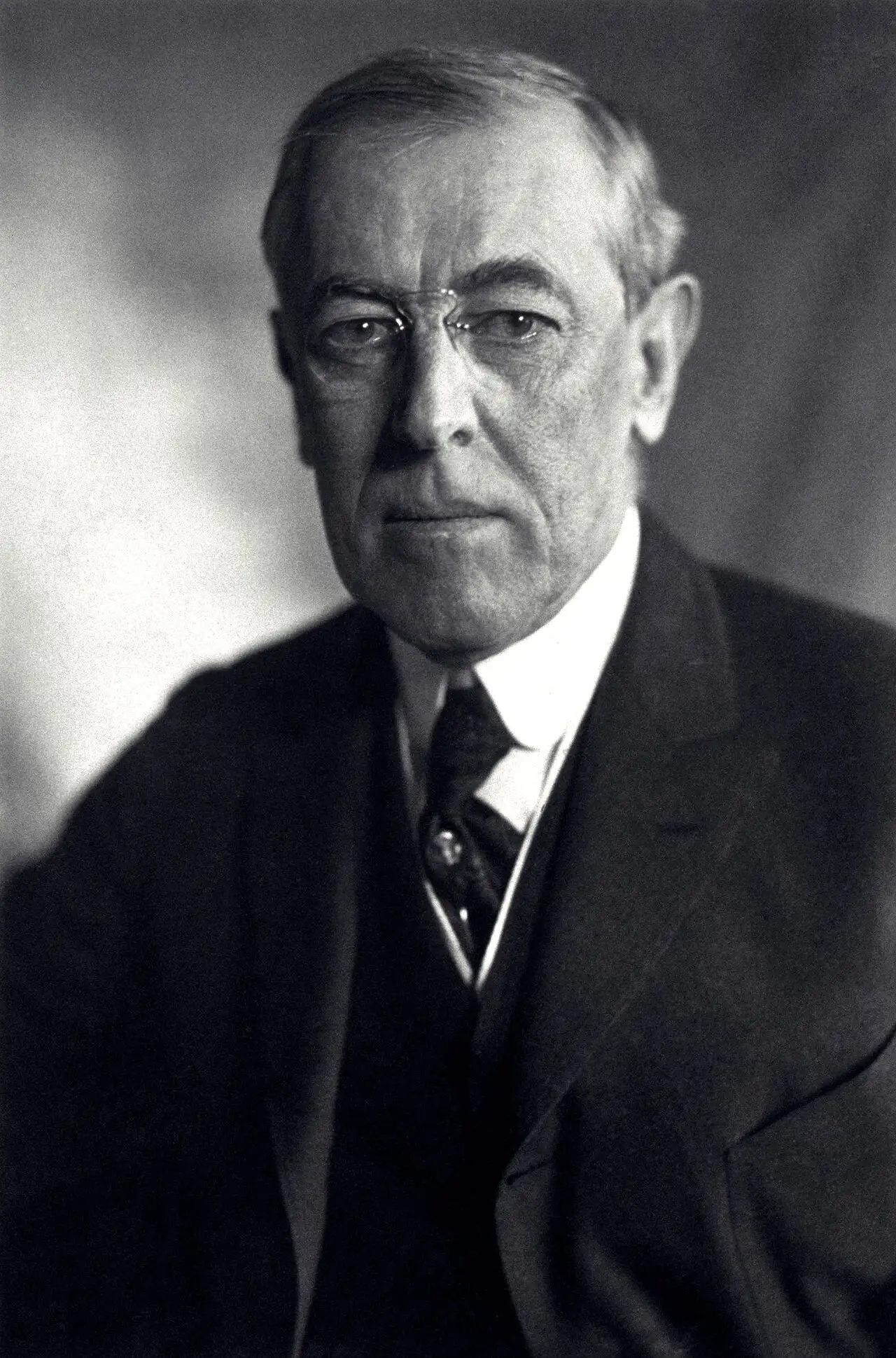
Photo: Woodrow Wilson in a 1919 portrait photograph by Harris & Ewing, taken the year after the Fourteen Points speech (public domain), via Wikimedia Commons.