
The Battle of New Orleans: Victory After the War Was Over
On January 8, 1815, Andrew Jackson's outnumbered Americans crushed a British assault outside New Orleans in about half an hour — unaware the War of 1812 had already ended two weeks earlier.
The war was already over. The ink on the peace treaty was two weeks dry. Nobody standing in the mud outside New Orleans knew it.
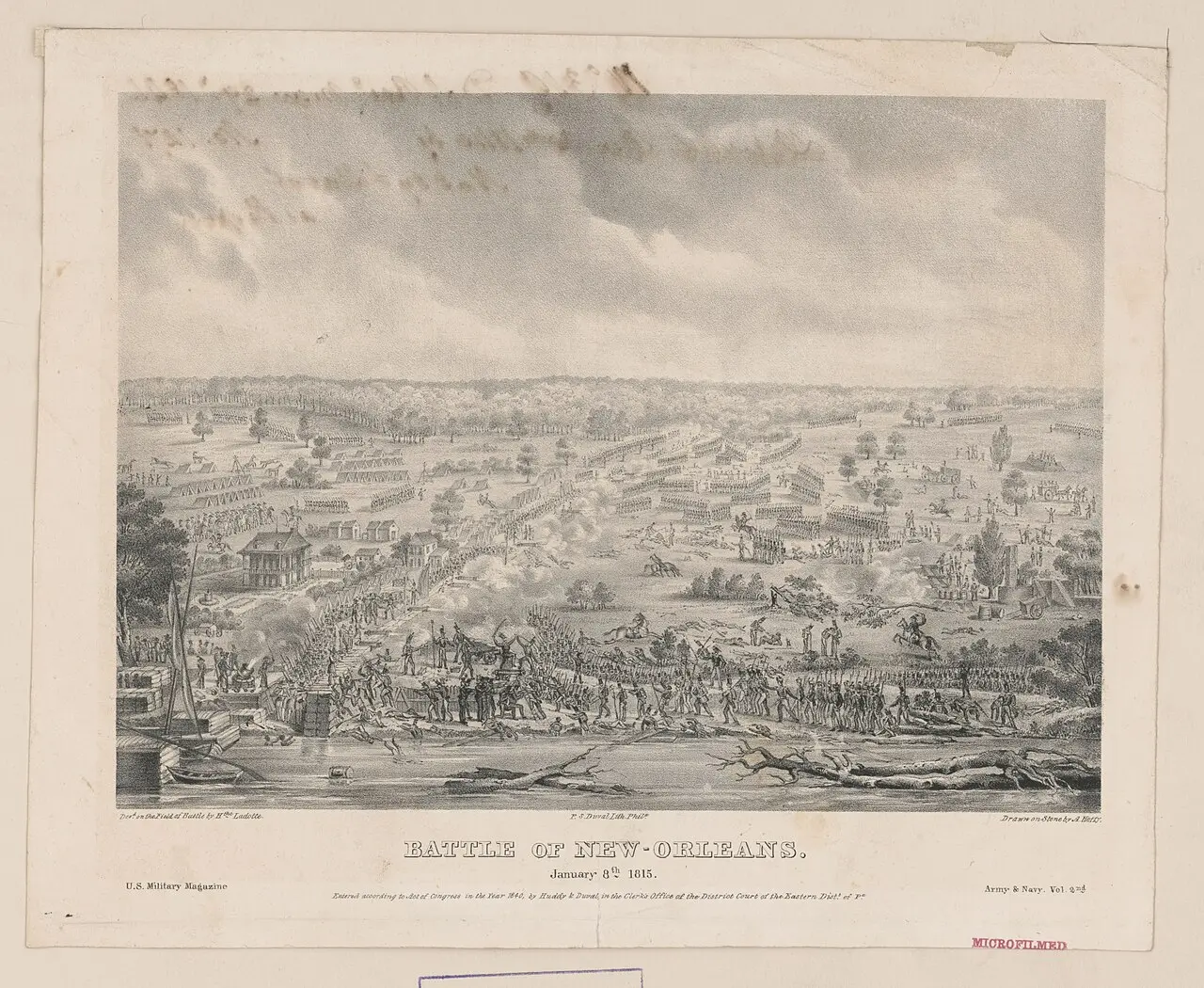
In the first light of January 8, 1815, some 7,500 British veterans of the Napoleonic Wars advanced across an open field at Chalmette, about five miles southeast of New Orleans. Their commander, Major General Sir Edward Pakenham, expected the Americans in front of him to break and run. Behind a long earthwork of mud and cotton bales along the Rodriguez Canal stood roughly 4,500 men under Brevet Major General Andrew Jackson — and they did not run.
Jackson's force was a patchwork army that could only have existed in America. A few hundred regular U.S. soldiers stood alongside Kentucky and Tennessee militiamen famous as marksmen, free Black volunteers, Choctaw warriors — and a company of pirates. The pirate Jean Lafitte, whose Baratarian smugglers Jackson had once called "hellish banditti," had warned the Americans of the British approach and thrown his men and artillery into the city's defense.
The battle was the climax of Britain's five-month Gulf Campaign, an attempt to seize New Orleans and with it control of the Mississippi and the Louisiana Territory. Weeks of skirmishes and artillery duels had led to this morning. Pakenham ordered a frontal assault in two columns, gambling that disciplined British regulars would sweep the earthworks aside. Instead, poor leadership, battlefield confusion, and the swampy ground turned the attack into a catastrophe. American riflemen and cannon fired from behind cover into packed redcoat ranks. In slightly more than half an hour, it was over. Pakenham was dead on the field, along with his second-in-command, Major General Samuel Gibbs. The British suffered more than 2,000 casualties — 291 killed, over 1,200 wounded, hundreds more missing or captured. Jackson's men lost 71.
And here is the twist that makes the battle legend: it changed nothing about the war, because the war had already ended. The Treaty of Ghent, formally ending the War of 1812, had been signed on December 24, 1814 — fifteen days earlier. News simply had not crossed the Atlantic in time, and the treaty would not even be ratified by the United States until February 16, 1815.
But the battle changed everything about how Americans felt. After a war full of setbacks, Jackson's lopsided victory unleashed a wave of national pride and made him a household hero — a fame that carried him to the presidency in 1828. It also marked the last armed engagement ever fought between the United States and Britain.
Today a federal battlefield park preserves the ground at Chalmette, where the earthworks' line is still visible. Visitors stand where Jackson's patchwork army stood, on a field where soldiers fought and died for a peace that had already been signed — and where a young nation first learned what victory felt like.
Image: an 1815 engraving of the battle by Jean-Hyacinthe de Laclotte, who sketched it on the field (Library of Congress, public domain), via Wikimedia Commons.