Uncle Sam Wants the King: Elvis Gets His Draft Notice
On December 20, 1957, rock-and-roll star Elvis Presley picked up his Army draft notice at Graceland, just as his career hit its peak.
The world's biggest rock star opened an envelope just before Christmas 1957 — and found Uncle Sam waiting inside.
On December 20, 1957, Elvis Presley picked up his draft notice in person. He was spending the holidays at Graceland, the Memphis mansion he had just bought, when word came that his induction notice was waiting. The Memphis Draft Board had announced a few days earlier that the call was coming, and the 22-year-old star drove over to collect it himself. Facing reporters that day, he said serving was 'a duty I've got to fill and I'm going to do it.'
The timing could hardly have been worse for the music business — or better for the legend. By the end of 1956, Elvis was a national phenomenon: a hit movie, Love Me Tender, and a string of gold records including 'Heartbreak Hotel,' 'Blue Suede Shoes,' 'Hound Dog,' and 'Don't Be Cruel.' Fans sent tens of thousands of letters to the Army begging for him to be spared. Movie producer Hal Wallis, who had $350,000 already invested in Elvis's next film, King Creole, pleaded for more time. The draft board granted one deferment — approved the day after Christmas — so Elvis could finish the picture.
Then the King did something nobody expected: he refused every shortcut. He turned down offers to join Special Services, where he could have sung for the troops and kept his career warm. Instead he entered as an ordinary private, sworn in at Memphis on March 24, 1958. He did basic training at Fort Hood, Texas, then shipped out to Friedberg, Germany, with the 3rd Armored Division, serving as a jeep driver. He donated his Army pay to charity and bought television sets for the men on his base. In Germany he met a teenager named Priscilla Beaulieu, who would one day become his wife.
He was honorably discharged as a sergeant on March 5, 1960 — and the career everyone feared was over came roaring back. His first single after the Army, 'Stuck on You,' was recorded that March and shot to number one on the Billboard Hot 100 by late April, spending four weeks at the top — proof the two years in uniform had only made him bigger. It all started, fittingly, with the film G.I. Blues. Two years in uniform had done what no publicist could: the pelvis-thrusting rebel came home a respected veteran, and the skeptics who had called his music a menace now called him a patriot.
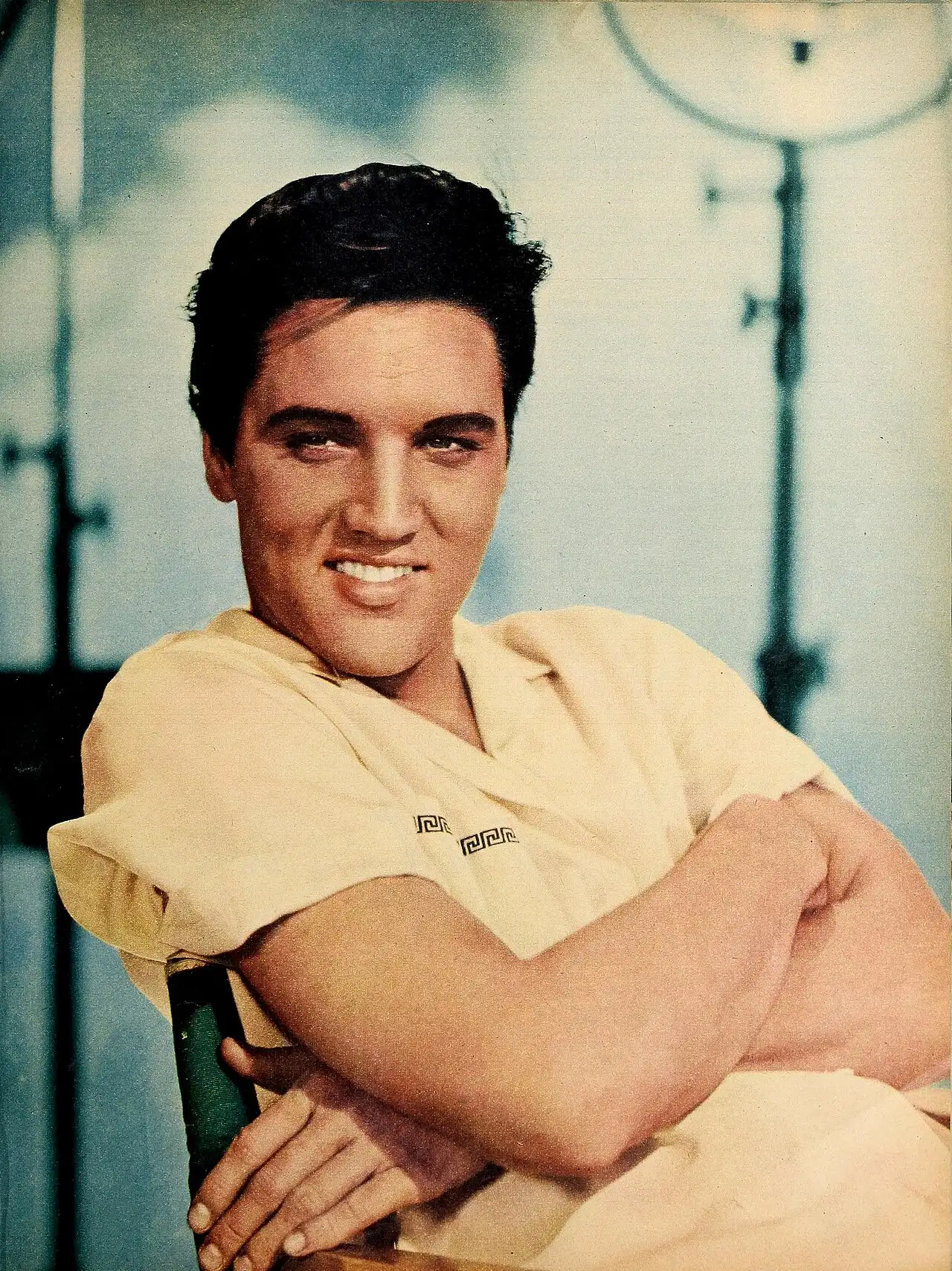
Photo: Modern Screen magazine, 1958, public domain (via Wikimedia Commons).