The Little Black Cube That Ate the World
On December 20, 1990, the first website went live at CERN on a NeXT computer — and the World Wide Web was born.
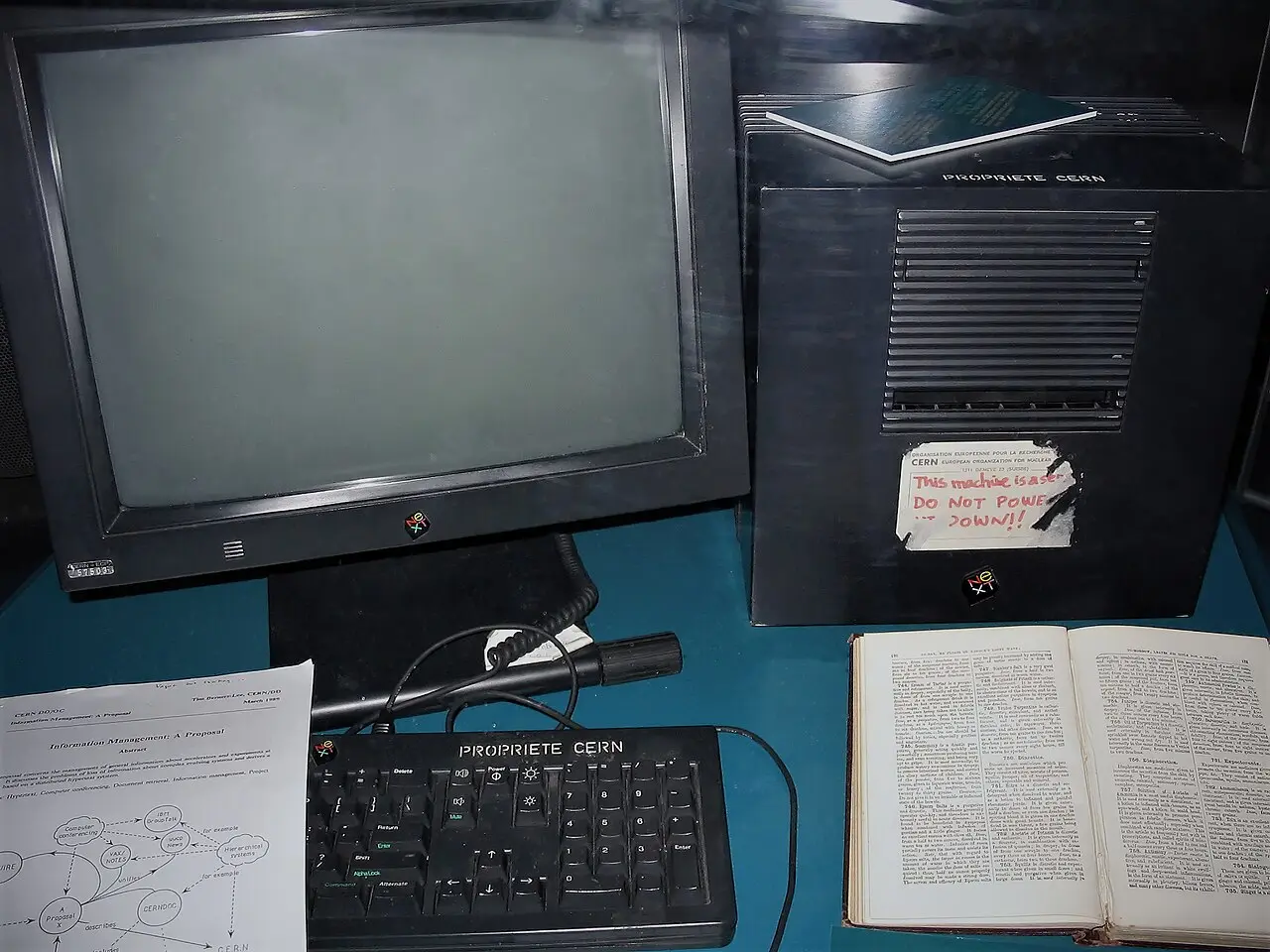
The most important invention of the modern age began as a side project — on a computer wearing a handwritten warning: 'This machine is a server. DO NOT POWER IT DOWN!'
On December 20, 1990, the first website in history went live. Its address was info.cern.ch, and it ran on a black cube-shaped NeXT computer — built by the company Steve Jobs founded after leaving Apple — sitting in the office of a British software engineer named Tim Berners-Lee at CERN, the particle-physics laboratory on the Franco-Swiss border near Geneva. The page was stark: black text, blue links, white background. It simply explained what the World Wide Web was, and how to use it.
Berners-Lee had been wrestling with a practical headache: CERN's thousands of scientists stored information on countless incompatible machines, and finding anything meant knowing exactly where to look. In March 1989 he submitted a proposal titled 'Information Management: A Proposal.' His supervisor, Mike Sendall, scribbled on the cover — 'Vague, but exciting' — and let him proceed. Working with colleague Robert Cailliau, Berners-Lee spent 1990 building the whole system from scratch: HTML for writing pages, HTTP for fetching them, URLs for addressing them, the first browser (called WorldWideWeb, which doubled as an editor), and the first web server software.
That first site was initially visible only inside CERN's own network. But Berners-Lee understood something his creation's future depended on: the web would only work if everyone could use it. He refused to patent it. In 1993, CERN released the web's underlying technology royalty-free, forever — one of the most consequential acts of generosity in business history. Berners-Lee went on to found the World Wide Web Consortium at MIT in 1994 to shepherd open standards, and in 2016 a panel of scientists, academics, and world leaders ranked the invention of the web the number-one cultural moment of the modern era.
Every page you have ever opened descends from that one stark page on a black cube in Switzerland. The page lived at the address info.cern.ch/hypertext/WWW/TheProject.html — and CERN later restored a surviving 1992 copy of that first page at its original address, a museum piece of the digital age. In 1992 there were just ten websites in the world; two years later there were three thousand. And it is still there: info.cern.ch remains online today, a quiet monument to the day the world got wired.
Photo: Coolcaesar, CC BY-SA 3.0 (via Wikimedia Commons).