Typhoid Mary and the Island She Never Left
On March 27, 1915, Mary Mallon was quarantined for the second time on New York's North Brother Island — where she would live out her final 23 years.
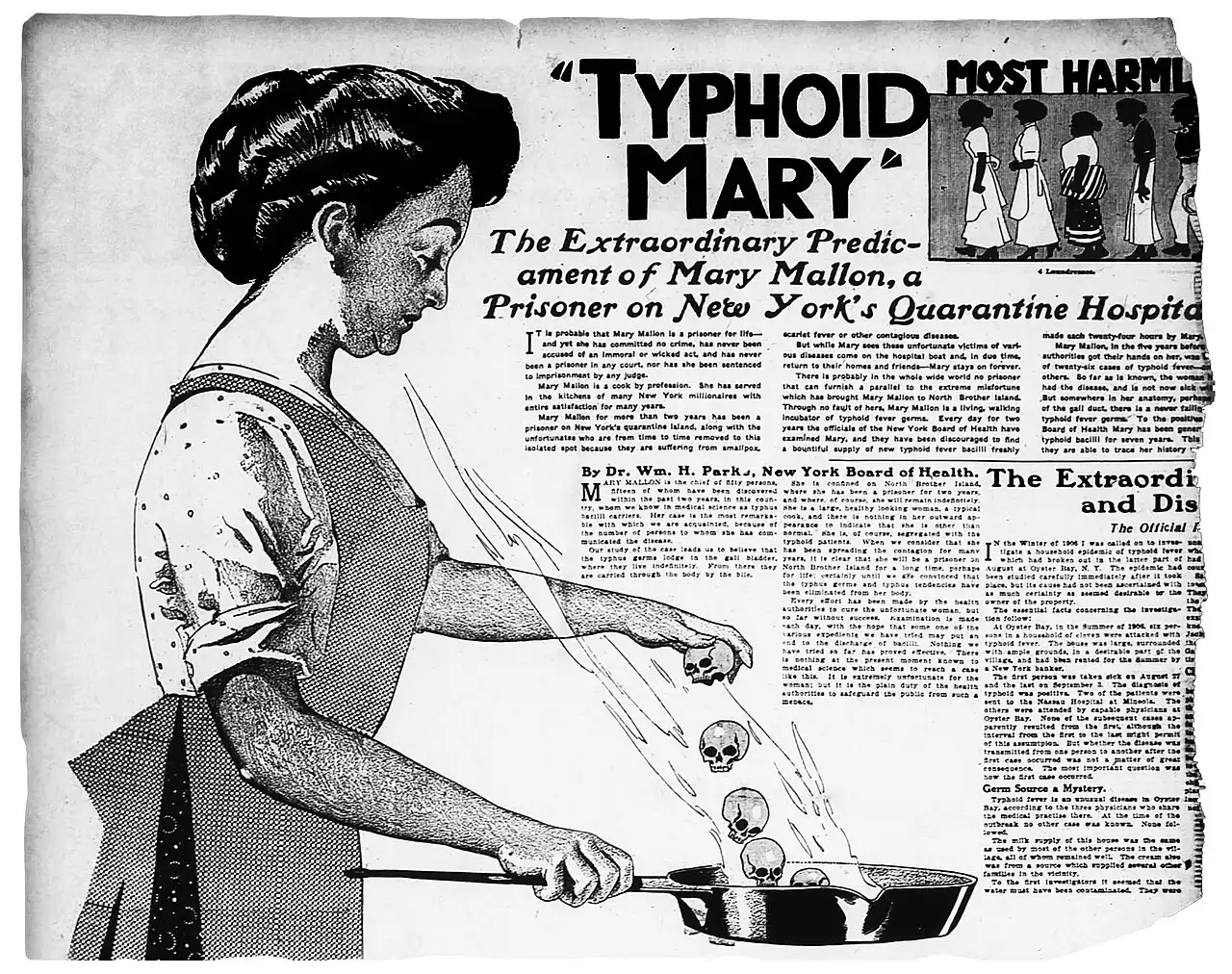
In March 1915, a maternity hospital in Manhattan had a terrifying problem. Twenty-five people at the Sloane Hospital for Women had come down with typhoid fever, and two were dead. The investigators traced the outbreak to the kitchen — and to a cook who called herself "Mrs. Brown."
"Mrs. Brown" was Mary Mallon, and the health authorities knew her all too well.
Mallon worked as a cook for wealthy New York families. She was also, though she never felt sick a day in her life, a carrier of typhoid fever — the first healthy carrier ever identified in the United States. Wherever she cooked, people fell ill: she was eventually linked to more than fifty infections and at least three deaths, and the true toll was probably higher.
Her first encounter with the authorities had come eight years earlier. In 1907, after typhoid kept striking the households where Mallon cooked, health investigators tracked her down and had her tested. The results were positive. Mallon — who believed, sincerely, that she was being persecuted — refused to cooperate. The city took her into custody and quarantined her on North Brother Island in the East River. She stayed there for three years.
In 1910, the city released her on one condition: she must never work as a cook again. Mallon agreed. And then, within a few years, she went back to cooking — under false names, in kitchens across the city. She may have believed the whole thing was a mistake; she may simply have needed the wages a cook could earn. Either way, the trail of fever followed her, straight to the Sloane Hospital.
This time there would be no second chance. On March 27, 1915, Mary Mallon was taken back to North Brother Island. This time the quarantine was permanent. She would live there for the next 23 years, until her death.
It is easy to cast Mallon as a villain, and the newspapers of her day did exactly that, branding her "Typhoid Mary" — a nickname that turned a woman into a warning. But the fuller story is harder and more human. Mallon was the first person in America to be identified as a healthy carrier of disease, at a time when the science of carriers was brand new and poorly understood. She never believed she was sick, because she never felt sick. On the island, she eventually trained as a laboratory technician and worked in the hospital lab — the same science that had condemned her, now her daily work.
She died of pneumonia on November 11, 1938, at the age of 69. An autopsy found live typhoid bacteria still thriving in her gallbladder — proof, if any were needed, that the diagnosis had been right all along.
Mary Mallon's story is really two stories at once. It is the story of a woman who, knowingly or not, spread a deadly disease and refused to stop. And it is the story of a public-health system that, faced with a problem it had never seen, chose to lock one woman away for life rather than find another answer. Both stories are true. That is why, more than a century later, we are still arguing about Typhoid Mary — and why her name is still shorthand for the hardest question in public health: what do you do with a person whose freedom endangers everyone else?
Photo: 1909 newspaper illustration of Mary Mallon, public domain.