
Twelve Nations, One Promise: NATO Is Born
On April 4, 1949, twelve nations signed the North Atlantic Treaty in Washington, pledging that an attack on one would be treated as an attack on all.
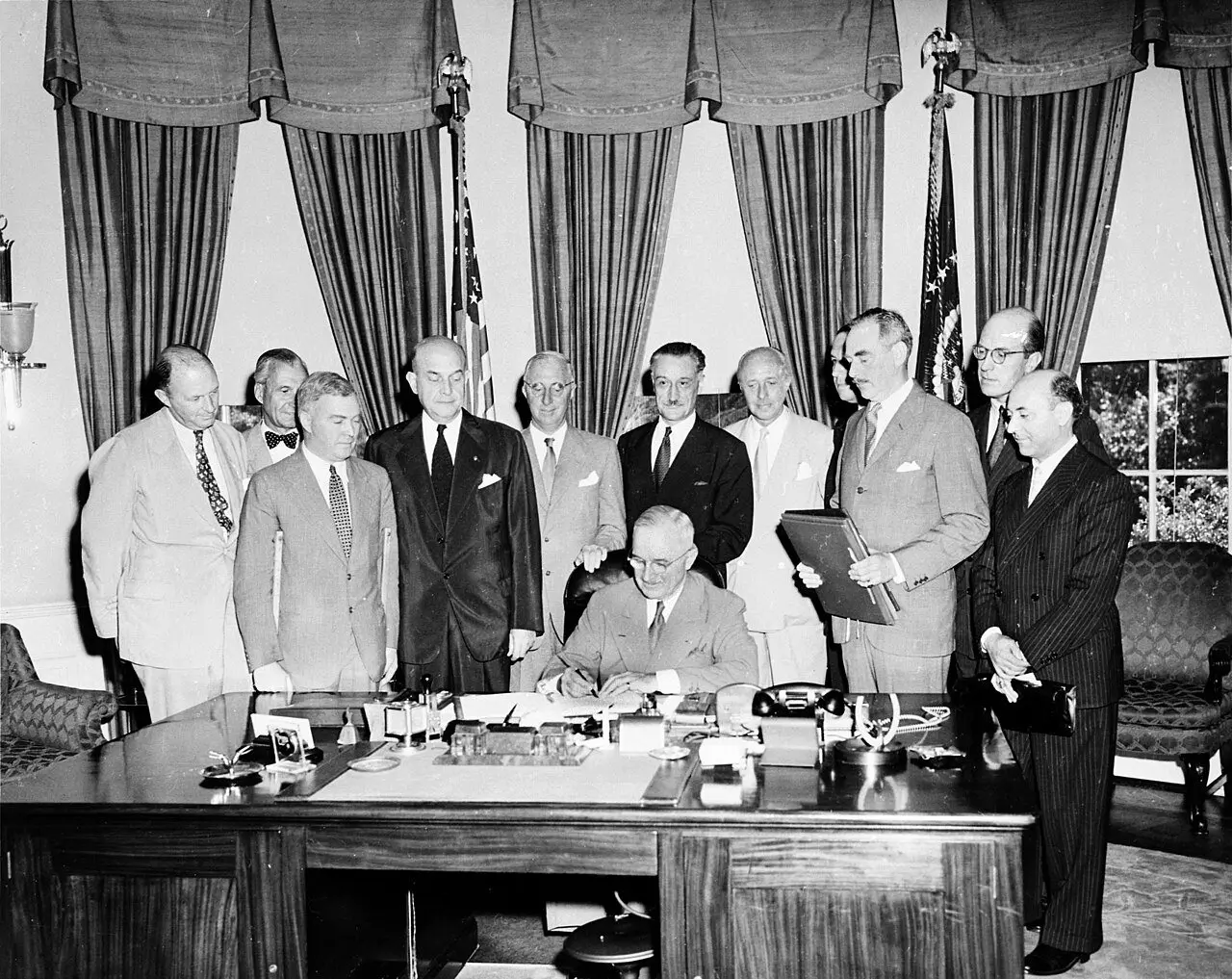
Four years after World War II ended, peace felt fragile. The Soviet Union was tightening its grip on Eastern Europe and blockading West Berlin. America's leaders concluded that the oceans no longer protected anyone — and did something the United States had never done in peacetime.
On April 4, 1949, the foreign ministers of twelve nations gathered in an auditorium in Washington, D.C., to sign the North Atlantic Treaty. Secretary of State Dean Acheson signed for the United States, with President Harry Truman standing beside him. The twelve founding nations were Belgium, Canada, Denmark, France, Iceland, Italy, Luxembourg, the Netherlands, Norway, Portugal, the United Kingdom, and the United States.
The road to that auditorium had been short and frightening. In 1948, communists seized power in Czechoslovakia and the Soviets blockaded West Berlin, trying to starve the Allies out of the city. Western Europe's leaders, still digging out from the rubble of World War II, concluded they could not face Moscow alone. Britain and France had already signed the Brussels Treaty in 1948; now they wanted America in the pact for good.
Truman told the gathering the pact would 'create a shield against aggression and the fear of aggression — a bulwark which will permit us to get on with the real business of government and society.' For the first time since the 1700s, America formally tied its security to Europe's.
The men who signed were the foreign-policy heavyweights of the West: Britain's Ernest Bevin, France's Robert Schuman, Canada's Lester Pearson — and for the United States, Acheson, who had spent a year steering the treaty through skeptical senators. NATO's first secretary general, Lord Ismay, later summed up its purpose bluntly: 'to keep the Russians out, the Americans in, and the Germans down.'
The heart of the treaty is Article 5: an armed attack against one member 'shall be considered an attack against them all.' Each nation promised to help restore security, by force if necessary. The U.S. Senate ratified the treaty 82 to 13 on July 21, 1949, and it took effect on August 24.
The alliance kept growing: Greece and Turkey joined in 1952, West Germany in 1955, Spain in 1982 — and after the Cold War ended, it kept expanding eastward.
Why it matters: NATO became the backbone of the West through the entire Cold War — the Soviet Union answered with its own Warsaw Pact in 1955 — and it endures today with 32 members. In more than 75 years, Article 5 has been invoked only once: after the terrorist attacks of September 11, 2001, when America's allies came to America's defense.
Photo: Abbie Rowe / U.S. National Archives, public domain (via Wikimedia Commons).