The Dreamer Falls: Martin Luther King Jr. Is Assassinated
On April 4, 1968, Dr. Martin Luther King Jr. was shot and killed on the balcony of the Lorraine Motel in Memphis, where he had come to support striking sanitation workers.
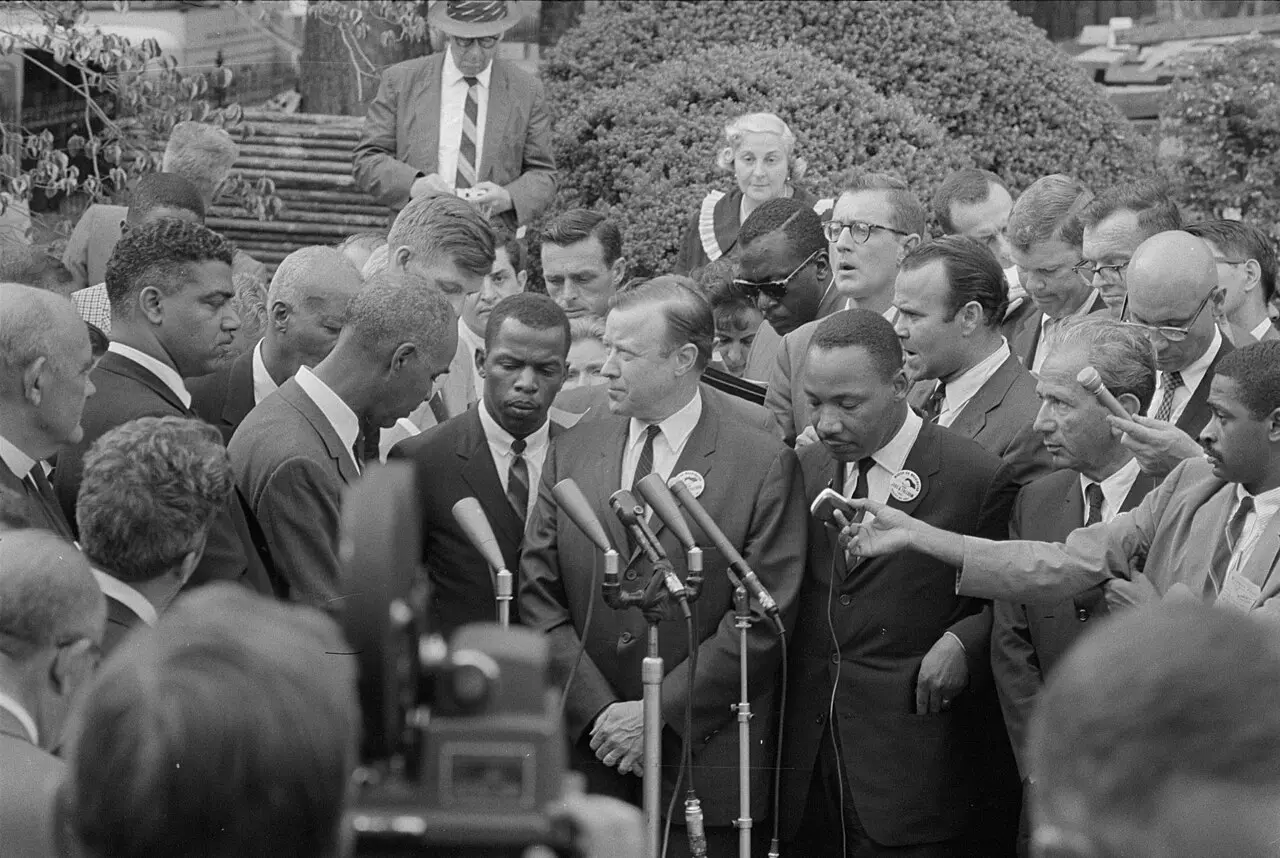
The night before he died, Martin Luther King Jr. stood in a packed Memphis church and seemed to look past his own future. "I've been to the mountaintop," he told the crowd at Mason Temple on April 3, 1968. "I may not get there with you." Less than twenty-four hours later, he was gone.
King had come to Memphis to stand with the city's Black sanitation workers, who were striking over unequal pay and degrading working conditions. A march he led there in March had turned violent, and he had returned determined to lead a peaceful one — part of the Poor People's Campaign against poverty he was building toward that spring.
On April 4, 1968, at 6:01 p.m., King stepped onto the second-floor balcony outside Room 306 of the Lorraine Motel. A single rifle shot cracked through the evening air. He was rushed to St. Joseph's Hospital, where doctors fought to save him, but he was pronounced dead at 7:05 p.m. He was 39 years old.
The news detonated across America. Grief and fury spilled into the streets of more than a hundred cities. President Lyndon B. Johnson called for calm and declared April 7 a national day of mourning. On April 9, tens of thousands of mourners followed King's casket through the streets of Atlanta. Two days later, Johnson signed the Civil Rights Act of 1968 — the Fair Housing Act — into law. With King's name long tied to the open-housing cause, it was widely seen as a tribute to him.
After a two-month international manhunt, police arrested James Earl Ray, an escaped convict from the Missouri State Penitentiary, at London's Heathrow Airport on June 8, 1968. Extradited to the United States, Ray pleaded guilty on March 10, 1969 and was sentenced to 99 years in prison. He later tried to withdraw his plea, and questions about the case lingered for decades.
In thirteen years King had become the conscience of the movement: the Montgomery bus boycott of 1955, the March on Washington in 1963 and its "I Have a Dream" speech, the Nobel Peace Prize in 1964, the campaigns that helped force the Civil Rights Act of 1964 and the Voting Rights Act of 1965. All of it rested on nonviolence — the discipline that violence could wound but never defeat.
Why it matters: the movement marched on without him, and in 1986 his birthday became a federal holiday. But April 4, 1968 remains the day America lost its most eloquent voice for justice — the day the dream had to learn to walk without the dreamer.
Photo: Library of Congress, public domain (via Wikimedia Commons).