Thirteen Stripes, Forever: The Flag Act of 1818
On April 4, 1818, President James Monroe signed the Flag Act of 1818, fixing the American flag at thirteen stripes and adding one star for each state.
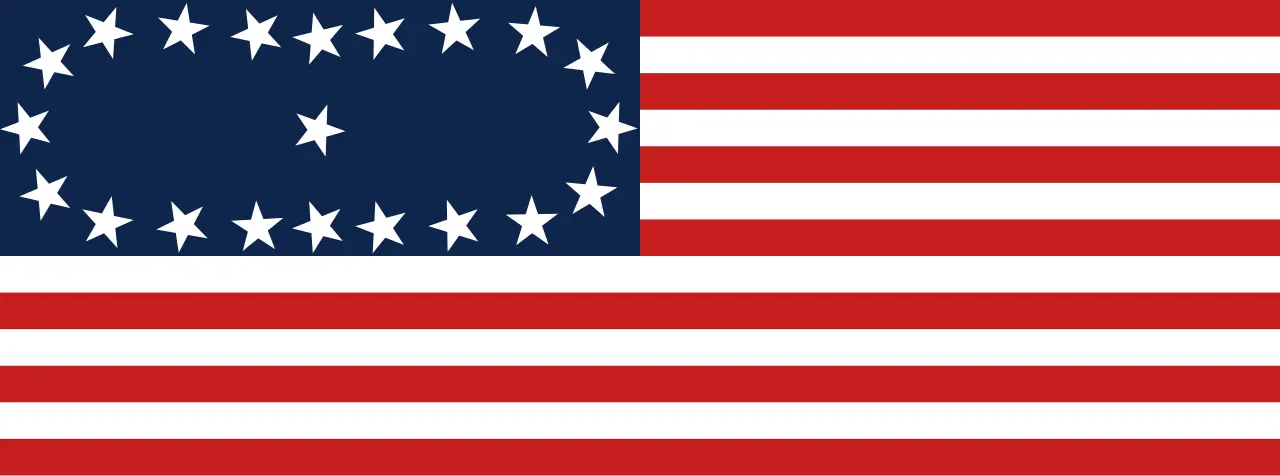
By 1818, the American flag had a growth problem. Every time a new state joined the Union, Congress added a star and a stripe — and the stripes were piling up fast.
The first flag law, passed in 1777, had set thirteen stars and thirteen stripes. When Vermont and Kentucky joined, a 1794 law made it fifteen of each — the "star-spangled banner" Francis Scott Key saw flying over Fort McHenry in 1814 — fifteen stars and fifteen stripes that survived the British bombardment of Baltimore and inspired the national anthem. Then came Tennessee, Ohio, Louisiana, Indiana, and Mississippi, and Congress never updated the law at all. There was no official sixteen-, seventeen-, eighteen-, or nineteen-star flag; flagmakers simply improvised, and the banner kept growing more crowded. Had the pattern continued, today's fifty-state flag would carry fifty stripes — a barber pole, not a banner.
On April 4, 1818, President James Monroe signed the fix. The Flag Act of 1818, passed by the 15th Congress after Representative Peter H. Wendover introduced it, declared that from that July 4 onward, the flag would carry thirteen horizontal stripes — honoring the original colonies — and twenty stars, one for each state then in the Union. From then on, every new state would add exactly one star, taking effect on the July 4 following its admission.
The law said nothing about how the stars should be arranged. Monroe himself directed that the twenty stars be set in four rows of five — but his instruction was widely ignored, and variety flourished: twenty-star flags appeared in circles, rows, diamonds, and scattered patterns, each maker's own folk art. It took nearly a century for Washington to standardize the look. President William Howard Taft's executive order of 1912 fixed the flag's proportions and set the stars in orderly rows; later orders arranged the forty-nine- and fifty-star fields. The fiftieth star, for Hawaii, was added on July 4, 1960.
Why it matters: more than two centuries later, the rule Monroe signed still governs the flag — thirteen stripes, one star per state, new stars every July 4. Every state admitted since has taken its place in the blue field on Independence Day. It is one of the longest-running design decisions in American history: a flag built to grow — thirteen stripes for the colonies that started it, and a star for every state that has joined since — with room to spare.
Illustration: Mrmw, CC BY-SA 4.0 (via Wikimedia Commons).