Tragedy at Wounded Knee Creek
On December 29, 1890, U.S. soldiers opened fire on a Lakota camp at Wounded Knee Creek, South Dakota, killing as many as 300 men, women, and children.
The morning of December 29, 1890, dawned bitter cold over Wounded Knee Creek in South Dakota. By noon, the snow was red. What happened there remains one of the darkest days in American history.
The Ghost Dance — a spiritual movement promising the restoration of the Lakota world — had swept through the reservations that year. Alarmed settlers and Indian agents called it rebellion. Two weeks earlier, on December 15, reservation police had killed the great Hunkpapa leader Sitting Bull while trying to arrest him, and fear crackled across the northern Plains.
Chief Spotted Elk, known as Big Foot, lay dying of pneumonia as he led his band of Miniconjou Lakota toward the Pine Ridge Reservation, seeking safety in numbers. On December 28, soldiers of the U.S. 7th Cavalry under Major Samuel Whitside intercepted the band and escorted them to a camp at Wounded Knee Creek. Colonel James Forsyth arrived with the rest of the regiment — some 500 troops — and ringed the camp with rifles and four rapid-fire Hotchkiss guns.
On the morning of the 29th, the soldiers began disarming the Lakota men. A deaf man named Black Coyote did not understand the order and resisted giving up his rifle; in the struggle, a shot rang out. No one knows who fired first. The soldiers opened fire on the camp.
When it ended, between 250 and 300 Lakota — men, women, and children — were dead, many of them chased down as they fled across the prairie. Twenty-five soldiers also died, many likely struck by their own side's fire in the chaos. The Army awarded 20 Medals of Honor for Wounded Knee — more than for any other single action in its history — a decision Congress has since moved to revisit.
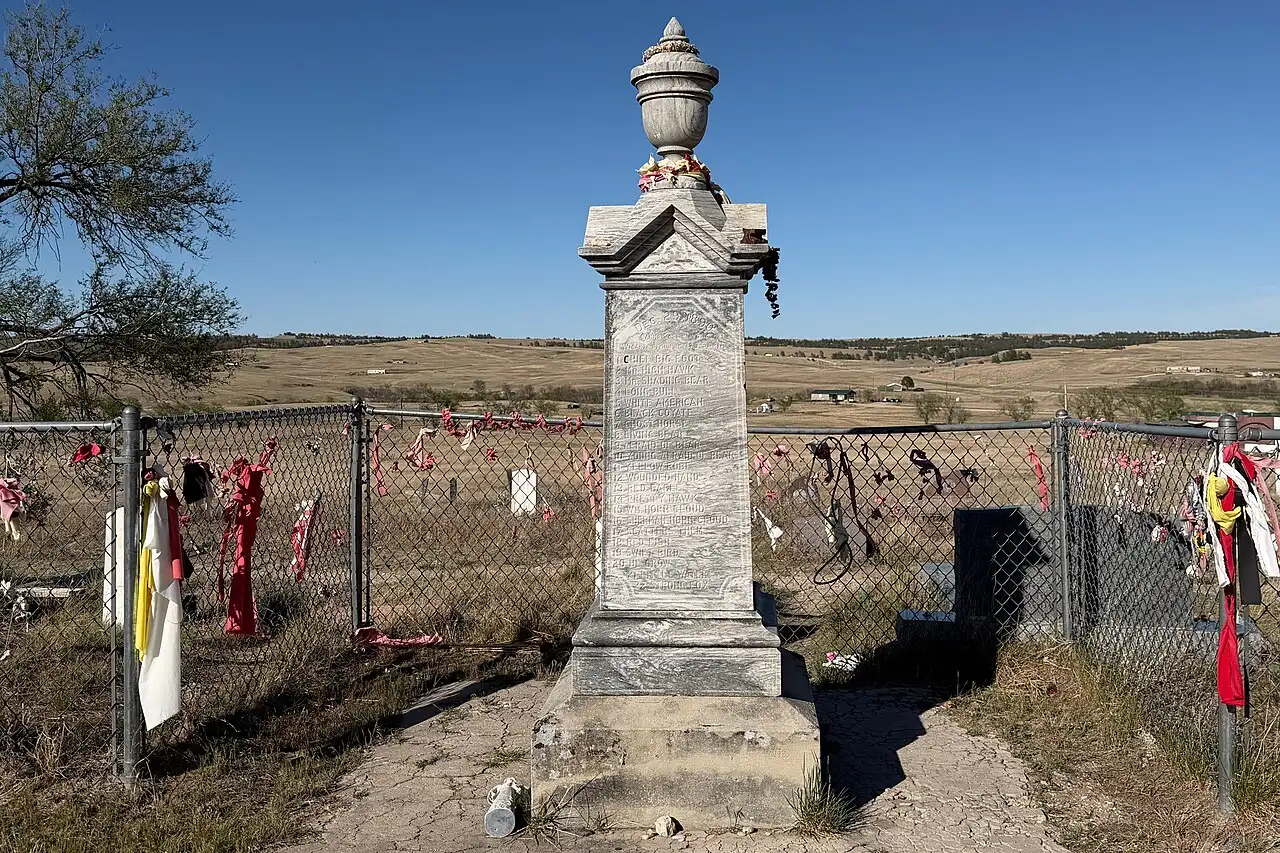
A century later, in 1990, Congress formally expressed deep regret for the massacre. The site is now a National Historic Landmark, and its monument bears the names of the Lakota who died there.
A blizzard swept in that night, and the dead lay frozen on the prairie until a burial party arrived days later. Among them was Spotted Elk himself. The mass grave they dug is marked today by the monument that still draws visitors — Lakota and non-Lakota alike — to pay their respects. In 1973, the site became a rallying point again during the 71-day American Indian Movement occupation, proof that Wounded Knee was never just history.
Wounded Knee ended both the Ghost Dance and the Indian Wars. It stands as a permanent reminder of what happens when fear governs policy — and of the resilience of the Lakota people, who remember their dead and refuse to let the world forget.
Photo: The Wounded Knee monument by SharonPapierdreams, CC BY-SA 4.0 (via Wikimedia Commons).