The Tree That Built Wall Street: The Buttonwood Agreement
On May 17, 1792, twenty-four brokers signed the Buttonwood Agreement on Wall Street, a one-page pact that became the founding document of the New York Stock Exchange.
The institution that now moves trillions of dollars began with two dozen men and a tree — or so the legend goes. On May 17, 1792, twenty-four brokers signed a short agreement on Wall Street that became the founding document of the New York Stock Exchange.
The agreement was born of chaos. Earlier that year, the young nation's first financial crisis — the Panic of 1792 — had convulsed New York. Reckless speculators, emboldened by easy credit from the new Bank of the United States, tried to corner the bond market; when their scheme collapsed, banks faced runs and securities prices tumbled. Treasury Secretary Alexander Hamilton contained the panic by May, pumping cash and credit into the city's banks, but the scare convinced New York's merchants that securities trading needed rules and trust.
In March 1792, twenty-four of the city's leading brokers and merchants began meeting secretly at Corre's Hotel to discuss a better system. Two months later, on May 17, they signed the result — a document of fewer than a hundred words, known to history as the Buttonwood Agreement. It had just two provisions: the signers would charge clients no less than a quarter-percent commission on every trade, and they would "give preference to each other in our Negotiations." In other words: they would deal only with one another, cut out the auctioneers who had been middlemen, and hold a common line on price.
The agreement takes its name from the brokers' traditional meeting place: a buttonwood tree — the old name for the American sycamore — that stood at 68 Wall Street. Legend has it the signing itself happened beneath its branches, though historians note the tree gave the document its name more than its setting. The earliest securities traded under the new rules were Revolutionary War bonds and stock in the First Bank of the United States and the Bank of New York — the whole American investment market, on one sheet of paper.
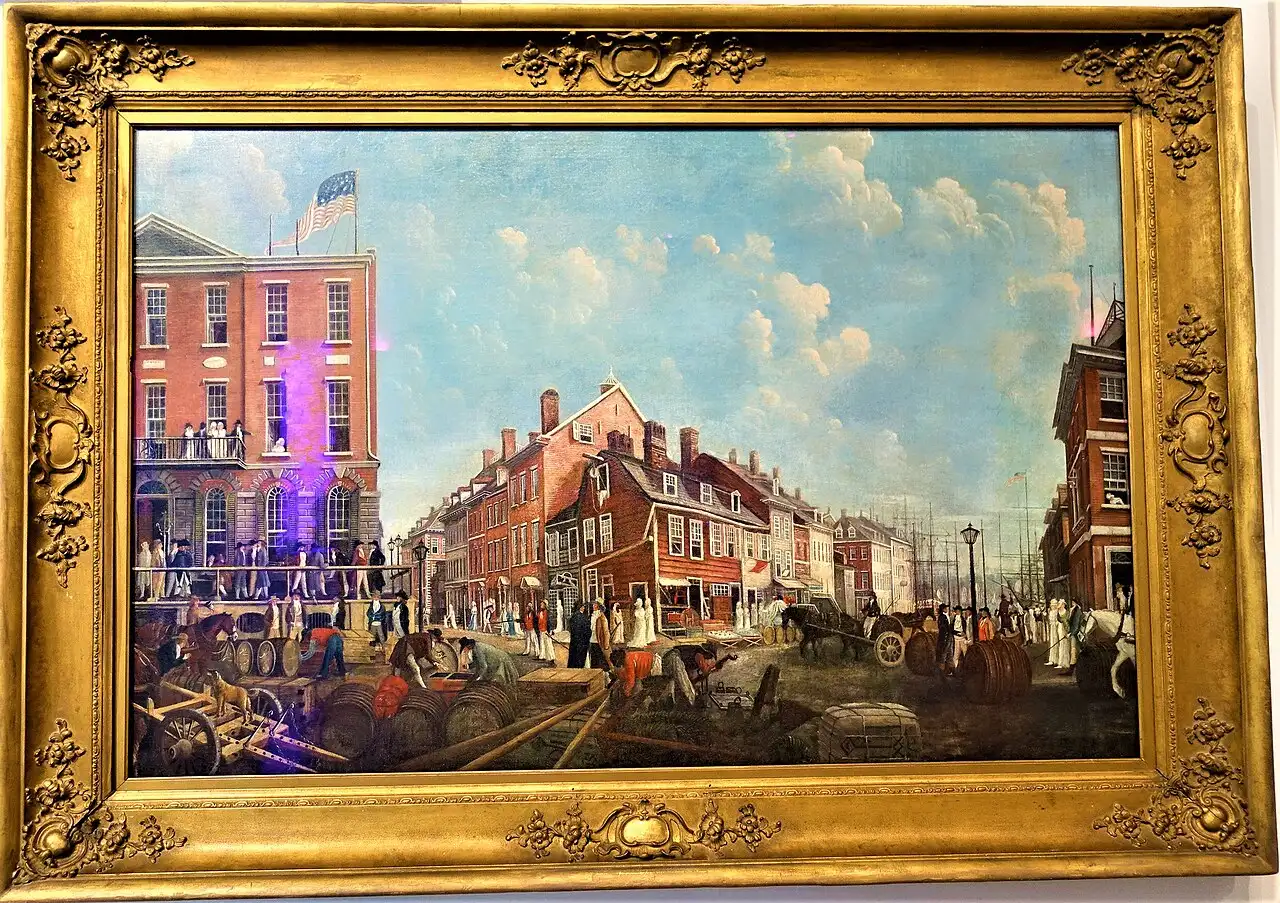
From there the brokers moved their dealings indoors, to the Merchant's Coffee House and then the Tontine Coffee House at Wall and Water streets, where they met for years. In 1817 they reorganized as the New York Stock & Exchange Board, adopting formal rules and rented rooms devoted to trading; in 1863 the name was shortened to the New York Stock Exchange. The buttonwood tree itself, oddly enough, outlived its fame for decades — a storm toppled it on June 14, 1865, more than seventy years after the signing.
Every great market rests on an agreement that strangers will keep their word. On a spring day in 1792, twenty-four men wrote that agreement down, and the tree-shaded bargain they struck became the financial heart of a nation.
Photo: Joyofmuseums (photograph of the 1797 Francis Guy painting), CC BY-SA 4.0 (via Wikimedia Commons).