The Treaty That Ended a War Halfway Around the World
On September 5, 1905, Japan and Russia signed the Treaty of Portsmouth at a U.S. navy yard in New Hampshire, ending a brutal war — and earning President Theodore Roosevelt the Nobel Peace Prize.
For eighteen months, two empires had been tearing each other apart across Manchuria, Korea, and the seas between them. Then, in the summer of 1905, both sides sent delegations to a quiet navy yard in New England.
The Russo-Japanese War had begun in February 1904 — a clash between the Russian Empire and Imperial Japan over influence in Korea and Manchuria. Japan won stunning victories on land and sea, but by 1905 the war was bleeding both countries dry: Russia was convulsed by revolution at home, and Japan was drowning in war debt.
President Theodore Roosevelt offered to mediate, and in June 1905 he asked both nations to name their negotiators. In August, the delegations gathered at the Portsmouth Naval Shipyard in Kittery, Maine — then considered part of Portsmouth, New Hampshire. Japan sent Foreign Minister Komura Jutarō and former ambassador Takahira Kogorō; Russia sent former finance minister Sergei Witte and former ambassador Roman Rosen. Twelve negotiating sessions stretched from August 9 to August 30, with the hardest fights over the ports of Manchuria and Korea, the island of Sakhalin, and who would pay for the war.
On September 5, 1905, the Treaty of Portsmouth was signed. Under its terms, Russia recognized Japan's paramount interest in Korea; ceded its lease on the Liaodong Peninsula — including the ports of Dalian and Port Arthur — to Japan; handed over the Russian-built South Manchuria Railway; and gave Japan the southern half of Sakhalin Island. Manchuria itself was returned to Chinese rule.
The treaty made headlines around the world, and for bringing the two sides together, Roosevelt was awarded the Nobel Peace Prize — the first American ever to receive it. Travel being what it was, he never collected the medal in person; his envoy accepted it for him in Norway on December 10, 1906.
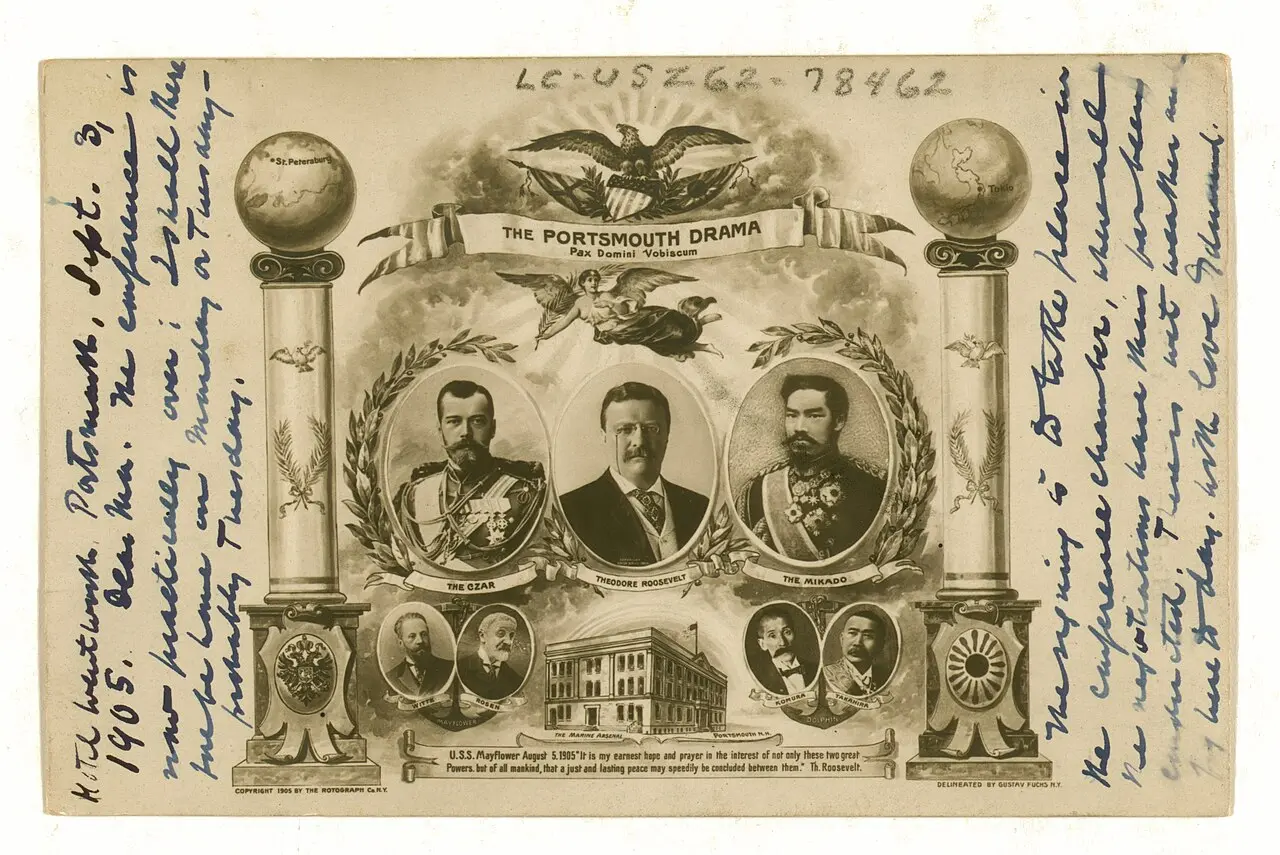
The celebrations were printed up on postcards. One of them — "The Portsmouth Drama" — shows the czar, the mikado, and Roosevelt himself in the center, and quotes his message to the delegations: "It is my earnest hope and prayer in the interest of not only these two great Powers, but of all mankind, that a just and lasting peace may speedily be concluded between them." The conference table where the delegates hammered out that peace survives today, preserved at the Museum Meiji-mura in Japan — a piece of furniture that ended a war.
Why it matters: Portsmouth was the first time in the modern era that an Asian power had defeated a European empire in war — and it announced Japan's arrival as a great power. It also made the United States, through Roosevelt, a peacemaker on the world stage: a role America would play again and again across the century that followed.
Photo: Library of Congress, public domain, via Wikimedia Commons.