The Little Spacecraft That Wouldn't Stop
On September 5, 1977, NASA launched Voyager 1 — a probe built for five years that became the most distant human-made object in history.
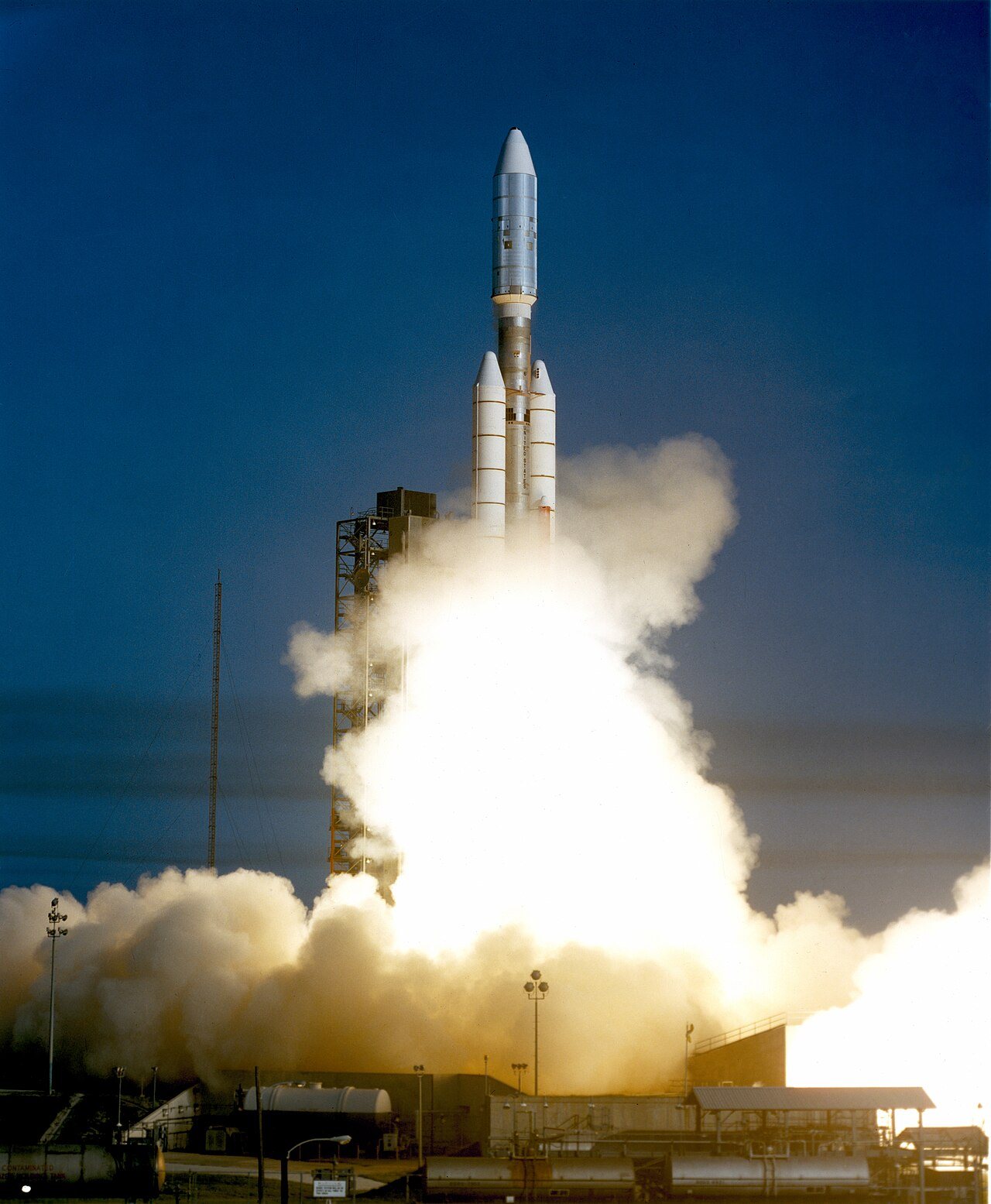
Voyager 1 was built to last five years. It has been flying for nearly fifty — and it is still calling home.
On September 5, 1977, the probe lifted off from Cape Canaveral, Florida, atop a Titan-Centaur rocket. Its twin, Voyager 2, had launched sixteen days earlier, but Voyager 1 rode a faster, shorter trajectory — and soon passed its sibling on the way out.
The launch nearly ended in disaster. A fuel-mixture error in the rocket's upper stage forced the Centaur to burn far more fuel than planned just to reach orbit. When Voyager 1 was finally on its way, engineers calculated that the rocket had just three and a half seconds of propellant to spare. The greatest voyage in history almost never left the launch pad.
Both Voyagers were chasing a cosmic coincidence: a rare lineup of the outer planets, which comes around only about every 175 years. By swinging past one planet after another — borrowing a little of each planet's gravity to fling itself onward — a spacecraft could tour the outer solar system on a thimbleful of fuel. NASA called it the Grand Tour.
Voyager 1 made the most of it. It swept past Jupiter in March 1979 and discovered active volcanoes erupting on the moon Io — the first volcanoes ever found beyond Earth. It reached Saturn in November 1980, studying the planet's rings and the thick, hazy atmosphere of its giant moon Titan.
Then it kept going — and going. Bolted to its side is the Golden Record, a gold-plated disc carrying the sounds of Earth: greetings in 55 languages, music from Bach to Chuck Berry, the sound of rain and laughter and a mother's kiss. It is a message in a bottle, cast into the cosmic ocean.
On August 25, 2012, Voyager 1 crossed the boundary of the sun's influence and entered interstellar space — the first human-made object ever to do so. Today it is nearly 16 billion miles from home, racing outward at some 38,000 miles an hour, and its faint radio signal takes almost a full day to reach Earth. Engineers who were not yet born when it launched now keep it alive.
Why it matters: Voyager 1 is the farthest thing humanity has ever sent anywhere — our first, tiny step into the space between the stars. Long after its cameras go dark, it will drift on, carrying its golden record of a small blue planet and the creatures who dared to say hello.
Photo: NASA, public domain (via Wikimedia Commons).