The Death of Crazy Horse at Fort Robinson
On September 5, 1877, the Oglala Lakota leader Crazy Horse — the warrior who helped defeat Custer at Little Bighorn — was bayoneted to death at Fort Robinson, Nebraska, four months after surrendering.
He was one of the most famous warriors in American history — and no one knows what he looked like.
Crazy Horse — Tȟašúŋke Witkó, "His Horse Is Crazy" — was a leader of the Oglala Lakota, born around 1840 near Rapid Creek in the Black Hills. He took up arms against the United States to defend Lakota land and a way of life, and his record in battle was extraordinary: he rode as a decoy in the Fetterman Fight of 1866, turned back General George Crook at the Battle of the Rosebud in 1876, and helped lead the Lakota and Cheyenne warriors who defeated Lieutenant Colonel George Armstrong Custer's Seventh Cavalry at the Battle of the Little Bighorn in June 1876.
But the victory at the Little Bighorn brought the full weight of the U.S. Army down on the Lakota. Troops hunted Crazy Horse's band relentlessly through the bitter winter of 1876–77. Cold, hungry, and abandoned by many of his followers, he rode into Fort Robinson, Nebraska, on May 6, 1877, and surrendered.
Four months later, he was dead. In September 1877, army officials decided to arrest him — suspicious that he was preparing to leave the reservation — and while being forced toward the camp guardhouse, he resisted. In the struggle, a soldier's bayonet fatally wounded him. He died that night, with his father at his side. Historians still debate exactly what happened in those final moments; even the identity of the soldier remains uncertain.
Crazy Horse had refused to be photographed, and he never signed a single document. The only widely published likeness of him is a 1934 sketch, drawn by a missionary working from his sister's description. His family carried his body away and buried it in secret, and the resting place has never been made public.
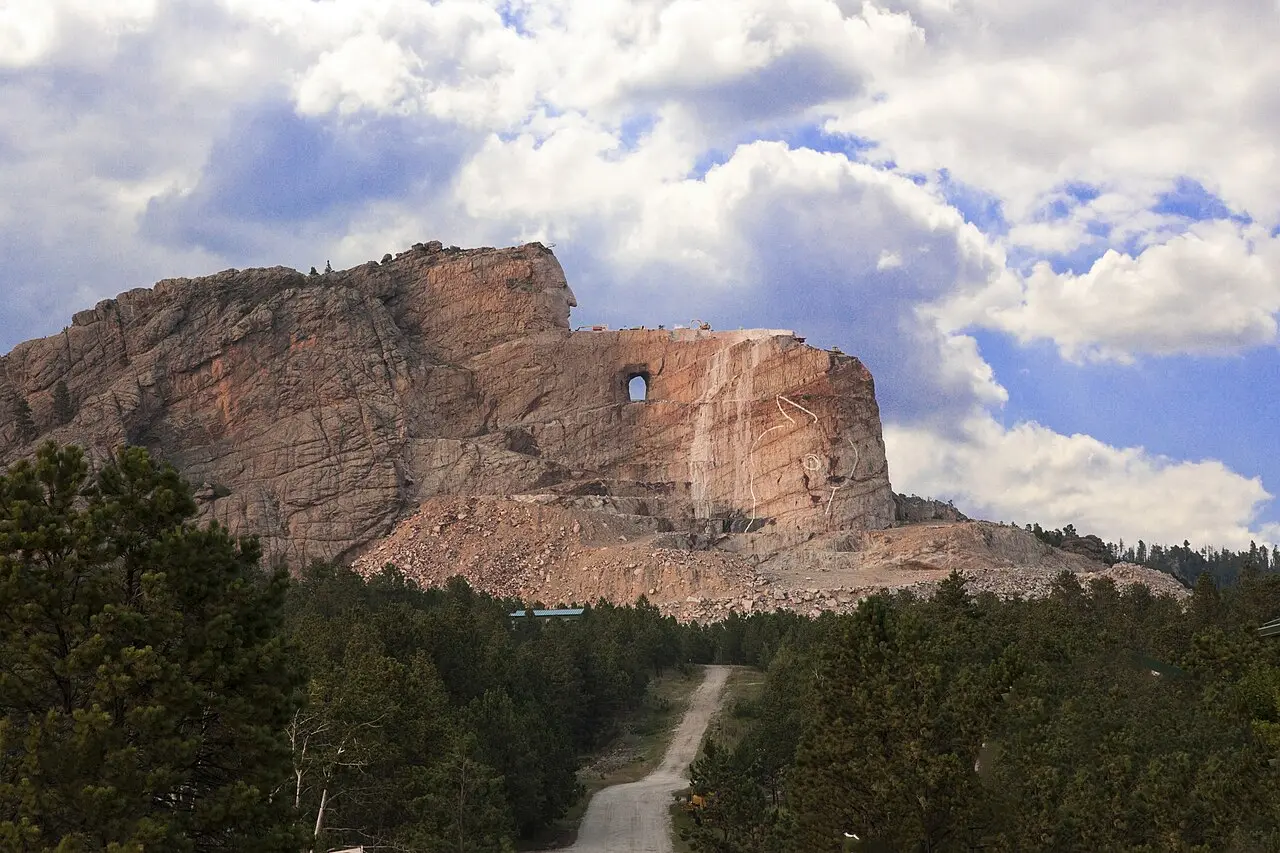
His legend only grew. The U.S. Postal Service honored him with a 13-cent stamp in 1982, and in the Black Hills, sculptors have been carving a mountain-sized memorial to him for decades — work that continues to this day. A Lakota historian has called September 5, 1877 the day "everything ended" for her people: the end of their freedom and way of life.
Why it matters: Crazy Horse never signed a treaty, never sat for a portrait, never made peace on paper. He lived and died fighting for the Lakota way of life, and because he left no image and no signature, he belongs entirely to the memory of his people — a warrior remembered in stories, not in photographs.
Photo: Ahzoov, CC BY-SA 4.0, via Wikimedia Commons.