The Stitch That Sewed the Modern World
On September 10, 1846, Elias Howe received U.S. Patent No. 4,750 for his lockstitch sewing machine — and changed how the world makes clothes.
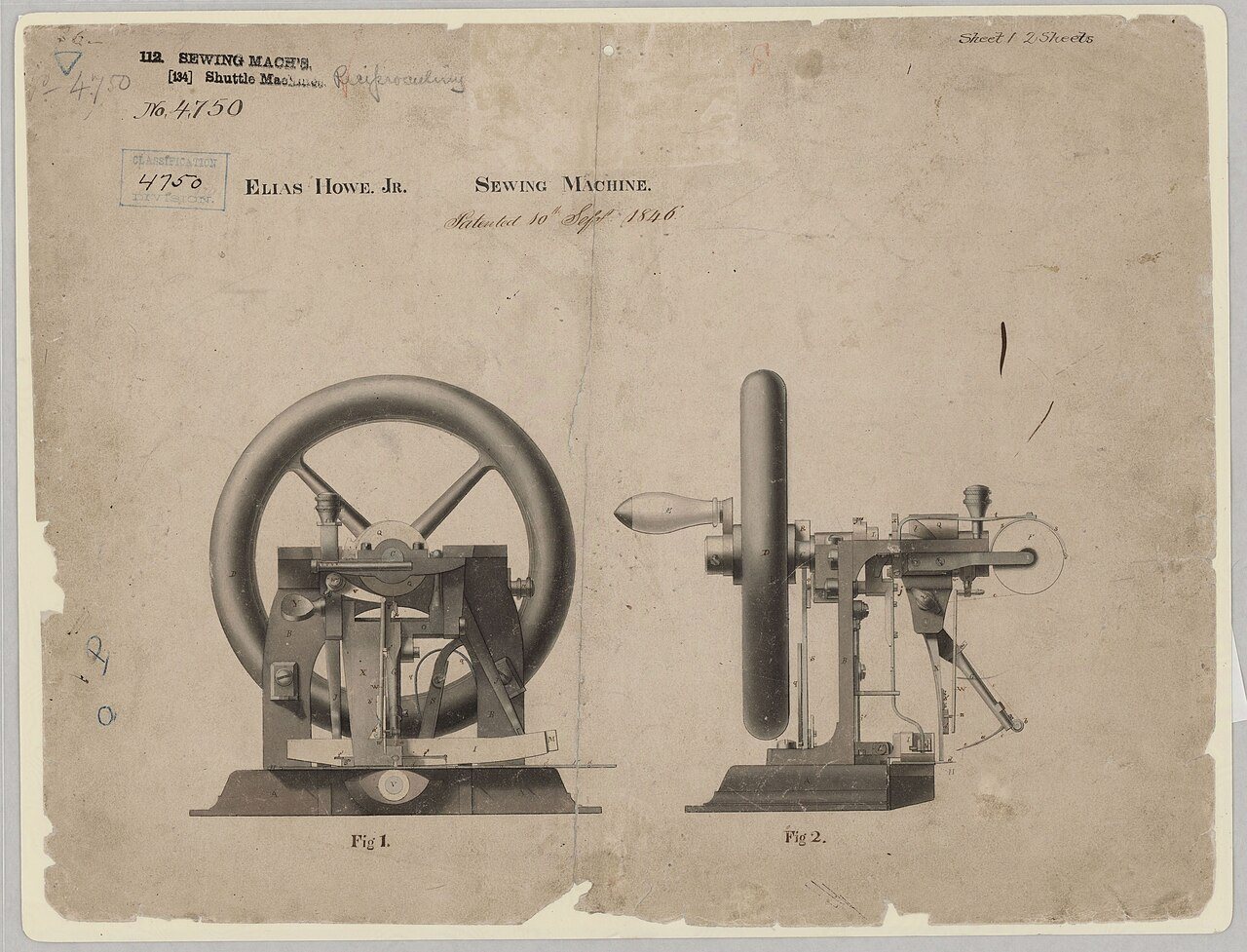
The breakthrough came to Elias Howe in a dream — or so family legend says. Frustrated by a puzzle he couldn't solve, Howe dreamed he was building a sewing machine for a savage king under threat of execution, and noticed the king's warriors carried spears pierced near the head. He woke at 4 a.m., ran to his workshop, and by 9 o'clock had modeled a needle with the eye at the point instead of the heel. Whether or not the dream really happened, the needle was real — and it changed the world.
On September 10, 1846, Howe, a journeyman machinist from Cambridge, Massachusetts, was awarded U.S. Patent No. 4,750 for his sewing machine. He hadn't invented the idea — tinkerers had been chasing mechanical sewing since 1790, and John Greenough held an earlier American patent from 1842. But Howe's machine was the first practical lockstitch design, and it contained the three features found in nearly every sewing machine since: a needle with the eye at the point, a shuttle moving beneath the cloth to lock each stitch, and an automatic feed to move the fabric along.
The inspiration had been close to home. Money was tight, and Howe's wife sewed for others by hand to help the family get by. Watching her work, Howe set out to mechanize the motion of her hands. In 1845 he built his first working machine; the next year he carried an improved model to the Patent Office in Washington.
Then came the hard part: selling it. American tailors feared the machine would destroy their livelihoods, and investors wouldn't touch it. Howe's brother sailed to England in October 1846 to find backing and sold a machine for £250 to a London manufacturer of corsets and umbrellas. Elias followed his family to London in 1848, but the deal soured, his wife's health failed, and he returned to America nearly penniless — to find other manufacturers happily building machines based on his patent without paying him a cent.
So Howe did what the patent system is for: he sued. His legal battle against the manufacturers — including Isaac Singer, who had built an empire on a machine using Howe's lockstitch — dragged from 1849 to 1854. Howe won. The royalties poured in, making both Howe and Singer wealthy men, and Howe's invention went on to win a gold medal at the Paris Exposition of 1867 and France's Légion d'honneur.
Every shirt, dress, and pair of jeans you own exists in a world Howe helped stitch together. The sewing machine didn't just speed up needlework — it made ready-made clothing possible, reshaped factories and fashion, and freed millions of hours of hand labor. Not bad for a machinist who, legend says, dreamed the answer.
And in a final twist worthy of a storybook: the 1965 Beatles film Help! is dedicated to his memory.
Photo: U.S. National Archives and Records Administration, public domain (via Wikimedia Commons).