First Beam: The Morning the Large Hadron Collider Woke Up
On September 10, 2008, scientists at CERN sent the first proton beam all the way around the 27-kilometer Large Hadron Collider, opening a new era of physics.
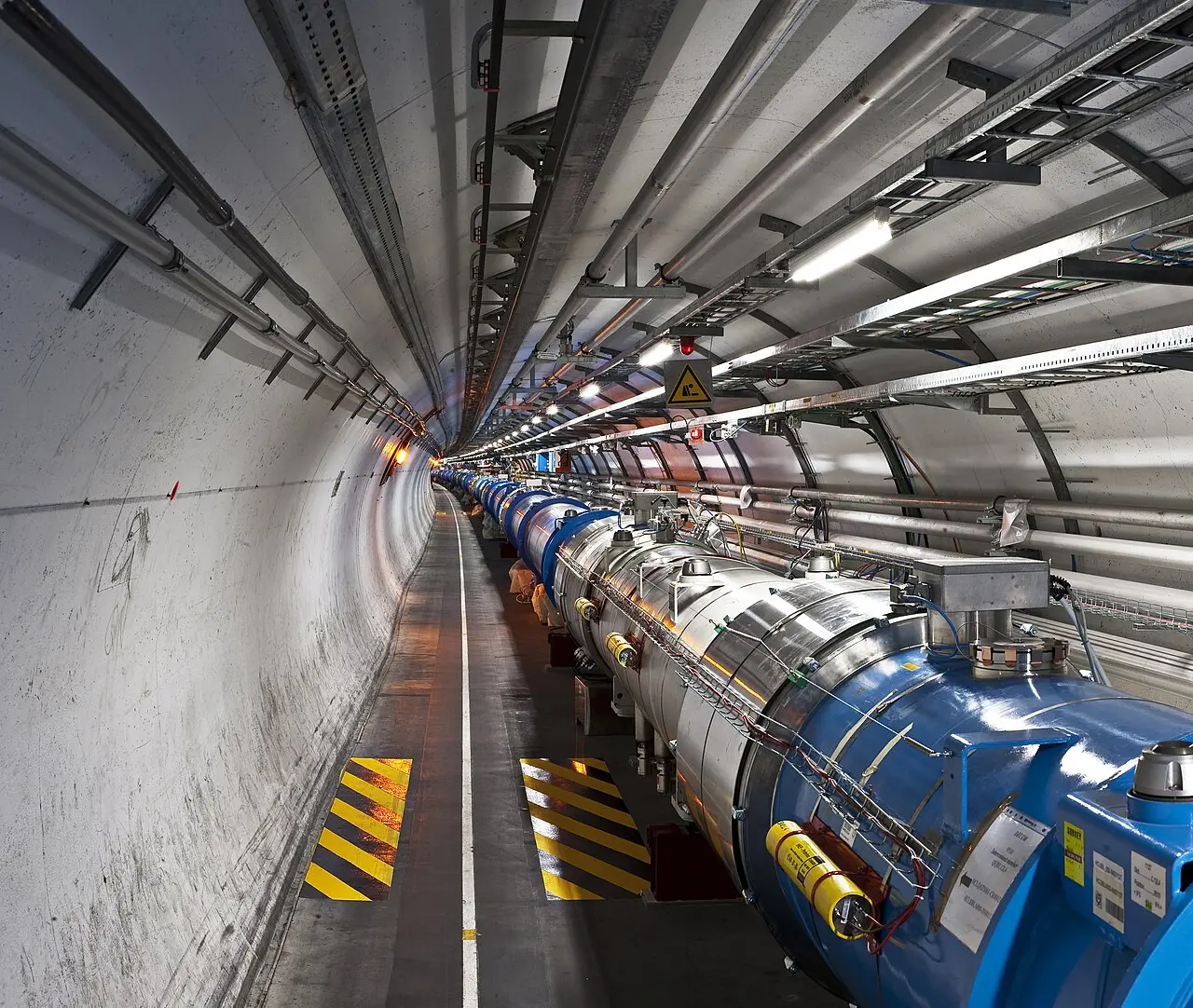
At 10:28 on a Wednesday morning, deep beneath the countryside near Geneva, a beam of protons finished a lap of the largest machine human beings had ever built. In control rooms on the surface, physicists applauded. After decades of planning and years of construction, the Large Hadron Collider was awake.
The numbers behind it are hard to grasp. The collider is a ring 27 kilometers around — about 17 miles — buried roughly 100 meters underground, straddling the border between France and Switzerland. Inside, superconducting magnets chilled to temperatures colder than deep space steer two beams of protons in opposite directions at nearly the speed of light, smashing them together so scientists can see what the universe is made of. Thousands of physicists and engineers from scores of countries spent years building it.
September 10, 2008, was the day it all came together. Engineers at CERN, the European particle-physics laboratory, threaded the first proton beam through the entire ring and kept it circulating. It was only a first step — the beams were not yet colliding — but it proved the machine worked. Newspapers around the world led with the story; for one day, particle physics was front-page news. Around the world, physicists who had spent their careers waiting for this machine followed the beam's progress together, cheering as the bright spot made its first full circuit.
The scientists had a big question waiting. Their theories predicted a particle called the Higgs boson, the particle that gives other particles their mass — the missing piece of the Standard Model of physics. Finding it would require trillions of collisions and unimaginable precision. The LHC was built, above all, to find it. Each collision recreates, on a subatomic scale, conditions unseen since fractions of a second after the Big Bang — turning the debris of each crash into a fleeting portrait of the infant universe.
Four years later, it did. On July 4, 2012, CERN announced that the collider had found a particle matching the Higgs boson, confirming a prediction made nearly half a century earlier. François Englert and Peter Higgs won the Nobel Prize the following year. The machine that woke up on a September morning in 2008 had answered one of the deepest questions in science: why anything has mass at all.
The LHC is still running, still smashing protons, still hunting for what the theories cannot yet explain — dark matter, extra dimensions, cracks in the Standard Model. Every answer it finds seems to arrive with a new question attached. That is the point of a machine like this: it was built not to confirm what we know, but to find out what we don't.
Photo: Maximilien Brice / CERN, CC BY-SA 3.0, via Wikimedia Commons.