
The Shot Heard Round the World
On April 19, 1775, the battles of Lexington and Concord turned a colonial protest into the American Revolutionary War.
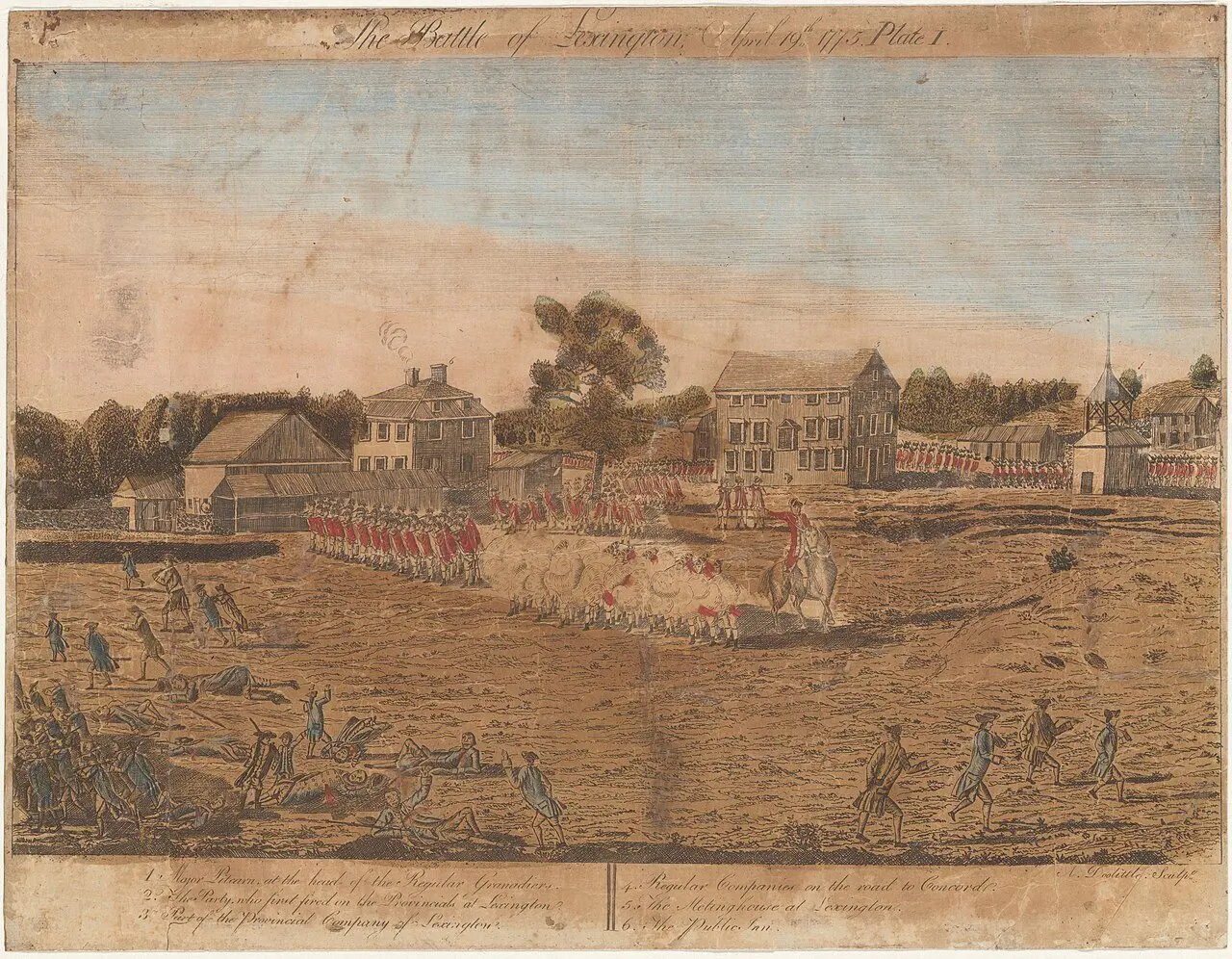
At dawn on April 19, 1775, seventy-seven farmers and craftsmen stood on the village green at Lexington, Massachusetts, facing the most powerful army on earth. They had been warned the night before by Paul Revere's riders. They knew what was coming. And they stood their ground anyway.
The British column — some 700 grenadiers and light infantry under Lieutenant Colonel Francis Smith — had marched out of Boston in the night on orders from General Thomas Gage. Their mission: march to Concord, seize the colonists' stockpile of muskets, powder, and cannon, and arrest the rebellion's leaders. It was meant to be a show of force that would end the unrest. Instead, it started a war.
At Lexington Green, the British advance guard under Major John Pitcairn found Captain John Parker's minutemen drawn up in formation — outnumbered roughly three to one. Parker, a veteran of the French and Indian War who was dying of tuberculosis, gave the order history remembers: "Stand your ground. Don't fire unless fired upon. But if they mean to have a war, let it begin here." The minutemen began to disperse. Then a shot rang out. No one knows — then or now — who fired it.
What followed was swift and brutal. The British fired a volley, then charged with bayonets. When the smoke cleared, eight colonists lay dead on the green and ten more were wounded. The column marched on to Concord, where the militia — forewarned — had already moved most of the military stores out of reach.
At Concord's North Bridge, the day's second battle unfolded. About 500 colonial militiamen under Colonel James Barrett faced roughly 90 British light infantrymen guarding the bridge. This time the colonists fired first — and the British fell back. Two colonists and three British soldiers were killed. For the first time, British regulars had been driven from the field by organized colonial resistance.
The worst was yet to come for the King's troops. The 18-mile march back to Boston became a running battle. Militiamen poured in from surrounding towns, firing from behind stone walls, trees, and farmhouses at the long red column. Only the arrival of reinforcements under General Hugh Percy at Lexington saved the British from complete disaster. By day's end, the British had suffered 273 casualties — 73 killed, 174 wounded, 26 missing. The colonists lost 95 — 49 killed, 41 wounded, 5 missing.
By the next morning, thousands of militiamen from across New England had surrounded Boston, beginning a siege that would last nearly a year. The protest had become a revolution. Decades later, Ralph Waldo Emerson would call the opening shot of that April day "the shot heard round the world" — and the world is still listening.
Photo: Ralph Earl and Amos Doolittle, public domain (via Wikimedia Commons).