The Saturday Night Massacre
On October 20, 1973, President Nixon's order to fire Watergate special prosecutor Archibald Cox triggered resignations at the top of the Justice Department.
On the night of Saturday, October 20, 1973, President Richard Nixon set off the most dramatic constitutional confrontation of the Watergate scandal. He ordered Attorney General Elliot Richardson to fire Archibald Cox, the special prosecutor who had subpoenaed the president's secret Oval Office tapes. Richardson refused — and resigned. By midnight, the Justice Department's top two officials were gone, and the prosecutor was fired.
Cox had been appointed that May to investigate Watergate independently. When the existence of the White House taping system came to light, Cox subpoenaed the recordings. Nixon refused to hand them over, offering a compromise instead; Cox refused the compromise. Nixon decided the prosecutor had to go.
The order went to Richardson, who had promised Congress the special prosecutor would be independent. He would not carry it out, and he quit. The order then fell to Deputy Attorney General William Ruckelshaus, who also refused and resigned. Finally it reached Solicitor General Robert Bork, third in line, who as acting attorney general carried out the dismissal. In one evening, a president had decapitated his own Justice Department to stop an investigation of himself.
The public reaction was explosive. Telegrams and phone calls flooded Washington, and the press gave the night its name: the Saturday Night Massacre. Within days, the House began the impeachment process. Less than a month later, on November 14, a federal judge ruled Cox's dismissal illegal. A new special prosecutor, Leon Jaworski, was appointed, and the drive for the tapes continued — all the way to the Supreme Court, which ordered their release the following summer. Nixon resigned on August 9, 1974.
Cox's successor, Leon Jaworski, picked up the subpoena fight where Cox had left off — and won. In July 1974 the Supreme Court ruled unanimously that Nixon had to surrender the tapes. Weeks later, one of them captured the president ordering the Watergate cover-up, and Nixon's remaining support in Congress collapsed.
Why it matters: the Saturday Night Massacre turned Watergate from a political scandal into a constitutional crisis — and showed that even a president could not fire his way out of the rule of law. The resignations of Richardson and Ruckelshaus remain the textbook example of officials choosing principle over orders.
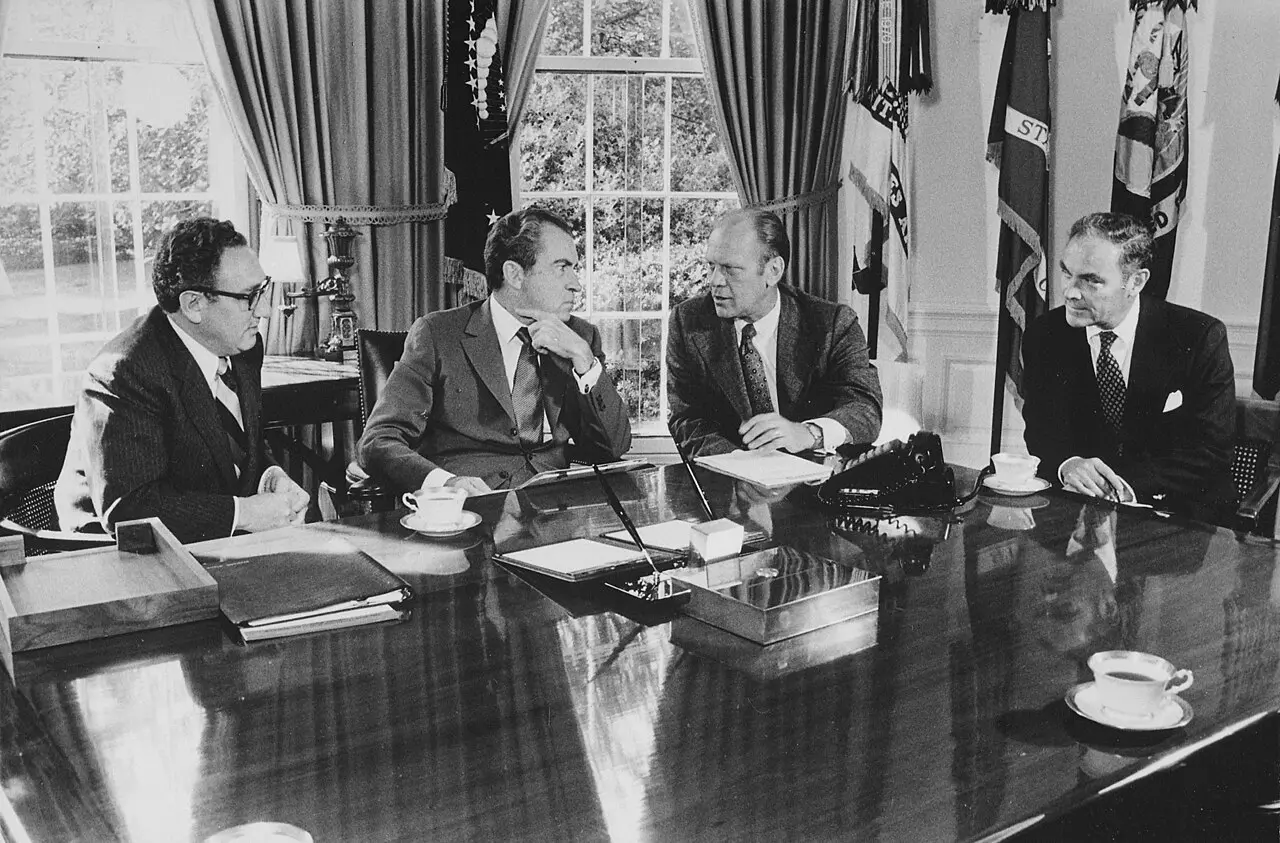
Photo note: President Nixon meets in the Oval Office with Gerald Ford, Henry Kissinger, and Alexander Haig on October 13, 1973 — one week before the Saturday Night Massacre. Photograph: White House Photo Office, public domain, via Wikimedia Commons.