The Penny Paper That Grew Into the Paper of Record
On September 18, 1851, Henry Jarvis Raymond and George Jones printed the first issue of the New-York Daily Times — a one-cent newspaper that would become The New York Times.
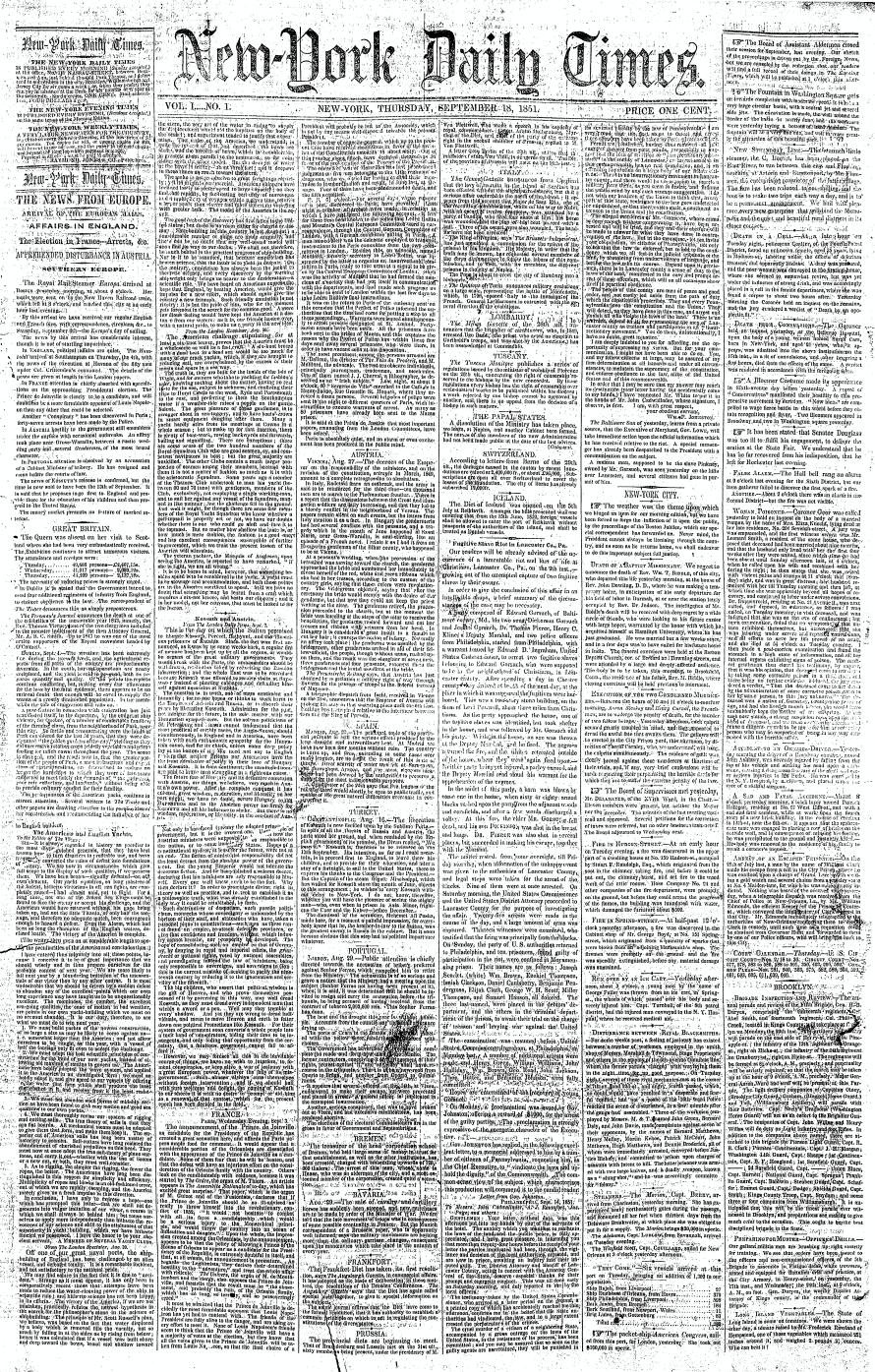
It sold for a penny, was printed in a basement, and began with a grand promise: to report the news without the yelling.
On Thursday, September 18, 1851, the first issue of the New-York Daily Times hit the streets of New York. Its founders, Henry Jarvis Raymond and George Jones, had quit their jobs at Horace Greeley's New-York Tribune to start a paper of their own, printed in the basement of 113 Nassau Street.
Their prospectus made a bold pledge for the rowdy newspaper age: the paper would "canvass freely the character and pretensions of Public Men, the merits and demerits of all administrations of Government, National, State and Municipal." In plain language — honest coverage of public life, free of the sensationalism that filled the era's penny press.
The one-cent price was deliberate: cheap enough for ordinary readers, but written for people who wanted their news straight. The formula worked. Within a year the young paper claimed 24,000 daily readers, and the price rose to two cents.
Then the paper grew teeth. During the Civil War, its correspondents reported from inside Confederate states, racing rival papers to the news. And in 1871, the Times did something that made it famous: it published the secret accounting books of Tammany Hall, exposing the staggering corruption of political boss William M. Tweed. Tweed offered to buy the paper for $5 million to make the story go away; the Times refused, published, and kept publishing. Tweed was tried in 1873 and sentenced to twelve years in prison.
The name evolved with the paper: The New-York Times in 1857, after the evening edition was dropped, and the hyphen disappeared in 1896 — the year struggling publisher Adolph Ochs took over and set the paper on its modern course.
The paper kept outgrowing its home. In 1858 it moved into a five-story building at 41 Park Row, designed by architect Thomas R. Jackson — the first building ever constructed specifically to house a newspaper.
That penny paper from a Nassau Street basement became one of the most influential newspapers on Earth. It matters as a reminder that institutions don't start great — they start small, with a clear idea. Raymond and Jones had one: that readers deserved news they could trust, at a price they could afford. More than 170 years later, that idea is still in print.
Photo: The New York Times Company, public domain (via Wikimedia Commons).