The Night Times Square Dropped Its First Ball
On December 31, 1907, a 700-pound ball of iron and wood slid down a Times Square flagpole at midnight — and a global New Year's ritual was born.
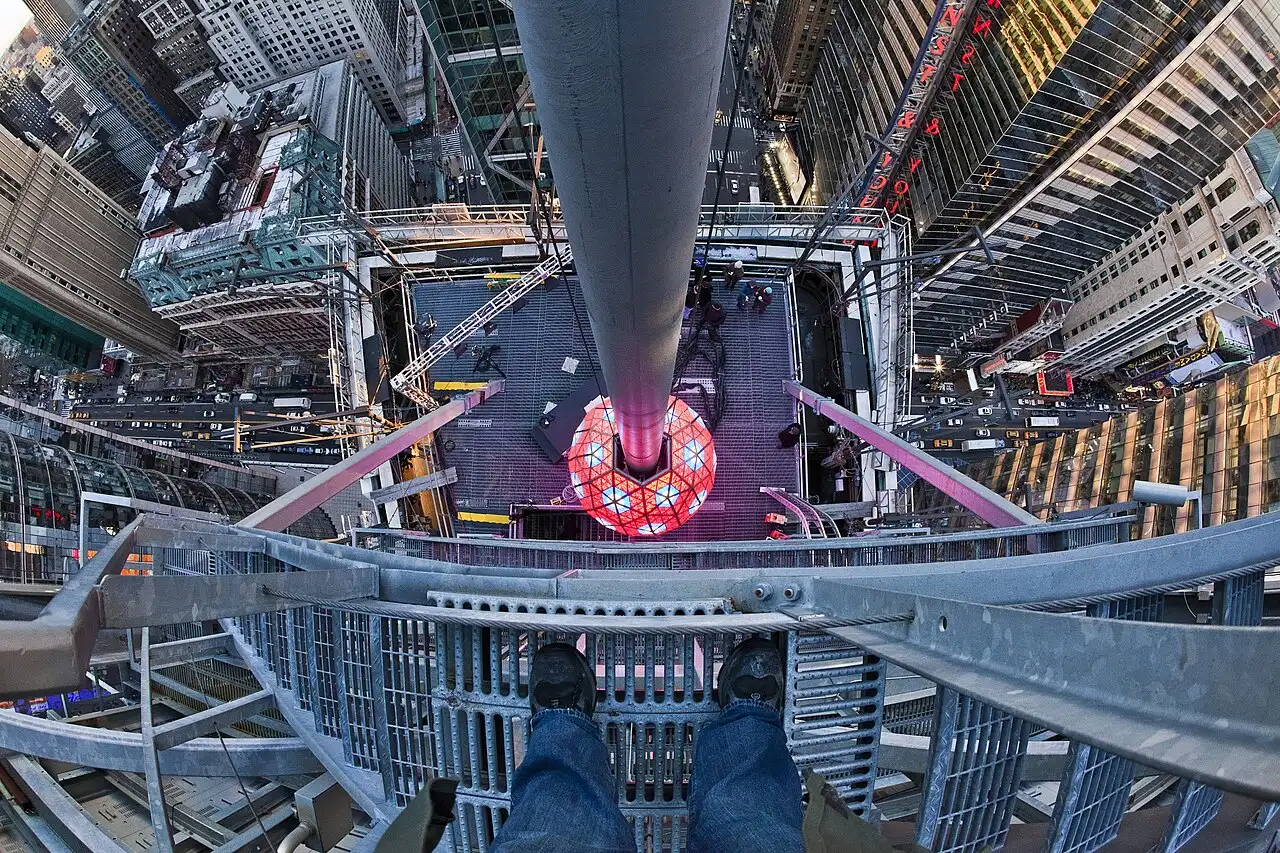
It weighed 700 pounds, it was made of iron and wood, and it had exactly one job: fall. On December 31, 1907, as the clock struck midnight over Times Square, a glowing ball slid down a flagpole — and invented the world's most-watched New Year's Eve ritual.
The party had started three years earlier. In 1904, New York Times publisher Adolph Ochs opened his newspaper's new headquarters at what was then Longacre Square, celebrated with a rooftop fireworks show that drew some 200,000 spectators — and got the square renamed Times Square in his paper's honor. The New Year's Eve bash became an instant tradition.
By 1907, though, the city had banned the fireworks: burning ash raining onto packed crowds will do that. Ochs needed a new spectacle, and he borrowed an old sailor's idea — the time ball, dropped at harbors and observatories to signal the exact time. He had seen one atop the Western Union Building downtown and thought: what if we made one of those, but shinier?
He hired the sign company Artkraft Strauss and its young metalworker Jacob Starr to build it: five feet across, 700 pounds of iron and wood, studded with 100 electric light bulbs — cutting-edge technology in 1907. Six men hauled it up the flagpole on the Times Tower roof.
At midnight, the ball began its descent as the crowd roared. The Times reported, perhaps with hometown exaggeration, that the cheers carried as far as Yonkers, ten miles up the Hudson. Waiters in nearby hotels wore electrified top hats spelling out "1908." A tradition was born.
The ball has stood down only twice — in 1942 and 1943, darkened for wartime — and it has grown from that iron-and-wood sphere into today's twelve-foot Waterford crystal globe. But the idea has not changed in more than a century.
The ball itself kept evolving with the times. The original iron-and-wood sphere gave way in 1920 to a lighter wrought-iron ball, then in 1955 to gleaming aluminum. For the 1980s it went red and green as a giant apple for the "I Love New York" campaign. Since 1999 it has been Waterford crystal — today's version is twelve feet across, studded with thousands of crystals and tens of thousands of LED lights. Only the idea — a glowing ball, falling at midnight — has never changed.
Every December 31, around a billion people watch a ball drop because a newspaper publisher needed a loophole for a fireworks ban. The best traditions, it turns out, are accidents that work.
Photo: The Times Square Ball by Anthony Quintano, CC BY 2.0 (via Wikimedia Commons).