The Night John Brown Tried to Start a Slave Rebellion
On the night of October 16, 1859, abolitionist John Brown seized the federal arsenal at Harpers Ferry, hoping to ignite a slave uprising — and set America on the road to civil war.
It was a quiet Sunday night in the mountain town of Harpers Ferry, Virginia. Just before eleven o'clock, nineteen men slipped across the railroad bridge over the Potomac River, moving through the dark toward the federal armory. Their leader was a gaunt, gray-bearded fifty-nine-year-old with burning eyes and an unshakable conviction that slavery was a sin God demanded he destroy — even if it took blood to do it.
His name was John Brown, and by sunrise he would hold one of the largest weapons stockpiles in America.
Brown had spent the summer hiding in plain sight at a rented farmhouse in Maryland, a few miles from town, drilling his small band in secret. His plan was audacious: seize the U.S. arsenal at Harpers Ferry, with its roughly 100,000 rifles and muskets, then use the weapons to arm enslaved people across the South and touch off a great uprising that would end slavery forever. He had even tried to recruit the great Black abolitionist Frederick Douglass as his liaison to the enslaved. Douglass listened, judged the plan suicidal, and refused — warning Brown, in words he later published, that Harpers Ferry was "a perfect steel-trap" and he would never get out alive.
On the night of October 16, the trap snapped shut around Brown instead of his enemies. At first, everything went his way. His men cut the telegraph wires, overpowered the lone night watchman at the armory, and fanned out through the sleeping town. A detachment rode to the nearby estate of Colonel Lewis Washington — the great-grandnephew of George Washington — and took him hostage, along with relics of the first president, including a sword said to have been a gift from Frederick the Great. Brown, who loved grand symbols, carried that sword himself.
But then came the cruel irony that history never forgot. When a train rolled into the station that night, Brown's men held it up — and in the confusion, they shot and killed the baggage handler who came to investigate. His name was Heyward Shepherd, and he was a free Black man. The first casualty of a raid meant to liberate Black people was a Black man who had nothing to do with slavery at all.
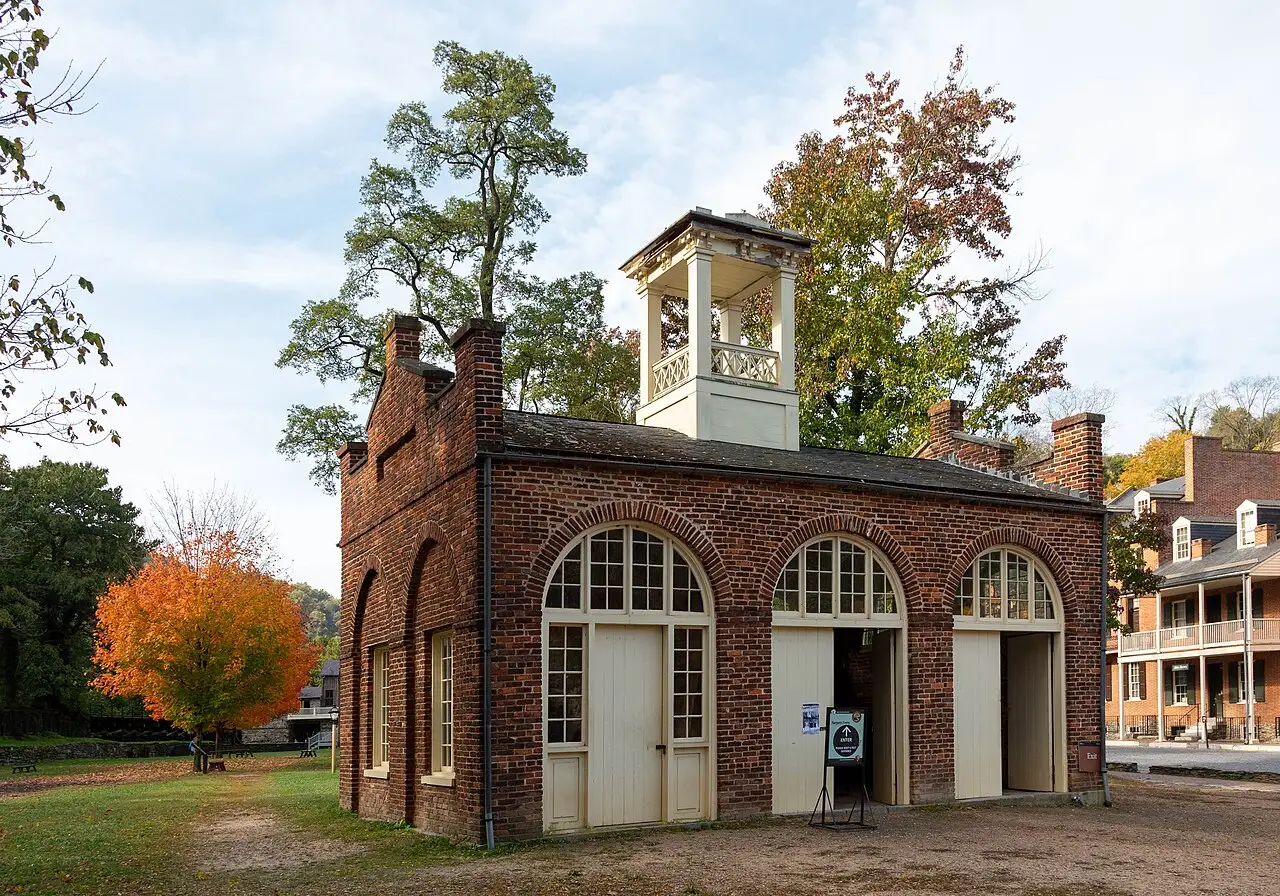
Worse, Brown made a fateful mistake: he let the train continue on its way. By dawn, the whole countryside knew armed men had seized the arsenal. Instead of enslaved people flocking to his banner, local militia companies poured into Harpers Ferry. Brown's escape route across the bridge was cut, and he and his remaining men were cornered in the armory's small brick fire engine house — the building in the photograph above, now known as John Brown's Fort.
President James Buchanan ordered in U.S. Marines under Colonel Robert E. Lee, with a young aide named J.E.B. Stuart. On the morning of October 18, the Marines stormed the engine house in minutes. Ten of Brown's men were dead, including his sons Oliver and Watson. Brown himself was taken alive, bleeding from a bayonet wound.
What followed made him immortal. Put on trial for treason against Virginia, the wounded Brown conducted himself with such dignity that Northern newspapers, which had first condemned the raid as madness, began to recast him as a martyr. He was convicted and hanged on December 2, 1859, at Charles Town. As Union soldiers marched off to war eighteen months later, they sang a new anthem: "John Brown's body lies a-mouldering in the grave, but his soul goes marching on."
The raid failed at everything it attempted — no uprising, no freed slaves, no captured arsenal held. Yet it succeeded at the one thing Brown may have wanted most: it made compromise over slavery impossible. The South saw proof that the North meant to destroy its way of life by force; the North saw a man willing to die to end human bondage. Within sixteen months, America was at war with itself. Douglass had been right about the steel trap — but wrong, perhaps, about what would spring from it.
Photo: David Brossard, CC BY-SA 2.0 (via Wikimedia Commons).