The Morning the World's Most Famous Smile Vanished
On August 21, 1911, an Italian handyman walked out of the Louvre with the Mona Lisa under his smock — and the theft made her the most famous painting on Earth.
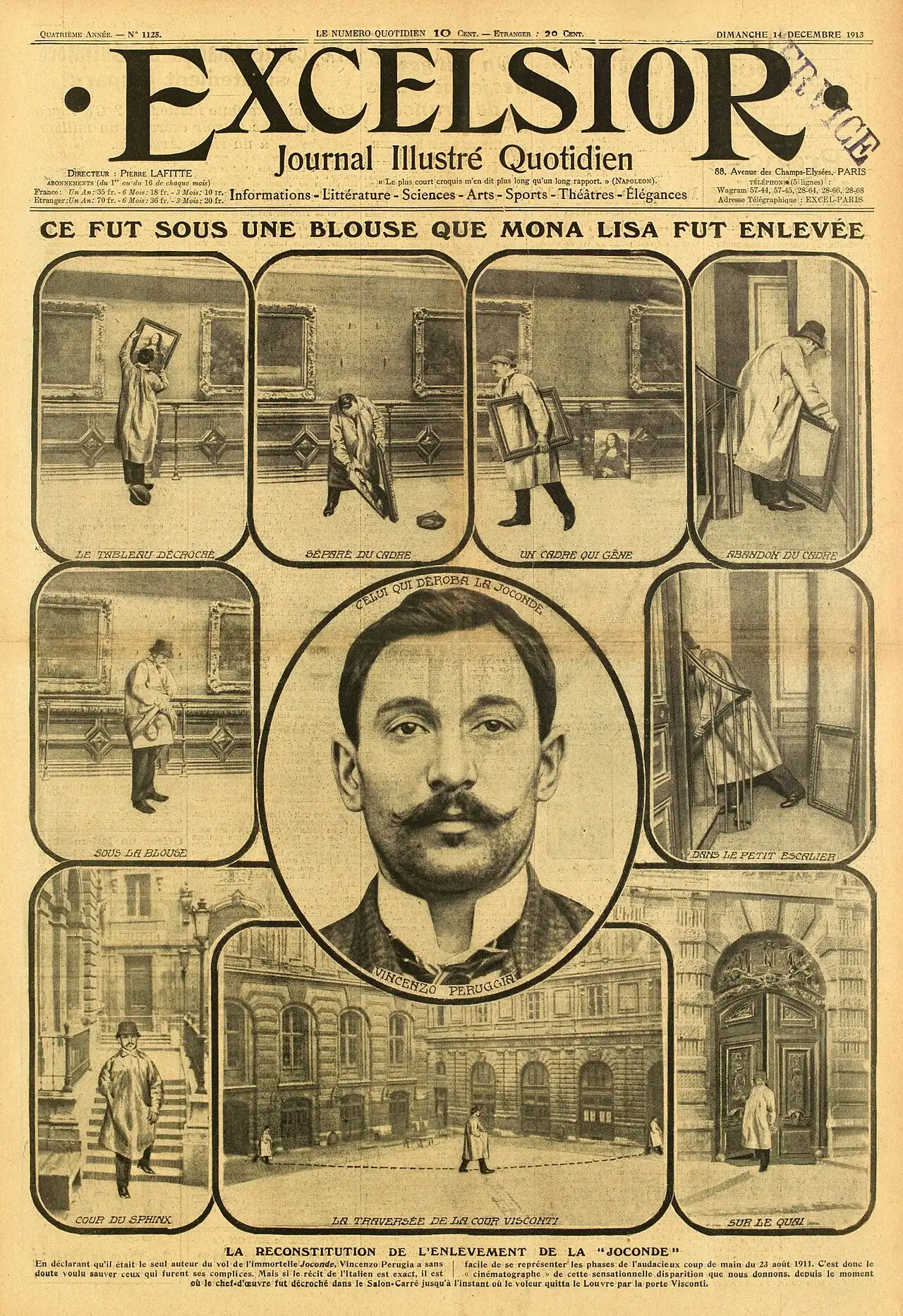
It was the boldest art heist of the century, and it was almost laughably simple. On the morning of Monday, August 21, 1911, Vincenzo Peruggia — a 30-year-old Italian handyman who had once worked at the Louvre — lifted Leonardo da Vinci's Mona Lisa off the wall of the Salon Carré, stripped it of its frame and glass in a stairwell, tucked the wood panel under his white work smock, and walked out into the Paris morning.
Monday was the museum's weekly closing day, and its security was, by any modern standard, a joke. Peruggia knew the building intimately: he had once helped construct the protective case around the painting itself. He had spent the night hidden inside, and when morning came, he simply chose his moment. Nobody stopped him. Nobody even noticed.
The theft was not discovered until the next day, when staff and visitors found an empty wall where the lady with the mysterious smile had hung. The Louvre shut down for a week. The investigation cast a wide net — at one point even Pablo Picasso was brought in for questioning — but the real thief was already home, the Mona Lisa hidden in a false-bottomed trunk in his small apartment on the rue de l'Hôpital Saint-Louis.
Peruggia's motive was a patriotic fantasy built on a historical error. He believed — wrongly — that Napoleon's armies had looted the Mona Lisa from Italy, and that by stealing it he was returning the painting to its rightful home. In truth, Leonardo himself had carried the portrait to France, where it entered the collection of King Francis I; it had hung in French royal collections for nearly four hundred years.
For more than two years, the painting sat in his apartment while Peruggia waited for the furor to die down. He later claimed the portrait's haunting smile tormented him, and that he sometimes wondered whether he should burn it. Finally, short of money, he wrote to an art dealer in Florence, Alfredo Geri, offering to sell Italy's “recovered treasure” for a reward. Geri alerted the authorities. When Peruggia arrived in Florence with the panel in December 1913, the police were waiting.
The recovery made him a folk hero in Italy and a convicted criminal in fact. A court in Florence sentenced him to a year and fifteen days in prison; he served about seven months. The Mona Lisa returned to the Louvre in January 1914 — and to a fame beyond anything she had known before.
That is the heist's strangest legacy. Before 1911, the Mona Lisa was admired by connoisseurs but unknown to the wider world. The two-year manhunt, the newspaper frenzy, and the crowds who came to stare at the empty wall turned her into a global icon — the most famous painting on Earth. She never would have become that without the man who stole her.
Photo: Excelsior newspaper front page, December 14, 1913, public domain (via Wikimedia Commons).