The Maid of Orléans Burns at Rouen
On May 30, 1431, nineteen-year-old Joan of Arc was burned at the stake in Rouen — and within 25 years the Church itself declared her trial corrupt.
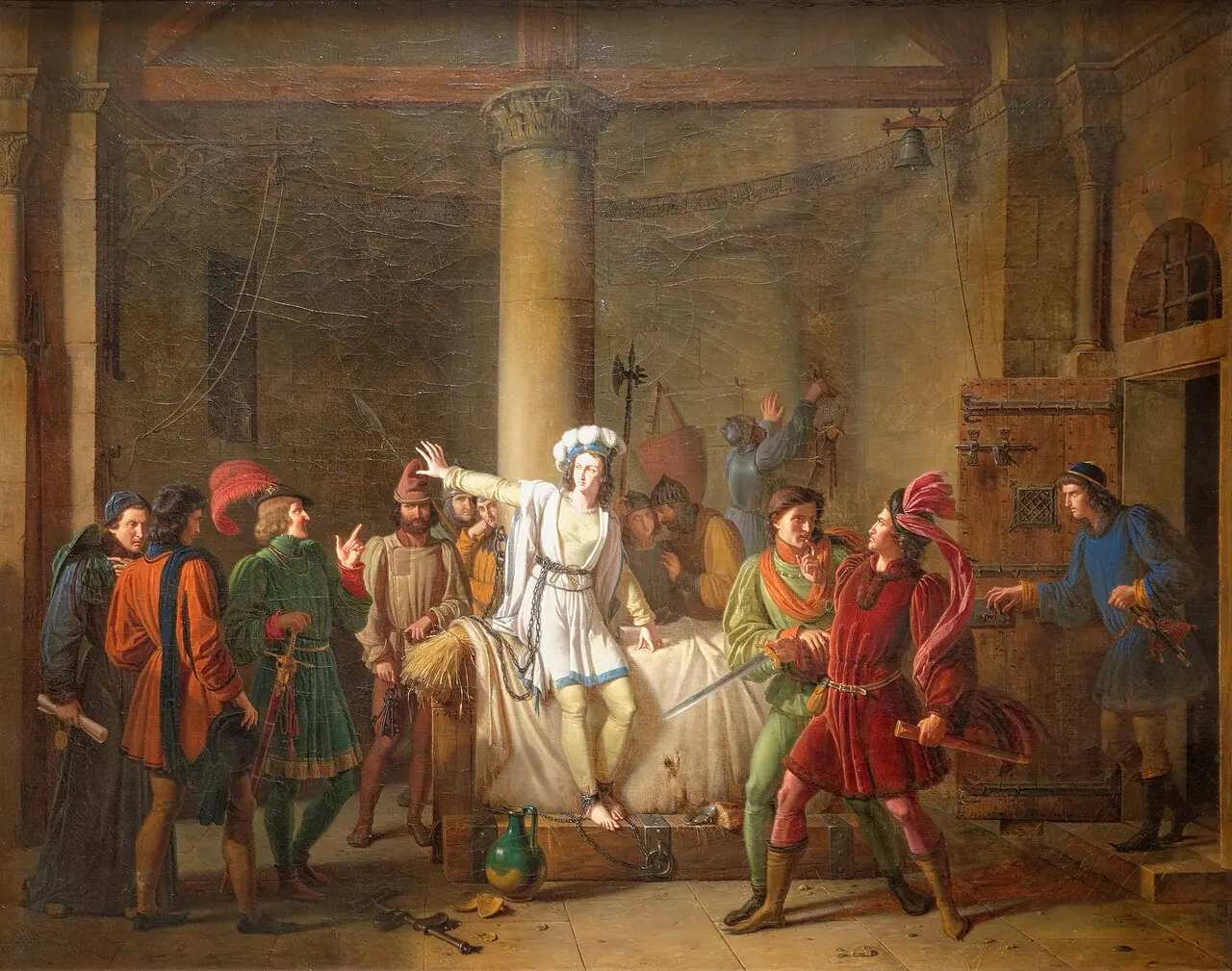
She was nineteen years old when they tied her to the pillar.
On the morning of May 30, 1431, Joan of Arc — La Pucelle, the Maid of Orléans — was led to the old marketplace of Rouen and burned at the stake. The English soldiers who guarded the square had once fled from her on the battlefield. Now she was a prisoner, condemned as a heretic, and no one came to save her.
Joan had been born a peasant girl in the village of Domrémy. As a teenager she said she heard the voices of saints urging her to drive the English from France and see the French dauphin crowned king. France was losing the Hundred Years' War badly — and then, astonishingly, the illiterate farm girl talked her way to the dauphin's court, was given an army, and in 1429 lifted the English siege of Orléans, the victory that turned the war around. Two months later she stood beside Charles VII at his coronation in Reims Cathedral, holding her banner.
Her luck ran out in 1430. While defending the town of Compiègne, she was captured by England's Burgundian allies, who sold her to the English for a prince's ransom. The English wanted more than a prisoner — they wanted to discredit the girl who had humiliated them, so they had her tried by the Church. The trial at Rouen was run by Bishop Pierre Cauchon, an English partisan, and though it wore the robes of justice, everyone understood the verdict in advance. Joan, uneducated and alone, answered her learned inquisitors with a calm and wit that stunned the courtroom.
She was convicted of heresy. After briefly recanting under the terror of the sentence, she withdrew the recantation, was declared a relapsed heretic, and on May 30 was handed to the secular authorities for execution. Before the fire was lit, she asked a priest to hold a crucifix where she could see it, and to call out prayers loud enough to be heard above the flames. Her ashes were thrown into the Seine so no relic could remain.
The verdict did not survive her. Twenty-five years later, with France victorious, her family and Pope Callixtus III reopened the case; in 1456 the Church formally annulled the condemnation, ruling the trial corrupt. She was beatified in 1909 and canonized as a saint by Pope Benedict XV in 1920.
Why it matters: Joan of Arc's public life lasted barely two years, yet it changed a war, a nation, and the idea of what an ordinary person — a teenage girl with no army, no title, and no education — could do. France made her its patron saint; the world made her a symbol of courage against impossible odds.
Photo: Pierre Révoil, public domain (via Wikimedia Commons).