Six Hours, Forty-Two Minutes: The First Indy 500
On May 30, 1911, Ray Harroun won the first Indianapolis 500 in his Marmon Wasp, a race that launched American motorsport — and the rearview mirror.
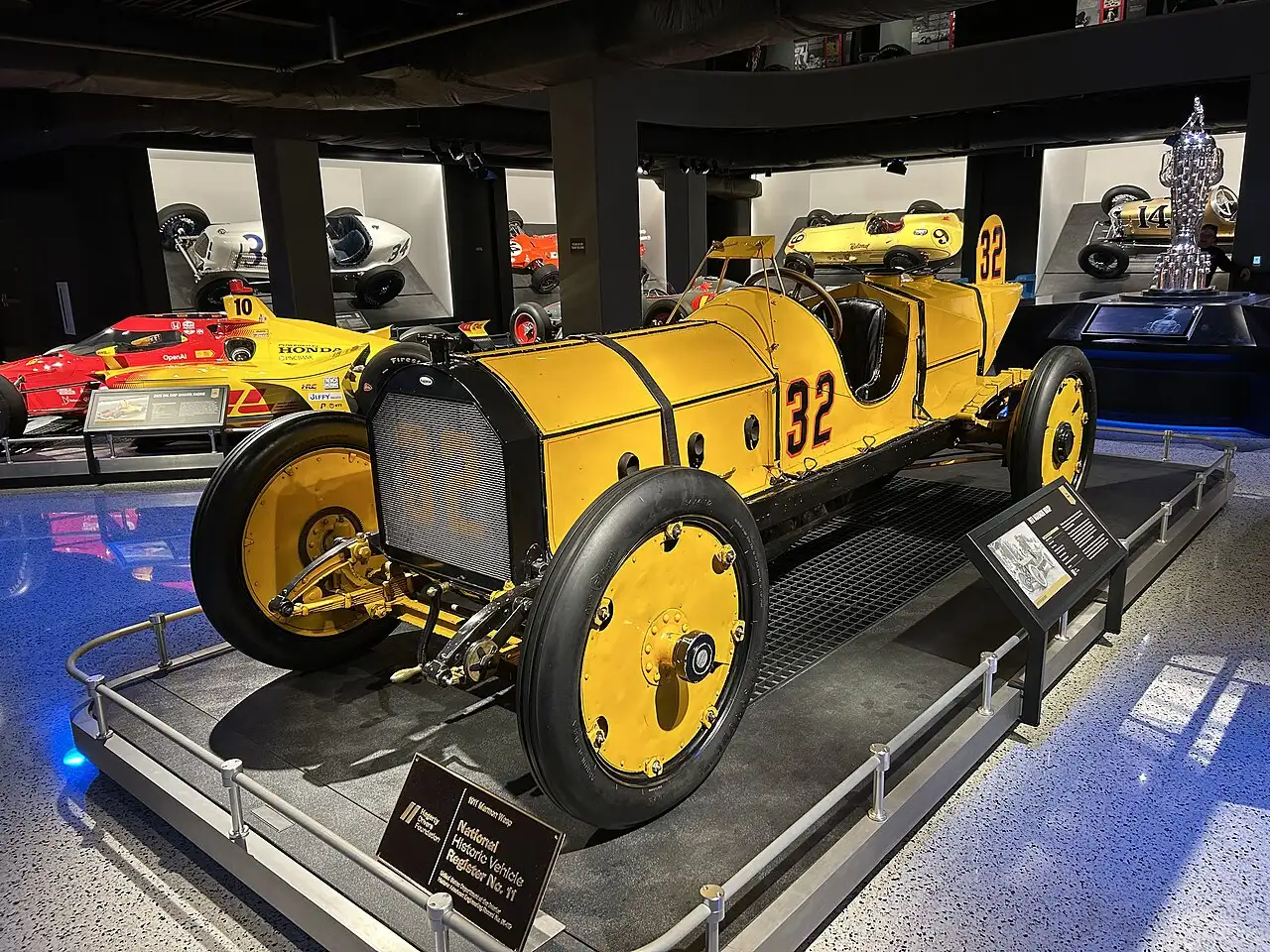
On Tuesday, May 30, 1911, forty cars lined up on a brick-paved oval in Indiana for a race nobody had ever seen before: 500 miles, 200 laps, winner take all.
The Indianapolis Motor Speedway had opened just two years earlier, built by businessman Carl Fisher as a testing ground for America's infant auto industry. After two seasons of smaller events, Fisher bet everything on one giant spectacle — the International 500-Mile Sweepstakes, staged on Memorial Day to draw the biggest possible crowd. Roughly 80,000 spectators showed up, and the race they witnessed became "the Greatest Spectacle in Racing."
The rules said each car should carry a driver and a riding mechanic — the mechanic's job was to watch for traffic behind. But one competitor arrived alone. Ray Harroun, a 32-year-old engineer for the Indianapolis-based Marmon Motor Car Company, had come out of retirement driving a single-seat car of his own design: the Marmon Wasp, a long yellow torpedo with a pointed, wasp-like tail. Rivals protested that Harroun couldn't see behind him. His answer was a small mirror bolted above the steering wheel — the first rearview mirror ever fitted to a race car, and quite possibly to any car at all.
Harroun, nicknamed "the Little Professor" for his methodical style, drove the race of his life. He took the lead and held it for 88 of the 200 laps, crossing the finish in 6 hours, 42 minutes, and 8 seconds at an average speed of 74.6 miles per hour. He collected $14,250 in prize money — a fortune in 1911 — climbed out of the cockpit, and retired from racing for good, right there in the winner's circle.
The first 500 was an instant institution. The traditions piled up over the decades: the singing of "Back Home Again in Indiana," the Borg-Warner Trophy (awarded since 1936), and the winner's bottle of cold milk — a custom that began when Louis Meyer asked for buttermilk after his 1936 victory. The race has run every year except during the two world wars, and the Speedway's yard of bricks at the start-finish line became sacred ground in American sport.
Why it matters: the 1911 Indianapolis 500 didn't just launch a race — it launched American motorsport. It turned the automobile from a rich man's toy into a national obsession, proved that speed and engineering could be a spectator spectacle, and gave the world the rearview mirror in the bargain.
Photo: OctaviaCombi, CC BY-SA 4.0 (via Wikimedia Commons).