The Lunchtime Quake That Burned Tokyo to the Ground
On September 1, 1923, a magnitude-8 earthquake struck Japan just before lunch — but it was the fires, fanned by typhoon winds, that killed more than 100,000 people.
The lunch hour was the worst possible moment.
At 11:58 on the morning of Saturday, September 1, 1923, Tokyo was a city of more than two million people, and most of them were about to eat. Charcoal braziers glowed in kitchens and food stalls. Then the ground tore loose.
The earthquake that struck the Kantō Plain measured roughly magnitude 8, with its epicenter beneath Sagami Bay, about 100 kilometers southwest of the capital. Modern research suggests it was not one shock but a sequence of three, rolling through the region over several minutes. Buildings swayed, toppled, and collapsed across Tokyo, the port city of Yokohama, and the surrounding prefectures of Kanagawa, Chiba, and Shizuoka.
One man had seen this coming. As early as 1905, the seismologist Imamura Akitsune warned that a great earthquake was due near Tokyo — and that fire, not shaking, would be the true killer. He urged the city to abandon kerosene lanterns and to leave gaps between buildings. His senior colleagues ridiculed him. One argued that great fires need wind, and earthquakes hardly ever strike in stormy weather.
He was half right. The earthquake did not bring a storm. A typhoon passing offshore brought the wind.
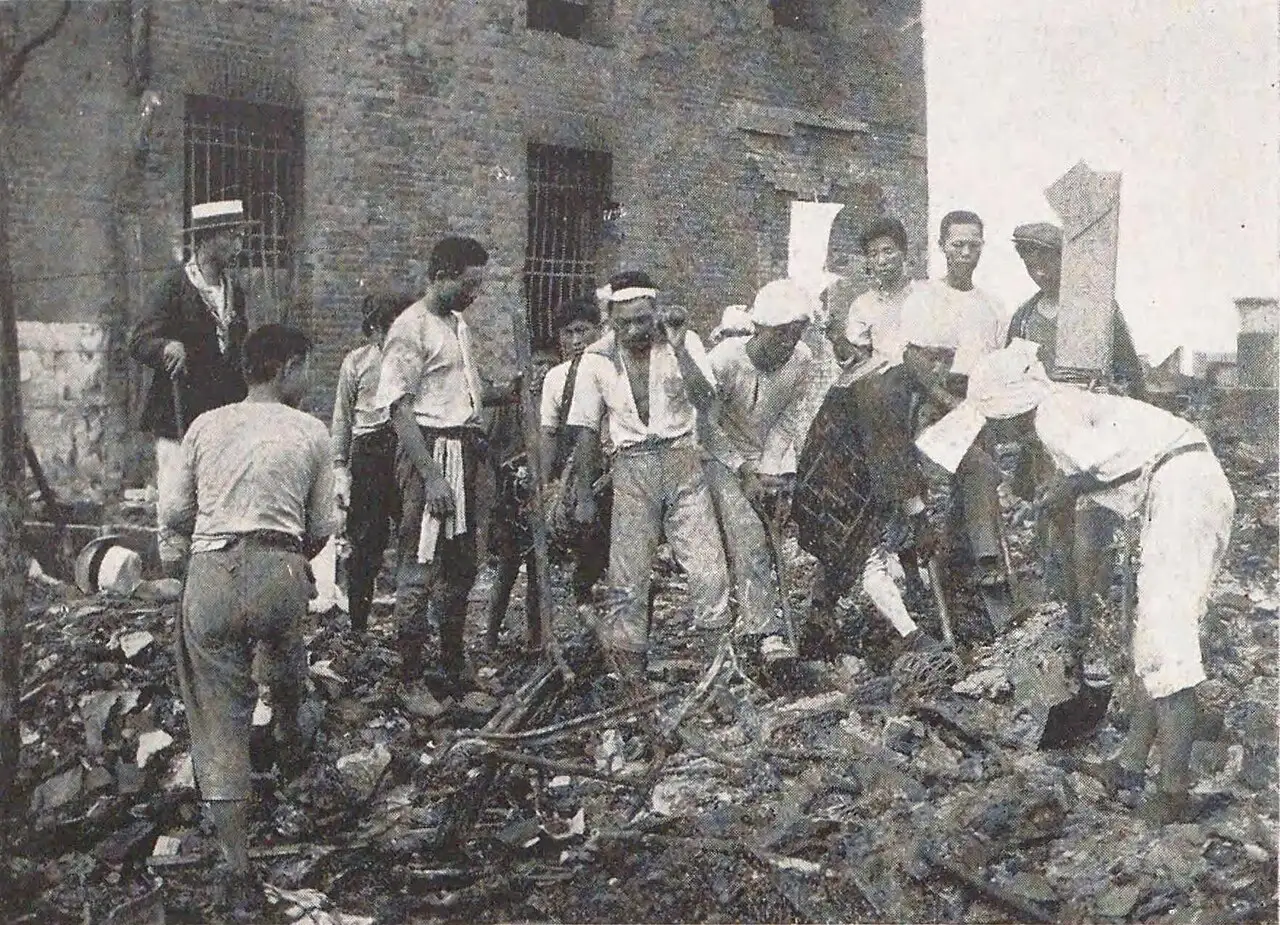
Because the quake hit at lunch hour, thousands of cooking fires were already lit. In a city built mostly of wood, the fires multiplied within minutes. Fanned by typhoon winds, separate blazes merged into firestorms — walls of flame that swallowed whole neighborhoods and sucked the oxygen from the air. Near the Sumida River, where tens of thousands had fled for safety, a whirling pillar of flame known as a "dragon twist" tore through the crowd. Roughly 44,000 people died there.
The sea joined in. Tsunami waves as high as 12 meters slammed into Atami and other coastal towns. By the time the fires burned themselves out, more than half of Tokyo and nearly all of Yokohama lay in ruins. The death toll reached at least 105,000, with some estimates as high as 140,000. About 2.5 million people were left homeless.
Then came the shameful part. False rumors spread that ethnic Koreans were poisoning wells and setting fires. Vigilante mobs, whipped up by panic and prejudice, murdered thousands of innocent people — most of them Koreans. It remains one of the darkest chapters of the disaster.
But Tokyo rebuilt. Wide boulevards and parks were laid out as firebreaks. New building codes demanded fire-resistant construction. And Japan turned the anniversary into something useful: since 1960, September 1 has been Disaster Prevention Day, when schools, offices, and whole cities hold earthquake drills.
Why it matters: the Great Kantō Earthquake taught the modern world the lesson Imamura had tried to teach decades earlier — in a city, an earthquake's deadliest weapon is fire. Every earthquake drill, every fire-resistant building code, and every September 1st drill in Japan traces back to that Saturday lunch hour when Tokyo burned.
Photo: Unknown photographer, 1923, public domain (via Wikimedia Commons).