The Day the World Went to War
On September 1, 1939, Germany's invasion of Poland ignited World War II — and the first shots rang out before dawn in Danzig harbor.
The war began with a lie, and it began in the dark.
On the night of August 31, 1939, Nazi agents staged a fake Polish attack on a German radio station at Gleiwitz, near the Polish border. It was theater — a manufactured excuse. Adolf Hitler wanted Poland, and he wanted the world to believe Poland had started the fight.
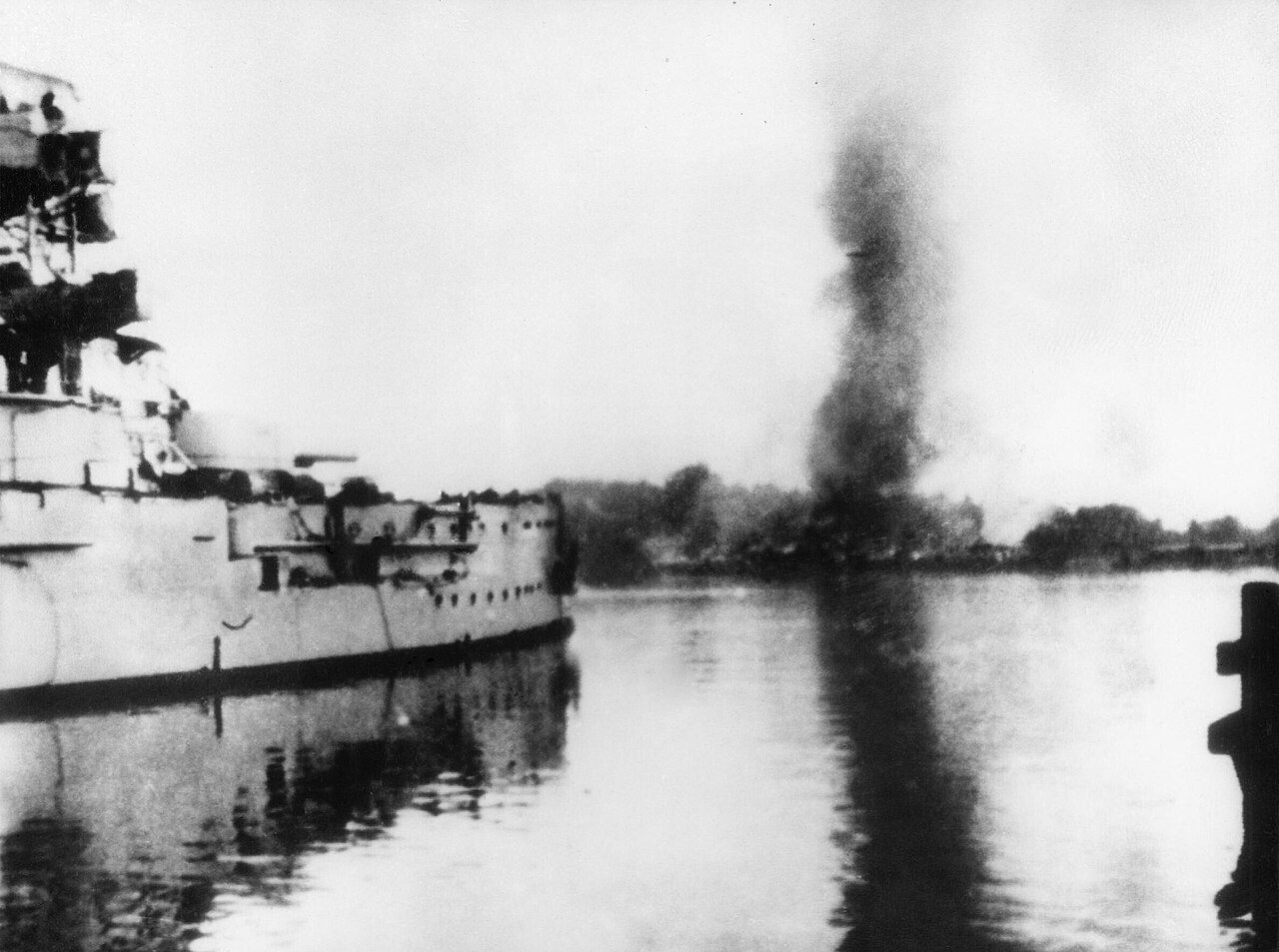
Meanwhile, in the harbor at Danzig (today's Gdańsk), the German battleship Schleswig-Holstein sat at anchor. She had arrived under the cover of a friendly naval visit. Her guns were loaded.
At about 4:45 on the morning of Friday, September 1, 1939, the battleship opened fire on the Polish military depot at Westerplatte, a small peninsula guarding the harbor. Those were the first shots of World War II. Inside the depot, 182 Polish soldiers under Major Henryk Sucharski scrambled to their posts. Their orders were to hold for twelve hours.
They held for seven days.
Outnumbered and pounded by naval guns, dive bombers, and repeated ground assaults, the little garrison refused to fold. Westerplatte became an instant symbol — proof that Poland would not simply be walked over.
But the battleship's guns were only the opening note. Within hours, more than a million German soldiers were pouring across the Polish frontier from the north, south, and west, backed by tanks and waves of warplanes. The Germans called it blitzkrieg — lightning war — and the speed was the point: shatter the defenders before they could regroup.
Britain and France, Poland's allies, responded the way their treaties demanded. On September 3, two days after the invasion, both declared war on Germany. A local invasion had become a European war. The Soviet Union invaded Poland from the east on September 17, and by early October Poland had been carved up between the two invaders.
The Second World War would last six years and claim tens of millions of lives. It reshaped borders, toppled empires, and scarred a generation. And it began on a September morning, in the dark, with a battleship's guns firing at a tiny peninsula fortress.
Why it matters: September 1 is the hinge on which the modern world turns. The war that started that day drew in nearly every nation on earth, ended with the defeat of Nazi Germany and imperial Japan, and gave birth to the United Nations — humanity's attempt to make sure nothing like it ever happened again. In Poland, the defenders of Westerplatte are still honored as heroes: 182 men who were told to hold for twelve hours and held for seven days.
Photo: Associated Press photographer (Imperial War Museums), public domain (via Wikimedia Commons).